
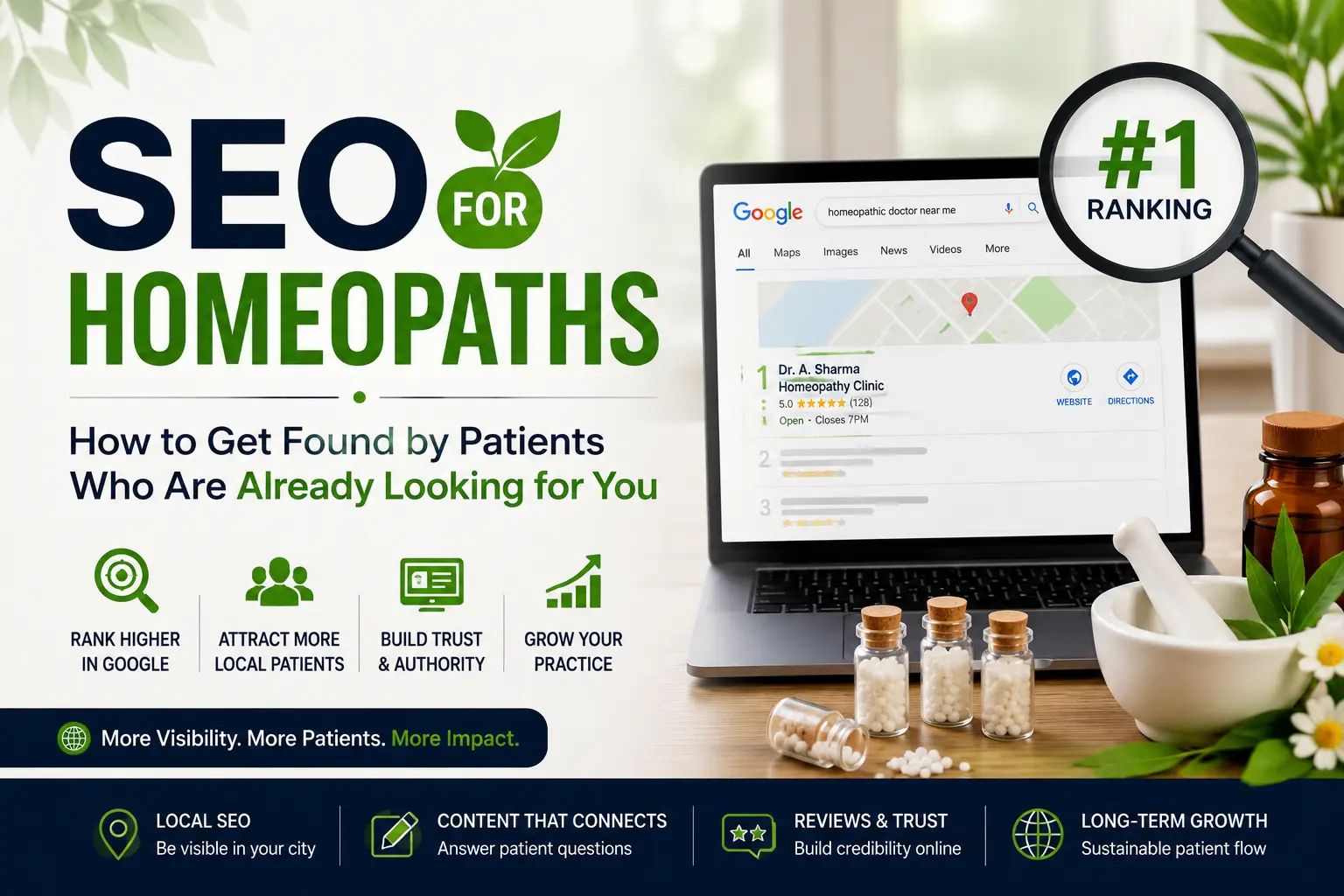
If you’re a homeopath in private practice, you’ve probably noticed that most of your best clients come through word of mouth. But there’s a second group — people who don’t know anyone to ask. They’re typing things like “homeopath near me” or “homeopathy for chronic fatigue [city name]” into Google right now. SEO (Search Engine Optimisation) is how you show up for them.
This guide is written specifically for homeopaths. Not vague SEO theory — practical steps that reflect the reality of a solo or small practice.
Table of Contents
- Why SEO Matters Differently for Homeopaths
- Step 1: Get Your Google Business Profile Right
- Step 2: Know What Your Patients Are Actually Searching For
- Step 3: Build Service Pages That Actually Help
- Step 4: Write a Blog That Demonstrates Real Expertise
- Step 5: Sort Out the Technical Basics
- Step 6: Build Credibility Signals (Without Buying Links)
- Step 7: Make It Easy for Patients to Trust You
- Realistic Expectations
- 90-Day Starting Plan
- FAQs
Why SEO Matters Differently for Homeopaths
Homeopathy operates in a trust-sensitive space. Potential patients have often already tried conventional medicine without success. They’re doing careful research before they pick up the phone. That means your online presence doesn’t just need to be findable — it needs to be credible and reassuring.
Google’s helpful content guidelines reinforce this: content written to genuinely help a reader always outperforms content written to game a ranking. For homeopaths, these two goals align beautifully — your real expertise is exactly what both Google and your future patients are looking for.
This is also a YMYL (Your Money or Your Life) niche, where Google applies stricter E-E-A-T standards (Experience, Expertise, Authoritativeness, Trustworthiness). Every page on your website is being evaluated on these signals.
This article is about marketing strategy, not medical advice. All clinical claims should be discussed with qualified practitioners.
Step 1: Get Your Google Business Profile Right
Before you touch your website, claim and complete your Google Business Profile (formerly Google My Business). This is free and has the highest impact for local searches. Claim yours at google.com/business.
What to do:
- Add your correct name, address, phone number(NAP), and website
- Choose “Alternative Medicine Practitioner”or “Homeopath” as your primary category
- Write a genuine description of who you help and how (200–750 characters)
- Upload real photos— your consultation room, yourself, your building entrance
- Collect reviews from existing patients(simply ask them after a positive session)
- Add your service areas, opening hours, and accepted payment methods
- Post regular updates (offers, articles, new services) — Google rewards active profiles
A fully completed profile with even five genuine reviews can get you into Google’s local “map pack” — the three businesses that appear above organic results for local searches.
If you want a deeper walkthrough on optimising a Google Business Profile, see this step-by-step Google Business Profile optimisation guide — though written for law firms, the framework applies directly to homeopathic practice.
Step 2: Know What Your Patients Are Actually Searching For
People don’t search for “constitutional prescribing” or “miasmatic treatment” — they search for their symptoms and conditions. This is the gap between practitioner language and patient language, and bridging it is the heart of keyword research.
High-value search terms for homeopaths:
| Type | Example Queries |
| Condition-based | homeopathy for eczema, homeopathy for anxiety, homeopathic treatment for IBS |
| Location-based | homeopath in [city], homeopath near me, homeopath [postcode] |
| Intent-based | is homeopathy safe, does homeopathy work for children, what to expect from a homeopath |
| Long-tail | natural homeopathy treatment for hormonal acne, homeopath who treats migraines in [city] |
Use free tools to discover what people in your area actually type:
- Google Search Console— see which queries already bring people to your site
- Google autocomplete — start typing a query and note the suggestions
- People Also Ask — the questions appearing in Google results
- Ubersuggestor AnswerThePublic for free keyword exploration
To go deeper into the strategy, here are some helpful guides on the foundations:
- How to do keyword research— the full beginner-friendly process
- Short-tail vs long-tail keywords— why long-tail wins for small practices
- Keyword intent mapping— matching content to what searchers actually want
- How to find low-competition keywords— your fastest wins
Important: Don’t try to rank for everything. Focus on 3–5 conditions you genuinely specialise in. Depth beats breadth.
Step 3: Build Service Pages That Actually Help
Most homeopath websites have a generic “What I Treat” page listing 30 conditions in bullet points. That page ranks for nothing because it helps no one deeply.
Instead, create individual pages for your core specialisms. This is core on-page SEO. For example:
- /homeopathy-for-eczema/
- /homeopathy-for-anxiety-and-stress/
- /homeopathy-for-children/
Each page should:
- Describe the conditionfrom the patient’s perspective (what it feels like to live with it)
- Explain your approach— not generic homeopathy theory, but how you specifically work with this presentation
- Address fears and questions: How long will it take? Is it safe alongside medication?
- Include real outcomes(with consent) and what realistic improvement looks like
- End with a clear call to action(book a free discovery call, email you, etc.)
On-page SEO essentials for each service page:
- A compelling title tagincluding your main keyword and location
- A unique meta descriptionthat earns the click
- A clean, descriptive URL slug
- Proper H1 to H6 heading hierarchy
- Natural keyword placement— never keyword-stuffed
- Optimised images with alt text
- Internal linksto related blog posts and service pages
- A clear, descriptive anchor text strategy
Step 4: Write a Blog That Demonstrates Real Expertise
A blog is not a marketing exercise — it’s a way to show Google (and patients) that you have genuine, lived knowledge of your subject. This is how you build E-E-A-T over time.
Blog post ideas with real search value:
- “What happens in a first homeopathy consultation?” — answers a top question from hesitant patients
- “Homeopathy for hay fever: what the research says and what I see in practice” — combines credibility with real-world experience
- “Why eczema keeps coming back (and what homeopathy looks at differently)” — addresses a frustration your ideal patient has
- “5 things to know before your child’s first homeopathy appointment” — targets parents searching for paediatric options
- “Homeopathy and conventional medicine: how they can work together” — addresses a common patient concern
Google’s self-assessment questions to ask before publishing:
- Does this share something only someone with direct experience could know?
- Would a patient feel genuinely informed after reading it?
- Is the title accurate, not clickbait?
- Have I avoided vague claims and instead shown my actual thinking?
- Does the post answer the question completely, without forcing readers elsewhere?
For more on creating publish-ready content, see content optimisation for SEO and content publishing for SEO.
Aim for one well-researched post per month rather than a burst of ten posts you can’t sustain. Quality and consistency beat volume.
Step 5: Sort Out the Technical Basics
You don’t need a developer for this — most website builders handle the basics if set up correctly. But understanding what technical SEO is helps you know what to ask for.
The essentials:
- Mobile-friendly design— most patients will find you on a phone. Google has fully moved to mobile-first indexing
- Fast loading times— audit your speed using page speed optimisation basics
- Strong Core Web Vitals— measured by Google as a ranking signal
- HTTPS security— your site should show a padlock in the browser
- An XML sitemapsubmitted to Google Search Console
- A correctly configured txt
- Schema markupfor medical practitioner, local business, and FAQ schemas
- No duplicate contentacross pages
Test your site with these free Google tools:
- Google PageSpeed Insights— speed and Core Web Vitals
- Google Mobile-Friendly Test— mobile rendering
- Google Rich Results Test— schema markup validation
- Google Search Console— overall site health
For a complete walkthrough, follow the full technical SEO checklist.
Step 6: Build Credibility Signals (Without Buying Links)
Google assesses your authority partly through who links to you. This is off-page SEO, and backlinks remain one of the strongest ranking signals. For homeopaths, natural link building looks like:
Professional directory listings
- The Society of Homeopaths(UK)
- Homeopathy UK
- The Faculty of Homeopathy
- ARH (Alliance of Registered Homeopaths)
- Top 30 health directories in India(if you practise in India)
- General local business directories
Healthcare guest posting
Writing for natural health publications, wellbeing blogs, or relevant industry sites earns you contextual backlinks plus exposure. See the healthcare guest posting guide for finding the right outlets and pitching successfully.
What good backlinks look like
Not all links carry equal weight. Understanding backlink quality vs quantity and the difference between do-follow and no-follow links helps you focus on links that actually move the needle.
What to avoid
Avoid paying for links or using link farms. If you’ve inherited bad links, learn how to use the disavow tool, and watch out for toxic backlinks. For local practitioners, see local SEO off-page factors for citations and NAP consistency.
Step 7: Make It Easy for Patients to Trust You
SEO brings someone to your website. Your website has to do the rest. Trust signals matter enormously for a health-related practice — and Google measures them too.
Display these prominently:
- Qualifications and registrationclearly (RSHom, LCH, MARH — and what they mean for patients)
- A professional photoof yourself — not a stock image
- Patient testimonials(with permission), especially for the conditions you specialise in
- Press mentions, podcasts, or publications— anything that demonstrates third-party credibility
- Transparent fees and consultation structure— patients fear hidden costs
- A clear “About” pageexplaining your training, philosophy, and why you do this work
- Privacy and consent policies— important for any health-related website
- A genuine FAQ sectionanswering common patient hesitations
Realistic Expectations
SEO is not advertising. It’s more like planting trees — the best time to start was two years ago, the second best time is now. Here’s how long SEO usually takes to show results.
For a local homeopath:
- Google Business Profilecan show results within 4–8 weeks of optimisation
- Service pagestypically take 3–6 months to rank competitively
- Blog postsbuild cumulative authority over 6–18 months
A Simple 90-Day Starting Plan
| Month | Focus | Outcome |
| Month 1 | Complete Google Business Profile; audit existing website; write first specialised service page | Local visibility starts; foundation laid |
| Month 2 | Publish 2 blog posts; set up Google Search Console; check mobile experience | Indexed in Google; tracking set up |
| Month 3 | Claim 5+ directory listings; ask 5 patients for Google reviews; publish a third blog post | First rankings appear; trust signals build |
Then keep going. SEO compounds — momentum from months 1–3 pays off in months 6–12 and beyond.
FAQs
How much does SEO cost for a homeopath?
If you do it yourself, your only costs are time and possibly a domain/hosting fee (£100–£200/year). If you hire help, expect to pay anywhere from £400/month for basic optimisation to £1,500/month for active content marketing. Avoid agencies promising “guaranteed first-page rankings” — that’s a red flag.
Should I use AI to write my homeopathy blog posts?
AI can help with structure and editing, but Google’s helpful content system prioritises content with genuine experience. See this AI content vs human content ranking report for a deeper look. Use AI as an assistant, not a replacement.
Is SEO worth it if I’m a small solo practitioner?
Absolutely — and arguably more worth it. Local SEO is one of the few channels where a single practitioner can outrank larger clinics by being more relevant, more local, and more genuinely helpful.
How do I rank for “homeopath near me”?
Three things: an optimised Google Business Profile, consistent NAP citations across directories, and Google reviews from real patients. Read more on local SEO for clinics.
Can I rank without writing a blog?
You can rank locally with just a strong Google Business Profile and well-optimised service pages. But a blog is what attracts patients researching their condition before they’re ready to book — and they convert at a higher rate because they’ve already learned to trust you.
Final Thought
The best SEO strategy for a homeopath is also the most ethical one: become genuinely visible for the people who are already looking for what you offer, and make sure what they find reflects the real depth of your practice.
Your expertise, your experience, and your care for patients — those are your competitive advantages online, just as much as they are in the consultation room.
Related Reading
- Local SEO for Clinics: Rank #1 in Your City
- Best SEO Strategies for Clinics in India
- Healthcare Guest Posting Guide
- Top 30 Health Directories in India
- E-E-A-T Explained
About the Author
Anand Bajrangi
Anand Bajrangi is an SEO professional with 6+ years of experience, having worked on 100+ projects across healthcare, e-commerce, SaaS, and local businesses. He specialises in ethical, long-term SEO strategies focused on trust, content quality, and sustainable growth.
Based in India · Available for healthcare and professional service SEO consulting