
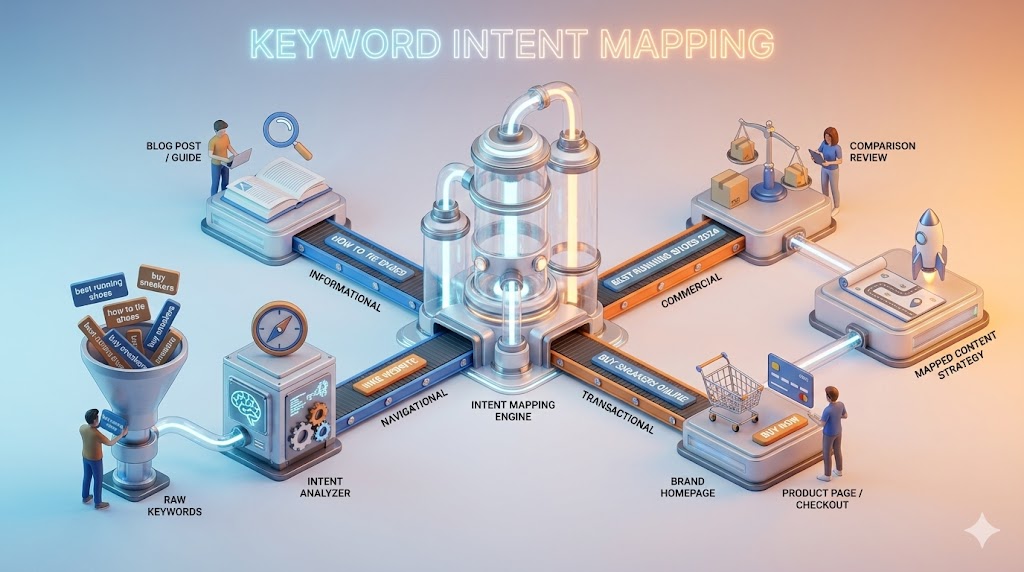
Keyword intent mapping connects each target keyword or topic to the page that best satisfies the searcher’s need. It helps prevent several pages from competing for the same purpose and gives your content plan a clear structure. This guide shows how to build and maintain a useful keyword map.
What is keyword intent mapping?
It is the process of grouping search queries by the goal behind them and assigning each group to an appropriate URL. A person searching “what is CRM” needs an explanation; someone searching “CRM software pricing” is comparing options. Those searches may need different pages.
Four common search intent types
- Informational: The user wants to learn or solve a question.
- Navigational: The user is looking for a particular brand or website.
- Commercial investigation: The user is comparing products, providers or solutions.
- Transactional: The user is ready to buy, book, sign up or take an action.
Intent can overlap. Use the actual search results and the wording of the query to understand what users expect.
How to create a keyword map
- Collect seed topics from services, products, customers and existing website content.
- Expand them with Search Console queries, keyword tools, customer questions and competitor topic research.
- Group close variants that share the same need; do not create one page for every spelling variation.
- Review search results for the main query to understand the dominant format and intent.
- Choose the best destination: guide, service page, category, product page, comparison or tool.
- Assign one primary topic to each URL and add related secondary queries naturally.
- Record the URL, intent, audience, funnel stage, priority and content status.
- Review the map when you publish, merge or substantially change pages.
Example keyword mapping table
| Query | Intent | Best page |
|---|---|---|
| what is local SEO | Informational | Educational guide |
| local SEO services | Commercial | Service page |
| local SEO agency pricing | Commercial | Pricing or comparison page |
| hire local SEO agency | Transactional | Service/contact page |
How to avoid keyword cannibalization
Two URLs are not automatically cannibalizing each other just because they rank for similar words. Investigate when multiple pages repeatedly appear for the same important queries but neither page clearly satisfies the need. Compare their purpose, content, internal links and Search Console performance. Consider improving differentiation, combining overlapping pages or redirecting a genuinely redundant URL. Do not merge pages solely because a third-party tool flags overlap.
Keyword mapping template
Track these fields in a spreadsheet: keyword cluster, primary query, intent, target URL, page type, audience, funnel stage, current status, internal links, priority and last review date.
Common mistakes
- Assigning keywords based only on volume.
- Creating a separate page for every close variation.
- Ignoring what the search results show about user expectations.
- Mapping several unrelated intents to one page.
- Changing URLs without planning redirects and internal-link updates.
- Assuming every ranking overlap is cannibalization.
Keyword intent mapping checklist
- Have you identified the user’s goal?
- Does the proposed page format satisfy that goal?
- Is there an existing URL that already serves the topic?
- Are related variants grouped sensibly?
- Is each important page clearly differentiated?
- Are internal links pointing to the preferred destination?
- Is the map reviewed after major content changes?
FAQs
Should one page target only one keyword?
No. A page can rank for many closely related queries when they share the same intent and the content answers them naturally.
How often should I update a keyword map?
Review it during content planning and after significant changes in search demand, business priorities or website structure.
Can two pages target similar keywords?
Yes, when they serve genuinely different needs. Make their purpose and content distinct.
Official resources
Key takeaway: Map topics to pages based on what searchers need. A useful keyword map is a content and website planning tool, not just a list of search terms.