
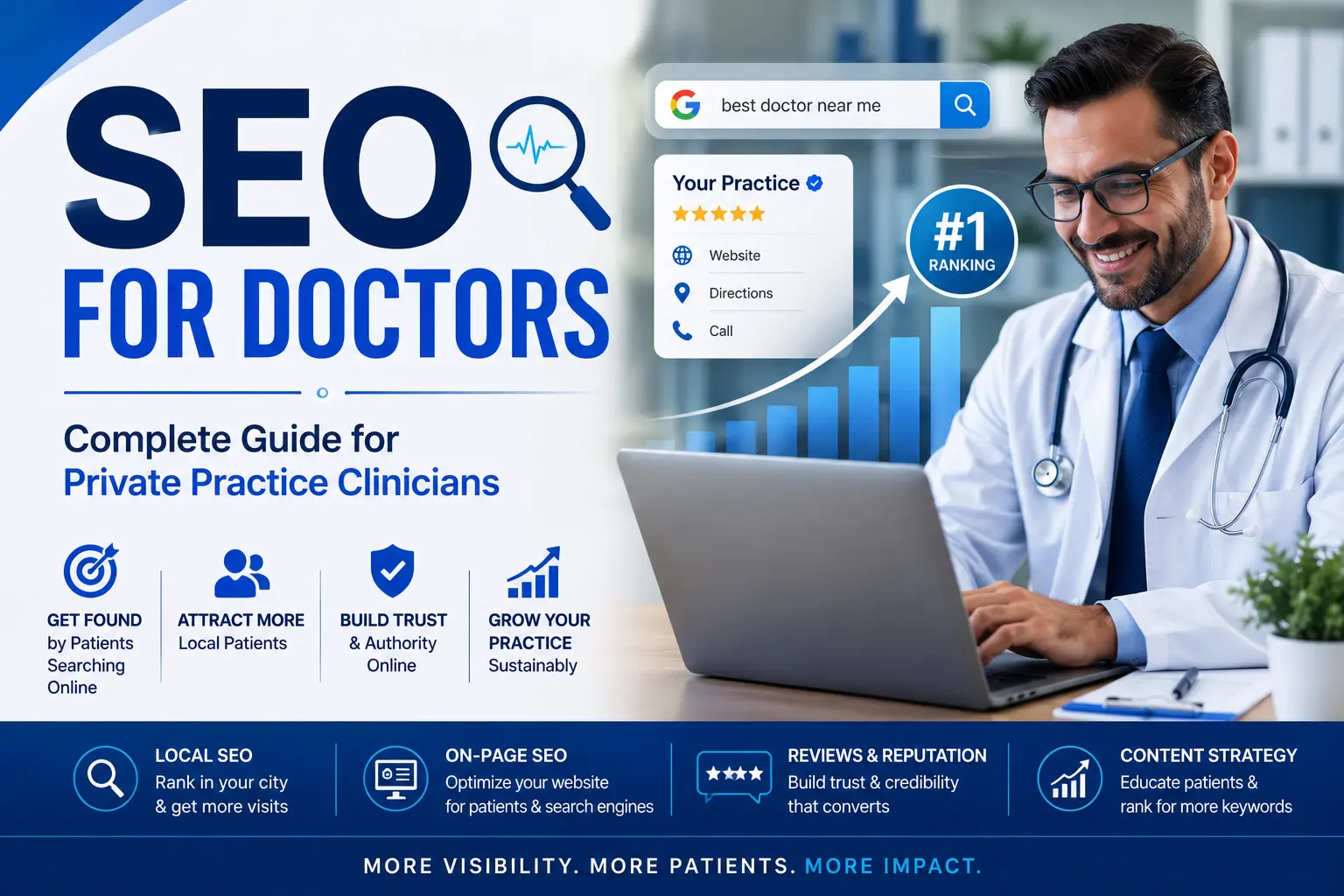
Roughly 77% of patients now research their doctor online before booking an appointment. They read reviews, compare credentials, scan websites, and quietly decide whether to trust you — often before you even know they exist. For a private practice doctor, this changes everything about how patients find you.
The good news: most doctors haven’t yet figured out how to win this online conversation. The bad news: a few have, and they’re capturing the patients who could have been yours.
This guide is written for the busy clinician. It cuts the marketing jargon, focuses on what actually moves the needle, and assumes you have limited time and zero interest in becoming an SEO expert. By the end, you’ll have a clear, ethical, sustainable path to becoming the most visible private practice doctor in your area.
Table of Contents
- Why SEO Matters More for Doctors Than Most Industries
- How Patients Actually Search for Doctors
- Step 1: Optimise Your Google Business Profile
- Step 2: Build a Patient-Friendly Website
- Step 3: Create Service Pages That Rank and Convert
- Step 4: Use Medical Schema Markup
- Step 5: Write a Blog That Demonstrates Real Clinical Expertise
- Step 6: Earn Authoritative Backlinks
- Step 7: Track What Matters
- Realistic Timelines and Costs
- 90-Day Action Plan
- FAQs
This article is about marketing strategy, not medical advice. All clinical guidance referenced here should be informed by your professional training and local medical regulations.
Why SEO Matters More for Doctors Than Most Industries
Search Engine Optimisation is how Google decides who to show when someone types “GP near me” or “best cardiologist in [city]”. For most businesses, ranking is about visibility. For doctors, it’s about something more important: being chosen during a moment of vulnerability.
Three things make medical SEO different:
It’s a YMYL niche. Google classifies medical content as “Your Money or Your Life” — meaning poor or misleading content can directly harm someone’s wellbeing. As a result, Google applies far stricter E-E-A-T standards (Experience, Expertise, Authoritativeness, Trustworthiness) to healthcare websites than to almost any other category.
Patient trust is built before the first appointment. Every page on your website is doing the work of a first impression. Patients are looking for clinical credibility, transparent pricing, and signals that you actually care.
Local intent is unusually high. Patients almost always want a doctor nearby. This means a well-optimised local presence can outperform much larger competitors who lack local relevance.
The combination is unique: high intent, high stakes, high trust requirements. Get it right, and the patients who find you online tend to be the best patients — already informed, already confident in your expertise, and already half-decided.
How Patients Actually Search for Doctors
Before optimising anything, it helps to understand how patients actually search. The way they describe their problem online is rarely how a clinician describes it.
This is core keyword research — bridging clinical language and patient language.
Four common patient search patterns:
| Search Type | Example Queries | What the Patient Wants |
| Symptom-based | chest pain when breathing, constant headaches for weeks | Reassurance and a possible cause |
| Condition-based | type 2 diabetes specialist, PCOS treatment | Expert care for a known issue |
| “Near me” / local | GP near me, dermatologist in [city] | Quick access to nearby care |
| Reputation | Dr. [Name] reviews, [Clinic] complaints | Validation before booking |
A well-rounded SEO strategy answers all four. To understand which queries to prioritise, learn how to do keyword research and how to map keywords to search intent.
Step 1: Optimise Your Google Business Profile
For a doctor in private practice, your Google Business Profile is the single highest-impact SEO asset you have. It’s free, it shows up above organic results in local searches, and it can drive bookings within weeks of being optimised.
What to set up properly:
- Practice name, address, phone number(NAP) — exactly the same wording across every directory
- Primary category— be specific (Cardiologist, not just Doctor)
- Secondary categories— add relevant ones like General Practitioner, Medical Clinic
- Services— list each consultation type, procedure, and condition you treat
- Languages spoken— surprisingly powerful for patients searching for care in their first language
- Insurance accepted— major filter for many patients
- Opening hours, including holidays— outdated hours kill bookings
- Real photos— clinic exterior, reception, consultation room, you and your team
- Booking link— direct integration with your appointment system
Patient review strategy
Google reviews are the most powerful local ranking signal — and the strongest trust factor patients use. Build a simple, ethical review process:
- Ask happy patients in person at the end of a positive consultation
- Send a follow-up SMS or email with a direct review link 2–3 days after the visit
- Always reply to every review, positive or negative, professionally
- Never offer incentives for reviews — this violates Google’s policy and your medical ethics code
For a deeper dive on local optimisation, see local SEO for clinics and local SEO off-page factors.
Step 2: Build a Patient-Friendly Website
Your website is the destination — Google decides who gets there, but your site decides who actually books. A medical website needs to do three things at once: load fast, display trust, and make booking effortless.
This is where technical SEO and patient experience overlap.
Technical essentials:
- Mobile-first design— most patients search on a phone. Google has fully moved to mobile-first indexing
- Fast loading speed— every additional second of load time loses patients. Audit using page speed optimisation basics
- Strong Core Web Vitals— measured by Google as a ranking signal
- HTTPS security— non-negotiable for any healthcare site
- Optimised images— use proper alt text and file names for every image
Trust signals to display prominently:
- Medical registration number (GMC, MCI, AMA, depending on country)
- Specialist qualifications and where you trained
- Memberships in professional bodies
- Any teaching, hospital, or research affiliations
- Awards, publications, media features
- Real, professional photos — never stock images
The booking experience:
- One clear, sticky “Book Appointment”button on every page
- Multiple contact methods: phone, online booking, WhatsApp, email
- Visible practice hours and location with embedded map
- A short FAQ near the CTA addressing payment, insurance, and what to expect
Test everything with Google PageSpeed Insights and Google’s Mobile-Friendly Test.
Step 3: Create Service Pages That Rank and Convert
The single biggest mistake doctors make online is having one generic “Services” page that lists 25 conditions. That page won’t rank for any of them, because it doesn’t help anyone deeply with any single condition.
The fix is structural: one focused page per condition or service you genuinely specialise in. This is the heart of on-page SEO.
The five elements every medical service page needs:
- A patient-perspective opening— describe the condition the way a patient experiences it, not the way a textbook does
- Your specific clinical approach— what’s different about how you assess and treat this condition
- What to expect— first appointment length, tests likely to be needed, treatment timeline
- Trust signals tied to this condition— your training, experience, related research or memberships
- A clear call to action— direct booking or contact, never just a generic “Get in touch”
On-page SEO checklist for each page:
- A compelling title tagwith keyword and location
- A unique meta descriptionthat earns the click
- A clean, descriptive URL slug— e.g. /services/diabetes-management/
- Proper heading hierarchy— one H1, structured H2s and H3s
- Natural keyword placement— never stuffed
- Internal linksto related conditions and your blog posts
Step 4: Use Medical Schema Markup
Schema markup is structured code that helps Google understand exactly what your website is about. For doctors, the right schema can dramatically increase visibility in rich results, knowledge panels, and AI-powered search.
Schemas to implement:
- Physician— for each doctor on your team (reference)
- MedicalBusinessor MedicalClinic — for your practice
- MedicalCondition— on each condition page you write about
- MedicalProcedure— for procedures you offer
- FAQPage— for the FAQ section on any page
- LocalBusiness— for your practice as a local entity
- Review / AggregateRating— for displaying review stars in search results
Most modern WordPress SEO plugins (Rank Math, Yoast) handle the basics automatically. For complex medical schemas, work with a developer or SEO specialist familiar with healthcare. Validate everything using the Google Rich Results Test.
Step 5: Write a Blog That Demonstrates Real Clinical Expertise
A blog is not a marketing chore. For a doctor, it’s the most powerful long-term SEO asset you can build — because it’s the clearest demonstration of your E-E-A-T to both Google and patients.
Why this matters specifically for doctors:
Google now requires medical content to be authored or reviewed by qualified medical professionals. As a real practising doctor, you have an enormous structural advantage — most “medical SEO” content is written by marketers, not clinicians. When you publish, you publish with authority that no agency can fake.
Blog post ideas with genuine search demand:
- “What to expect from your first cardiology consultation”
- “PCOS vs PCOD: what’s the difference and why it matters”
- “When should knee pain be checked by a specialist?”
- “5 things every parent should know about childhood asthma”
- “Type 2 diabetes: early signs most people miss”
Quality bar before publishing:
- Would a peer trust the clinical accuracy?
- Would a patient feel genuinely informed, not sold to?
- Are claims backed by clinical guidelines or peer-reviewed sources?
- Is the language accessible without being patronising?
- Is the title descriptive and not clickbait?
For more on the writing process, see content optimisation for SEO and content publishing for SEO.
Realistic cadence: one well-researched post per month is enough. Quality beats volume — especially in YMYL.
Step 6: Earn Authoritative Backlinks
Backlinks — links from other websites pointing to yours — remain one of Google’s strongest ranking signals. For doctors, the right links can be the difference between page two and page one.
This is off-page SEO, and quality matters far more than quantity. Understand backlink quality vs quantity before you start.
Where to ethically earn links:
Medical association directories:
- Country-specific medical councils (GMC, MCI, AMA, MDA)
- Specialist society directories (cardiology, paediatrics, oncology, etc.)
- Practitioner platforms (Practo, Lybrate, Healthgrades, Doctify)
- See our list of the top 30 health directories in Indiaand general local business directories
Hospital and academic affiliations:
- Listed on the websites of hospitals you visit
- Faculty pages of medical colleges where you teach
- Research collaboration pages
Health publications and guest posts:
- Write for established health sites and patient publications
- See the healthcare guest posting guidefor finding the right outlets
Local press and community:
- Health awareness articles in local newspapers
- Speaking at local health camps, schools, or corporate wellness events
- Sponsoring local health initiatives
What to avoid:
- Paid link schemes
- Low-quality directory submissions
- Reciprocal “I’ll link to you if you link to me” arrangements with unrelated sites
- Comment spam on other blogs
These can trigger Google penalties — especially harsh in YMYL — and damage your professional reputation simultaneously.
Step 7: Track What Matters
Most doctors who start with SEO fixate on traffic numbers. The number that actually matters is bookings attributed to organic search.
Set up these free tools first:
- Google Search Console— see which queries bring patients to your site
- Google Analytics(or an alternative like Plausible) — measure visits, bounce rate, time on page
- Call tracking— use software like CallRail or a simple secondary tracking number to identify calls from your website
Metrics to review monthly:
- New patient bookings from your website (the only number that pays the bills)
- Phone calls from your Google Business Profile
- Top-performing search queries
- Top-performing pages
- New backlinks earned
- Average position for your target keywords
Metrics to mostly ignore:
- Total page views (high traffic with no bookings is just noise)
- Bounce rate in isolation (medical visitors often read one page and call — that’s success)
- Domain authority scores from third-party tools (Google doesn’t use them)
Realistic Timelines and Costs
SEO is the slowest marketing channel to start working — and the most powerful one once it does. Here’s what realistic looks like for a private practice. For a deeper view, see how long SEO takes to show results.
Timeline expectations:
| Timeframe | What to Expect |
| 30 days | Google Business Profile starts driving impressions and calls |
| 60 days | First non-branded search rankings appear |
| 90 days | Steady growth in calls and form fills from local searches |
| 6 months | Most service pages ranking on page 1 for low-competition queries |
| 12 months | Compounding traffic; consistent monthly patient flow from organic |
| 18 months | Established authority; competitors start trying to catch up |
Cost expectations:
- DIY— your time, plus £100–£300/year for hosting, domain, and tools
- Freelancer or specialist consultant— £400–£1,500/month depending on scope
- Healthcare-specialist agency— £1,500–£5,000+/month for full-service work
Red flags when hiring an SEO provider:
- “Guaranteed first-page rankings in 30 days”
- No transparency about what they actually do each month
- Bulk-buying directory submissions or backlinks
- No experience with healthcare or YMYL content
- Refusal to share reporting or access to your tools
A trustworthy SEO partner sounds a lot like a trustworthy doctor: realistic about timelines, transparent about methods, and ethical about boundaries.
A 90-Day Action Plan
| Month | Focus | Outcome |
| Month 1 | Optimise Google Business Profile; technical website audit; write your first specialist service page | Local visibility starts; foundation laid |
| Month 2 | Add 3 more service pages; publish 1 blog post; set up Search Console; ask 5 patients for reviews | Indexed in Google; first rankings begin |
| Month 3 | Earn 3 directory listings; publish second blog post; implement schema markup; set up call tracking | Measurable inbound calls; trust signals build |
After 90 days: keep going. SEO compounds. The clinics with the strongest organic presence today started 18–36 months ago and never stopped.
FAQs
How much does SEO cost for a medical practice?
If you do it yourself, your only costs are time and basic tools (£100–£300/year). Hiring a freelancer typically costs £400–£1,500/month. Healthcare-specialist agencies charge £1,500–£5,000+/month. Avoid any provider promising guaranteed rankings — that’s a red flag, not a service.
How long does it take to rank a doctor’s website on Google?
Local Google Business Profile results can appear within 4–8 weeks. Service page rankings typically take 3–6 months for low-competition queries and 6–12 months for competitive specialities. See how long SEO takes for a full breakdown.
Is SEO better than Google Ads for doctors?
They serve different purposes. Google Ads delivers patients immediately but stops the moment you stop paying. SEO is slower but compounds over time and builds long-term authority. Most successful private practices run both — ads for immediate flow, SEO for sustainable growth.
Do I need a separate website for each speciality?
No. One well-structured website with dedicated pages per speciality almost always outperforms multiple thin websites. Multiple sites split your authority and double your maintenance burden.
Can I do medical SEO myself, or should I hire someone?
You can do the foundational 70% yourself: Google Business Profile, basic content, asking for reviews, claiming directories. The technical 30% — schema markup, advanced auditing, link building — is where specialist help pays off. Start the complete SEO beginner roadmap and decide what to delegate after 60 days.
What’s the difference between SEO and reputation management?
SEO helps people find you. Reputation management shapes what they see when they do (reviews, news mentions, third-party profiles). For doctors, both matter — but SEO is the foundation. Without visibility, there’s nothing to manage.
How do I handle patient privacy in SEO content?
Never share identifiable patient information without explicit written consent. Use anonymised case studies, generic examples, or composite scenarios instead. Always follow your local data protection laws (HIPAA in the US, GDPR in the UK/EU, DPDP in India).
Final Thought
The best SEO strategy for a doctor is the one most aligned with how good medicine is already practised: be genuinely helpful, be transparent, build trust over time, and let the quality of your work speak for itself.
The internet has become the new waiting room. Patients are already there, already researching, already deciding. SEO simply ensures that when they’re ready to choose, they find you — and that what they find reflects the real depth of your expertise and care.
Related Reading
- SEO for Homeopaths
- Local SEO for Clinics: Rank #1 in Your City
- Best SEO Strategies for Clinics in India
- Healthcare Guest Posting Guide
- E-E-A-T Explained
- Complete SEO Beginner Roadmap
Ready to grow your practice through ethical, sustainable SEO? Book a free 30-minute audit call to find your fastest wins.
About the Author
Anand Bajrangi
Anand Bajrangi is an SEO professional with 6+ years of experience, having worked on 100+ projects across healthcare, e-commerce, SaaS, and local businesses. He specialises in ethical, long-term SEO strategies focused on trust, content quality, and sustainable growth.
Based in India · Available for healthcare and professional service SEO consulting