
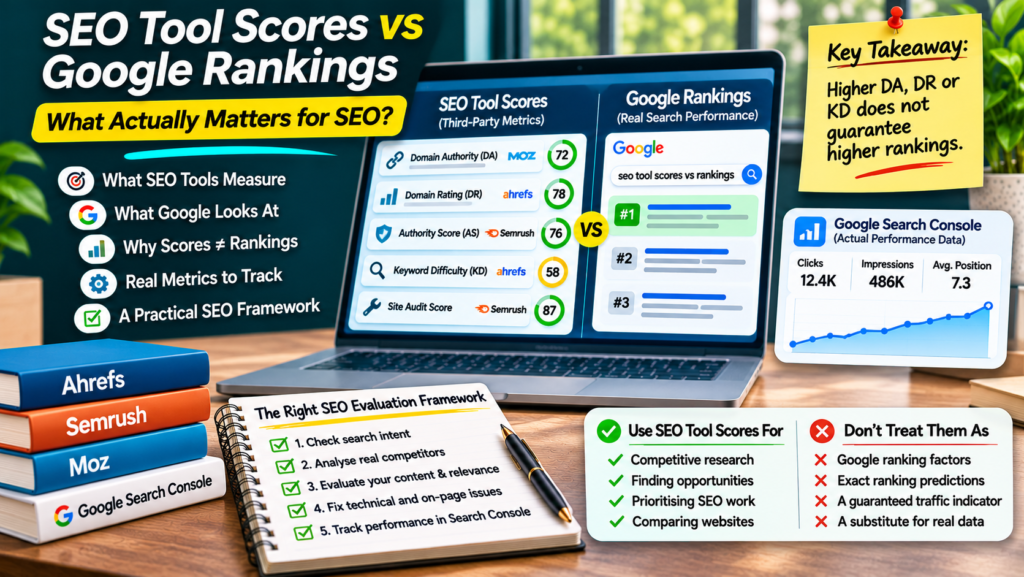
SEO tools make it easy to compare websites using scores such as Domain Authority (DA), Domain Rating (DR), Authority Score, Keyword Difficulty (KD) and Site Audit Score. These metrics are useful, but they are often misunderstood. A website with a higher score does not automatically rank above a website with a lower score.
The important distinction: third-party SEO metrics are estimates created by SEO platforms. They are not Google ranking scores. To understand whether a website can rank, you need to evaluate its relevance, content, technical accessibility, competition, links and actual search performance.
1. Are SEO tool scores Google ranking factors?
No. Scores such as DA, DR, Authority Score, Keyword Difficulty and website audit scores are not Google ranking factors in themselves. They are measurements developed by SEO tools to help users analyse websites, keywords and possible issues.
Google’s ranking systems evaluate many signals to identify useful, relevant results for a search. A third-party score can provide context, but it does not tell Google where to rank a page. Treat these scores as diagnostic indicators, not targets that Google is trying to reward.
2. Domain Authority vs Domain Rating vs Authority Score
These metrics may look similar because they try to estimate aspects of a website’s authority or strength. However, each platform uses its own data and methodology. Their scores are not interchangeable.
| Metric | Platform | What it estimates | How to use it |
|---|---|---|---|
| Domain Authority (DA) | Moz | Likelihood of a domain ranking in search results, based on Moz’s link data and model | Compare potential link strength between relevant competitors |
| Domain Rating (DR) | Ahrefs | Strength of a website’s backlink profile on Ahrefs’ scale | Review backlink profile strength and compare domains |
| Authority Score | Semrush | A composite estimate of a domain’s overall authority | Use as one input when reviewing domains and competitors |
A DA of 40 is not equal to a DR of 40. Do not compare the numbers as if they were measured on the same scale. Instead, compare websites using the same tool and then inspect the quality and relevance of their backlinks.
For link analysis, look beyond the headline score. Check referring domains, topical relevance, link placement, natural anchor text, traffic patterns and whether the links appear editorially earned. A large number of irrelevant or low-quality links does not automatically create a strong website.
3. What does Keyword Difficulty actually tell you?
Keyword Difficulty is an estimate of how challenging it may be to rank for a keyword. SEO platforms calculate it using their own datasets and methods. Some place strong emphasis on backlinks to ranking pages, while others combine several indicators.
This means the same keyword can have different KD scores in different tools. A low score does not guarantee an easy ranking, and a high score does not mean ranking is impossible.
How to evaluate a keyword beyond its KD score
- Search the keyword in Google and study the pages currently ranking.
- Identify the search intent: informational, commercial, transactional or navigational.
- Check whether the results are dominated by major brands, specialist websites, local businesses or forums.
- Compare the quality, depth and usefulness of competing pages.
- Review backlink strength, but also assess topical relevance and website expertise.
- Decide whether your website can create a more useful page for the same intent.
For a deeper explanation, read Keyword Difficulty Explained. You can also learn how to assess search volume and build a structured keyword research process.
4. Why can a low-DR website outrank a high-DR website?
Imagine two websites competing for a specific, low-volume topic. Website A has a DR of 70 but publishes a broad page that only briefly mentions the topic. Website B has a DR of 18 but publishes a detailed, accurate page that directly answers the searcher’s question.
Website B may have a better chance of ranking for that query because its page is more relevant and useful for the search intent. This is an illustrative example, not a prediction of a particular ranking outcome.
Authority metrics can help explain a site’s backlink profile, but they do not replace page-level analysis. Evaluate the actual pages competing for the query, not only the domain-level scores.
5. Does a high SEO audit score mean a website is healthy?
Not necessarily. Most SEO audit tools use their own checks and scoring systems. A site may receive a high score while still having important business or search problems. For example, it may target the wrong keywords, have weak content, attract irrelevant traffic or fail to convert visitors.
A lower audit score may also include warnings that have little impact on the site’s most important pages. Review each issue based on its cause, affected URLs, scale and likely impact instead of trying to achieve a perfect score.
Prioritise issues by impact
- Critical: pages blocked from crawling or indexing unintentionally, widespread server errors, broken important pages or serious rendering problems.
- High priority: incorrect canonical tags, important redirect problems, poor internal linking and major content gaps.
- Page improvement: unclear titles, weak headings, missing useful information and poor search-intent alignment.
- Low priority: cosmetic warnings that do not meaningfully affect users, crawling or the performance of important pages.
Use a structured technical SEO checklist and review the affected URLs before deciding what to fix.
6. Google Keyword Planner competition is not organic Keyword Difficulty
Google Keyword Planner includes a competition metric for advertisers. It describes competition among advertisers for a keyword in Google Ads. It is not a direct measurement of how difficult it is to rank organically in Google Search.
Do not treat a keyword with “Low” paid competition as an easy organic SEO opportunity. For organic research, inspect the search results, ranking pages, intent, content quality and relevant competition.
7. Google Search Console vs third-party SEO tools
Third-party tools are useful for research and competitive analysis. Google Search Console provides performance data for your own verified website in Google Search, including clicks, impressions, click-through rate and average position.
| Tool or data source | Best use |
|---|---|
| Google Search Console | Measure your site’s actual search impressions, clicks, CTR and average position |
| Google Analytics | Understand what visitors do after arriving on your website |
| Ahrefs / Semrush / Moz | Research competitors, backlinks, keyword opportunities and estimated metrics |
| Crawling and audit tools | Find technical and on-page issues that need investigation |
Use Search Console to understand how your pages are performing in Google Search. Use third-party tools to find opportunities and investigate competitors. Neither view should be used in isolation.
8. A practical five-step process to evaluate SEO opportunities
Step 1: Understand the search intent
Search the target keyword and identify what users expect to find. A product page, service page, comparison article and tutorial serve different intents. Choose the page type that best matches the query.
Step 2: Analyse the actual ranking pages
Review the top results. Look at their content quality, topical coverage, freshness, page experience, structure and relevance. Identify what the current results do well and what they fail to answer.
Step 3: Use tool metrics as supporting evidence
Check KD, referring domains, DA or DR to understand the competitive landscape. Compare like with like, use the same tool for comparisons and remember that these are estimates.
Step 4: Check your website’s ability to compete
Ask whether your website has relevant expertise, useful supporting content, a technically accessible page and a clear internal linking path. Review whether the page can satisfy the search intent better than the available alternatives.
Step 5: Measure real outcomes
After publishing or improving the page, monitor impressions, clicks, CTR and average position in Search Console. Also measure meaningful business outcomes such as enquiries, leads, sales or sign-ups where tracking is available.
For a repeatable process, use keyword intent mapping to connect search terms with the right pages. You can also use the SEO Inspector Chrome Extension for quick on-page checks.
9. Which SEO metrics should you track?
| Goal | Metrics to monitor | Where to review |
|---|---|---|
| Search visibility | Impressions, clicks, CTR, average position and query/page trends | Google Search Console |
| Technical health | Indexing status, crawl errors, status codes, canonicalisation and Core Web Vitals | Search Console and crawling tools |
| Content performance | Relevant queries, landing-page engagement, content gaps and conversions | Search Console and analytics |
| Authority and links | Relevant referring domains, link quality and link growth | Backlink research tools |
| Business results | Qualified leads, enquiries, purchases and revenue | Analytics and CRM |
DA, DR, KD and audit scores can stay in your reporting dashboard as supporting indicators. They should not be the only measures of SEO success. The most useful metrics are the ones that help you understand search visibility, website quality and business results.
10. Common myths about SEO tool scores
- Myth: A higher DA guarantees higher rankings. Reality: DA is a third-party estimate, not a Google ranking score.
- Myth: A high DR means every page on the domain is strong. Reality: Domain-level backlink metrics do not describe the relevance or quality of every individual page.
- Myth: Low KD guarantees a quick ranking. Reality: KD is an estimate. Search intent, result types and content quality still matter.
- Myth: A 100/100 audit score guarantees SEO success. Reality: An audit score cannot measure every aspect of relevance, usefulness or business performance.
- Myth: Google Ads competition tells you organic difficulty. Reality: Paid advertiser competition and organic ranking competition are different concepts.
Frequently asked questions
Does Google use Domain Authority or Domain Rating?
DA and DR are metrics created by third-party SEO platforms. They are not Google metrics. Use them to compare backlink profiles, not as direct measures of Google’s ranking decisions.
Which is more important: DA or DR?
Neither is universally more important. They use different methodologies. Choose a tool that supports your workflow and focus on the relevance and quality of links rather than chasing a particular score.
Can a new website rank with a low DR?
Yes. A new or low-DR website can rank for relevant queries when its pages satisfy the search intent and compete effectively. The level of competition and the quality of the page both matter.
Should I stop tracking SEO tool scores?
No. These scores can help with competitor research, backlink monitoring and technical checks. Just avoid treating them as the final measure of SEO performance.
What is the best metric for measuring SEO success?
There is no single metric for every website. Track search visibility with Search Console, website behaviour with analytics and business outcomes such as qualified leads or revenue. Use technical and third-party metrics to explain what may be affecting those results.
Final thoughts
SEO tools are valuable when you understand what their metrics actually measure. DA, DR, Authority Score, Keyword Difficulty and audit scores can help you research competitors and identify areas to investigate. But none of these numbers guarantees a Google ranking.
Focus on understanding search intent, creating useful pages, maintaining a technically accessible website, earning relevant links and measuring real search and business outcomes. Use tool scores to support your decisions—not to make decisions for you.