
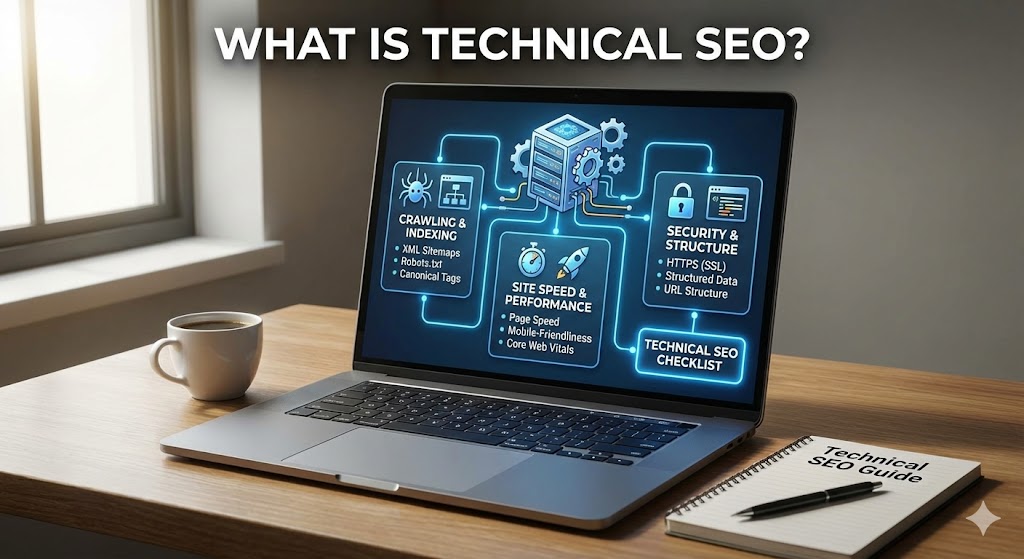
Technical SEO is the part of search engine optimization that deals with how your website works behind the scenes. It focuses on the setup, structure, and performance of your site so that search engines can easily read and understand it. When your website is technically healthy, search engines can find your pages faster and show them to the right people in search results.
On its own, Technical SEO does not change the words or pictures that people see on a page. Instead, it supports your On-Page SEO by making sure that your well-written content can be crawled, indexed, and displayed correctly. It also supports Off-Page SEO by helping search engines trust your site more when they see that it is fast, secure, and well-organized.
By learning the basics of Technical SEO, you build a strong base for all your other SEO work. With a solid technical setup, your content has a better chance to rank, your visitors can move around your site more easily, and your website is more prepared for future changes in search engine rules and algorithms.
Introduction
Many sites cover the same topics, yet only a few appear at the top of search results. The difference often lies in how well their behind-the-scenes setup supports search engines. That hidden foundation is where Technical SEO plays a key role.
Rather than changing the words on your pages, this part of SEO makes sure your site is easy for search engines to visit, read, and trust. It works together with your On-Page SEO (your content) and your Off-Page SEO (links and reputation) so that all three support each other and keep your site strong over time.
What Is Technical SEO?
Before you can improve your site, it helps to understand what Technical SEO actually means. At its core, it is about how your website is built and how it behaves when search engines and users interact with it.
When people ask, What is Technical SEO?, they are really asking how a website is structured and how it performs. This area of SEO deals with the infrastructure of your site: the code, the way pages connect, and how fast and safely they load.
Instead of focusing on writing text or choosing pictures, Technical SEO works behind the scenes to improve performance, crawlability, and indexing. In simple words, it helps search engines find your pages, understand them, and decide when to show them to users.
Why Technical SEO Is Important
Knowing what Technical SEO is makes it easier to see why it matters for search visibility and user experience. Without a solid technical base, even great content can struggle to appear where people can find it.
Even the best article cannot rank well if search engines cannot reach it or read it correctly. A strong technical setup makes it easier for your whole website to perform well in search results and for visitors to have a smooth experience.
Some key benefits of good Technical SEO include:
- Better crawling and indexing – search engines can discover and store your pages more efficiently.
- Improved website performance – pages load faster, which helps visitors stay longer.
- Better user experience – users can move around the site easily, on both desktop and mobile devices.
- Higher trust and security – using secure connections helps protect data and builds confidence.
- Stronger base for future growth – a clean technical setup makes it easier to add more content and features later.
What Technical SEO Helps Search Engines Do
Once you see the benefits, it is helpful to look at what actually happens when search engines visit your site. Technical SEO directly shapes how well each step of that process works.
Behind every search result, there is a process where search engines find, store, and understand pages. Technical SEO influences how smoothly that process works for your site, step by step.
With the right setup, search engines can:
- Crawl pages – follow links and discover new or updated content on your site.
- Index content – save a copy of your pages in their database so they can show them later.
- Understand site structure – see how pages fit together, which ones are most important, and which topics each section covers.
- Choose the right page version – select between desktop, mobile, or alternate versions when needed.
“Search engines reward websites that are easy to crawl, quick to load, and simple to understand.” – Aleyda Solis
Core Elements of Technical SEO
After understanding the overall role of Technical SEO, the next step is to break it down into its main parts. Each element below contributes to how easily search engines can work with your site.
The following sub-sections explain important areas like crawling, indexing, speed, mobile-friendliness, structure, and security in simple terms, so you can recognize how each one affects search visibility.
Website Crawling
Search engines begin by discovering your pages, and that discovery process depends on how well your site can be crawled. If crawlers cannot move through your pages, they cannot find or update your content.
Think of search engine bots, often called crawlers or spiders, as tiny robots that walk through your site by following links. Their job is to discover new pages and check old ones for updates.
Good Technical SEO makes that journey easy by keeping links working, avoiding endless loops, and using tools like robots.txt to tell crawlers which parts of a site they should or should not visit.
Indexing
After pages are discovered, search engines must decide what to store in their index. Clear signals here help make sure the right versions of your content appear in results.
After a crawler finds a page, the search engine needs to decide if it should store that page in its index. This process, called indexing, is like placing a book on a library shelf so it can be found later.
Technical SEO uses signals such as meta tags, canonical tags, and clear page content to help search engines know which pages to index, which ones to skip, and which version of similar pages is the main one.
Website Speed
Beyond indexing, how quickly your pages load strongly affects both users and search engines. Faster sites tend to keep visitors engaged and reduce the chances they leave early.
Slow pages frustrate visitors and often lead them to leave before they even read your content. Search engines notice this behavior and may treat very slow sites less favorably.
Improving page speed can include actions like compressing images, reducing heavy scripts, and using efficient hosting. Even simple steps can make pages load seconds faster, which is important for both ranking and user satisfaction.
Mobile-Friendliness
Modern browsing habits mean that a large share of your visitors will come from mobile devices. Technical SEO therefore also focuses on how well your site adapts to smaller screens.
Most people now browse the web on phones or tablets. Because of this, search engines use mobile-first indexing, which means they mainly look at the mobile version of your site when deciding how to rank it.
A mobile-friendly site has text that is easy to read, buttons that are not too small, and layouts that adjust to smaller screens. Responsive design and simple navigation help both visitors and search engines.
Website Structure
Beyond speed and mobile use, the way your pages are organized also sends strong signals to search engines. A clear structure helps both users and crawlers understand your main topics.
A clear structure is like a good table of contents in a book. It helps people and search engines see what topics you cover and how different pages connect.
Using a logical hierarchy with categories, subcategories, and internal links makes it easier for crawlers to find important pages. Simple, readable URLs and helpful menus also support a strong structure.
Security (HTTPS)
Technical SEO also includes how safely data moves between your visitors and your site. Security signals show both users and search engines that your website can be trusted.
Visitors want to know that their data is safe when they browse or fill in forms. Sites that use HTTPS create a secure connection between the user and the server.
Search engines prefer secure sites, especially when users enter passwords or payment details. Moving from HTTP to HTTPS is a basic but very important Technical SEO step for any modern website.
Technical SEO vs On-Page SEO
With the main elements in mind, it becomes easier to see how Technical SEO fits alongside other SEO types. One of the most common comparisons is between Technical SEO and On-Page SEO.
It is easy to mix up these two parts of SEO because they both affect how your site performs in search. However, each has a different focus and uses different tools.
Technical SEO looks at how your site is built and how it works. It covers things like speed, security, structure, and how search engines crawl and index pages. On-Page SEO, on the other hand, deals with what is on each page, such as text, headings, images, and keywords.
Both are under your control, but they solve different problems. Technical work makes your site easy to access and understand; on-page work makes your content useful and relevant to the person doing the search.
Common Technical SEO Issues
Knowing the difference between SEO types helps you spot where things might be going wrong. Many sites share a set of common technical issues that quietly hold back their performance.
Many websites, especially new ones, suffer from similar technical problems. These issues can limit search visibility even when the content is strong and helpful.
Beginner-level Technical SEO problems often include:
- Broken links that lead to 404 error pages.
- Slow loading times due to large images or heavy scripts.
- Missing HTTPS, leaving the site on an insecure connection.
- Duplicate content without proper canonical tags.
- Poor mobile layout that is hard to use on small screens.
- Blocked pages in robots.txt that should be open to crawlers.
- No XML sitemap to guide search engines through important URLs.
- Confusing URL structure with long, messy, or changing addresses.
Who Should Focus on Technical SEO?
Once you recognize these issues, the next question is whether Technical SEO really applies to your type of website. In practice, any site that cares about search traffic can benefit from getting the basics right.
Any site that wants steady traffic from search engines needs at least a basic level of technical health. Even a small blog can lose visitors if pages are broken, slow, or hard to crawl.
The types of websites that benefit greatly from strong Technical SEO include:
- Blogs that publish many posts and want them all to be discovered and indexed.
- Business websites that rely on search to bring in leads, bookings, or contact form submissions.
- E-commerce sites with many product pages, filters, and categories that must be easy to crawl and secure for payments.
- News and media sites that need fast indexing when new stories go live.
Related Topics
After you have a basic technical foundation in place, you can explore more detailed areas that build on what you have learned. These related topics help you fine-tune how search engines see and understand your site.
Once you understand the basics, you can explore other areas that connect closely with Technical SEO. These topics help deepen your knowledge and give you more tools to improve your site.
- XML sitemaps
- Robots.txt configuration
- Structured data and schema markup
- Core Web Vitals
- Canonicalization
- URL parameters handling
- Log file analysis
- Internal linking strategies
Bringing Technical SEO Together for Better Performance and Visibility
All of these ideas come together to form the technical backbone of your website. When that backbone is strong, every other SEO effort has a better chance to succeed.
Understanding what Technical SEO is gives you a clear view of how your website works behind the scenes. Instead of changing your words or images, it shapes the infrastructure and performance that allow search engines to find, read, and trust your pages.
By supporting both On-Page SEO and Off-Page SEO, a healthy technical setup acts as the base that holds all of your other SEO efforts in place. When crawling, indexing, speed, mobile use, structure, and security are in good order, your content has a fair chance to compete in search results and your visitors enjoy a smoother journey.
You do not need to fix everything at once to see progress. Starting with simple checks for speed, mobile-friendliness, clear structure, and HTTPS can already make a real difference to both users and search engines. Over time, you can explore related areas like XML sitemaps, structured data, and Core Web Vitals to refine your site even more.
In the end, Technical SEO is about making your website easy to access, understand, and trust. Treating it as an ongoing part of website care helps you maintain a strong, visible, and reliable online presence over the long term.