
Search Engine Optimization, or SEO, is the process of helping your website show up higher in search results when people look for information online. In simple words, SEO makes it easier for search engines to understand your pages and match them with what users are searching for. It connects user questions with your answers in a way that follows clear, logical rules, similar to an algorithm in math or computer science.
For beginners, SEO can feel confusing because it includes many skills, tools, and moving parts. Without a clear order, people often jump into the wrong things and feel lost. A structured roadmap fixes this problem by showing you exactly what to learn first, what to ignore for now, and how each new skill builds on the last. This step-by-step approach turns a big, scary topic into small, simple stages that anyone can follow.
This guide is designed like a learning path, from level 0 to the advanced level. You will see each SEO level explained in plain language, with a strong focus on what truly matters and what is optional. By following the roadmap in order, you can grow from a complete beginner to a confident, job-ready SEO practitioner.
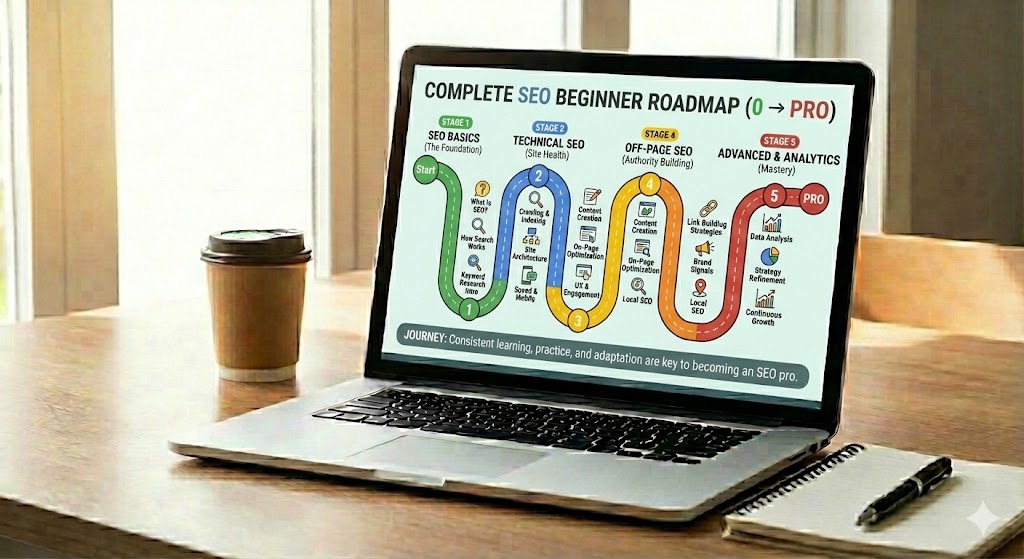
Complete SEO Beginner Roadmap (0 → Pro)
Learning SEO often feels like opening ten tabs and getting nowhere. Information appears in random order, and beginner, intermediate, and expert topics get mixed. The Complete SEO Beginner Roadmap solves this by telling you exactly what to learn now and what can safely wait.
This roadmap moves in levels, from simple to complex, like learning math from addition to algebra. You start with basic ideas and words, then move into page content, technical foundations, and finally into advanced strategy and careers. Each stage gives you just enough knowledge to practice without feeling lost, so your skills grow in a steady, logical way and prepare you for the next section.
Who This Complete SEO Beginner Roadmap Is For
Different people arrive at SEO with different goals, but most share one desire: they want more people to find them online. This roadmap is built so a wide range of learners can follow the same clear path, no matter their starting point.
The groups below will benefit the most from this guide. If you recognize yourself in any of them, the roadmap is written with your needs and challenges in mind.
- Absolute beginners: You have little or no background in digital marketing. You just want someone to explain everything in simple steps without hard jargon or confusing tools.
- Bloggers and content writers: You write, but your posts do not get traffic. You need a practical way to match your articles with what people actually search for.
- Business owners: You run a shop, service, or startup and cannot rely only on ads. You want a basic, repeatable method to attract visitors without wasting your budget.
- Marketing students: You already know theory from class, but you need a real-world, step-by-step system to turn that theory into skills you can show in a portfolio or job interview.
SEO Basics and Foundations for Beginners
Strong SEO skills start with understanding how search engines see and organize the web. Before touching tools or tactics, you need a few simple concepts that make every later step easier. Think of this part as learning the alphabet before trying to write a book.
At this stage, focus on a few core pillars that explain how visibility works online. Once these are clear, every level in the Complete SEO Beginner Roadmap will feel more logical and less overwhelming.
One essential idea is that search engines act like huge libraries. Their bots, called crawlers, move from page to page, read your content, and save it in a big index. Only pages that are stored in this index can later compete to rank when someone types a query.
Another key foundation is understanding that search systems try to match user intent with the best answers, not with tricks. Simple things like clean structure, clear wording, and honest information are not “nice extras” – they are the building blocks of long-term results and prepare you for more detailed work on keywords and on-page SEO.
Keyword Research, Search Intent, and On-Page SEO
Once you understand how search engines work, the next step is learning how to create content people actually want. That means moving from guessing topics to using keyword research and search intent to plan pages, then applying on-page SEO so search engines can easily read them.
Imagine trying to answer a question nobody is asking. That is what happens when you create content without first checking what people type into search engines. To move from random ideas to a clear plan, you need to connect keyword research, search intent, and on-page SEO in one simple workflow.
Keyword research starts with making a list of words and phrases real people might use to find your page. Focus on specific, long-tail phrases like “how to clean white sneakers at home” instead of only short, vague ones. Then check if those phrases match what your site can realistically cover in a useful, honest way.
After you have ideas, think about search intent: is the person trying to learn, compare, or buy? A phrase like “best budget laptops 2025” usually shows commercial intent, while “what is RAM in computers” is more educational. Aligning your page with this purpose makes visitors stay longer and helps rankings over time.
On-page SEO is how you package your answer so search engines can easily read it. Use the main keyword in the title tag, one main heading, and naturally in the first short paragraph. Support it with related phrases and clear structure so the content reads well for humans, not just for bots.
- Write one main topic per page.
- Use short, readable sentences and simple words.
- Link to other helpful pages on your site using descriptive anchor text.
When these three pieces work together – the phrase people search, the reason they search, and how your page is built – your site becomes much easier to find and understand. That foundation then feeds into the next layer of the roadmap: making sure your website is technically healthy.
Technical SEO and Website Health in the Complete SEO Beginner Roadmap
Good content only works if people can reach it quickly and reliably. The technical side of SEO makes sure search engines can crawl your pages, and users can load them without frustration. At this level, you learn how your site behaves behind the scenes.
Have you ever clicked a result, waited too long, and gone back immediately? That simple action sends a strong signal about a site’s technical health. Even the best-written page can struggle if search engines cannot easily crawl it or if users leave because it loads slowly.
Within this stage of the Complete SEO Beginner Roadmap, the goal is to make pages easy for both people and crawlers to access, read, and trust, without needing deep developer skills.
Start with basic crawling and indexing. Make sure each important page can be reached through internal links, shows a clear URL, and is not blocked by mistakes in files like robots.txt or by accidental noindex tags. A simple, flat site structure where key pages are only a few clicks from the homepage helps crawlers move efficiently.
Then consider page speed and mobile-friendliness. Compress large images, avoid heavy scripts you do not need, and choose layouts that adapt to small screens. When a site loads in under a few seconds and is easy to tap and scroll on a phone, visitors stay longer and interact more.
- Use short, descriptive URLs that match the page topic.
- Prefer HTTPS so data between user and server is encrypted.
- Avoid near-identical pages that cause duplicate content issues.
Finally, keep an eye on overall website health like broken links, redirect chains, and missing canonical tags. These are small technical details, but fixing them early makes every other SEO effort work better and sets you up for the next step: building authority and trust beyond your own site.
Off-Page SEO, Authority, and Local Search Essentials
After your content and technical basics are in place, the next challenge is proving that your site deserves to rank. Off-page SEO looks at signals outside your own pages that show whether others trust and recommend you. These signals are crucial for both general and local visibility.
Why do some sites with simple design still outrank bigger, prettier websites? Often, the answer lives outside the page itself. Off-page SEO focuses on signals around your site that show if others trust you, recommend you, and talk about you.
In this part of the Complete SEO Beginner Roadmap, you move beyond code and content and learn how reputation is built on the web. These signals matter for both global and nearby searches, which is where local SEO comes in.
The most famous off-page signal is the backlink: a clickable link from another domain to yours. When that link comes from a relevant, respected site and uses clear anchor text, it acts like a vote of confidence. A few strong links often beat many weak ones, so quality is more important than raw count.
Authority is also shaped by brand mentions, even without a link, and by user behavior that search engines can observe. Social posts and shares do not directly boost rankings, but they can spread your content, attract visitors, and naturally lead to more links over time.
- Focus on earning links from related, trustworthy websites.
- Avoid spammy, automated link schemes that risk penalties.
- Use anchor text that describes the topic in simple words.
For businesses with a physical address, local search adds another layer. Search engines look at consistent citations (name, address, phone), honest reviews, and local references from nearby sites to decide which companies to show for “near me” type searches.
When your information is correct everywhere, reviews are answered politely, and local partners mention your brand, your local authority grows. This real-world trust then supports the final core stage of the roadmap: building a long-term content system and maintaining your results.
Content Strategy, Measurement, and Long-Term SEO Maintenance
Reaching good rankings once is only half the job; keeping and growing them over time is where real results come from. A simple content strategy, regular measurement, and light maintenance turn scattered efforts into a stable, repeatable system.
Why do some websites keep growing year after year while others peak once and then slowly fade? The difference is rarely one magic trick. It usually comes from a simple, written content strategy, clear measurement habits, and regular maintenance routines that protect results over time.
In this stage of the Complete SEO Beginner Roadmap, you connect everything you learned so far into a stable system. You will see how to plan what to publish, how to track if it works, and how to keep your site healthy so traffic does not slowly slip away without you noticing.
Start with a basic plan. List your main topics, target audiences, and the key problems you solve. For each idea, define the primary keyword, the search intent, and the page’s role in your site (guide, product, FAQ, or support article). This turns random posting into a clear map you can follow week after week.
Then set simple, trackable goals. Examples include more organic sessions, higher click‑through rate on key pages, or better conversion rate from specific articles. Check these numbers on a fixed schedule so you learn which topics bring real value and which need to be updated, merged, or removed.
- Create a small content calendar for at least 4–8 weeks.
- Group articles into topic clusters around your main services.
- Mark pages that need updates, new sections, or extra internal links.
Long-term care is like doing regular checks on a car. Every month or quarter, review traffic trends, fix broken links, refresh outdated facts, and improve weak titles or meta descriptions. This light but steady SEO maintenance helps your site adapt when algorithms, users, or your own business change over time and prepares you for more advanced topics and career paths.
Advanced Topics, Careers, and the Future of SEO
After you can research keywords, optimize pages, and maintain a healthy site, you are ready to look at SEO from a bigger, more strategic angle. Advanced topics help you handle large or complex sites and open doors to professional roles in the field. This level also connects your skills to where search is heading next.
What happens after you know how to choose keywords, fix pages, and track results? At that stage, you start moving from simple tactics into advanced thinking about systems, careers, and where search is going next.
Higher levels of the Complete SEO Beginner Roadmap focus less on single pages and more on how large sites, complex code, and whole businesses behave in search. This is where you connect technical depth, strategy, and long-term planning.
On the advanced side, you will hear concepts like crawl budget, JavaScript rendering, international targeting, and site migrations. These topics teach you how to guide search engines across thousands of URLs, handle dynamic content, and move or redesign a site without losing all your rankings overnight.
- Use XML sitemaps and clean internal links to control which pages get crawled often.
- Test JavaScript-heavy pages to be sure important text and links are visible to bots.
- Plan big redesigns with redirects, content maps, and careful monitoring.
As you look beyond pure tactics, you also meet ideas like E‑E‑A‑T (Experience, Expertise, Authoritativeness, Trustworthiness). These push you to show real-world proof: who wrote the content, why they know the topic, and how users’ safety and privacy are protected.
Professional paths grow from this deeper layer. Modern SEO work can mean being a technical specialist, a content strategist, or a full‑stack SEO generalist inside an in‑house team, agency, or as a freelancer. Each role combines core knowledge with extras like basic HTML, analytics skills, or project management.
- Practice reading simple server logs to see how bots really crawl a site.
- Learn to explain complex changes in plain words for non‑technical clients.
- Keep a small portfolio of before‑and‑after SEO case studies.
Looking ahead, AI‑driven search, rich results, and conversational answers will keep reshaping how people discover information. Yet the same foundations still sit underneath: clear intent, fast and safe pages, and helpful content that real humans value.
“The technology changes every year; the need for truthful, useful information does not.” – Rand Fishkin
Turning the Complete SEO Beginner Roadmap into Real Results
The Complete SEO Beginner Roadmap (0 → Pro) gives you a clear order: understand how search works, learn keywords and on‑page basics, build technical health and authority, create a simple content system, and only then explore advanced topics and careers. Instead of chasing random tricks, you now have a step‑by‑step way to think, test, and improve.
As search engines and AI‑driven results keep changing, the skills you build here remain useful: knowing what users want, creating helpful content, keeping your site fast and clean, and measuring what truly works. You do not need to master everything at once; pick your current level, practice the core habits, then move up when they feel natural.
If you keep learning, testing, and staying honest with your audience, this roadmap can carry you from confused beginner to confident, professional SEO who can adapt to whatever the future of search brings.