
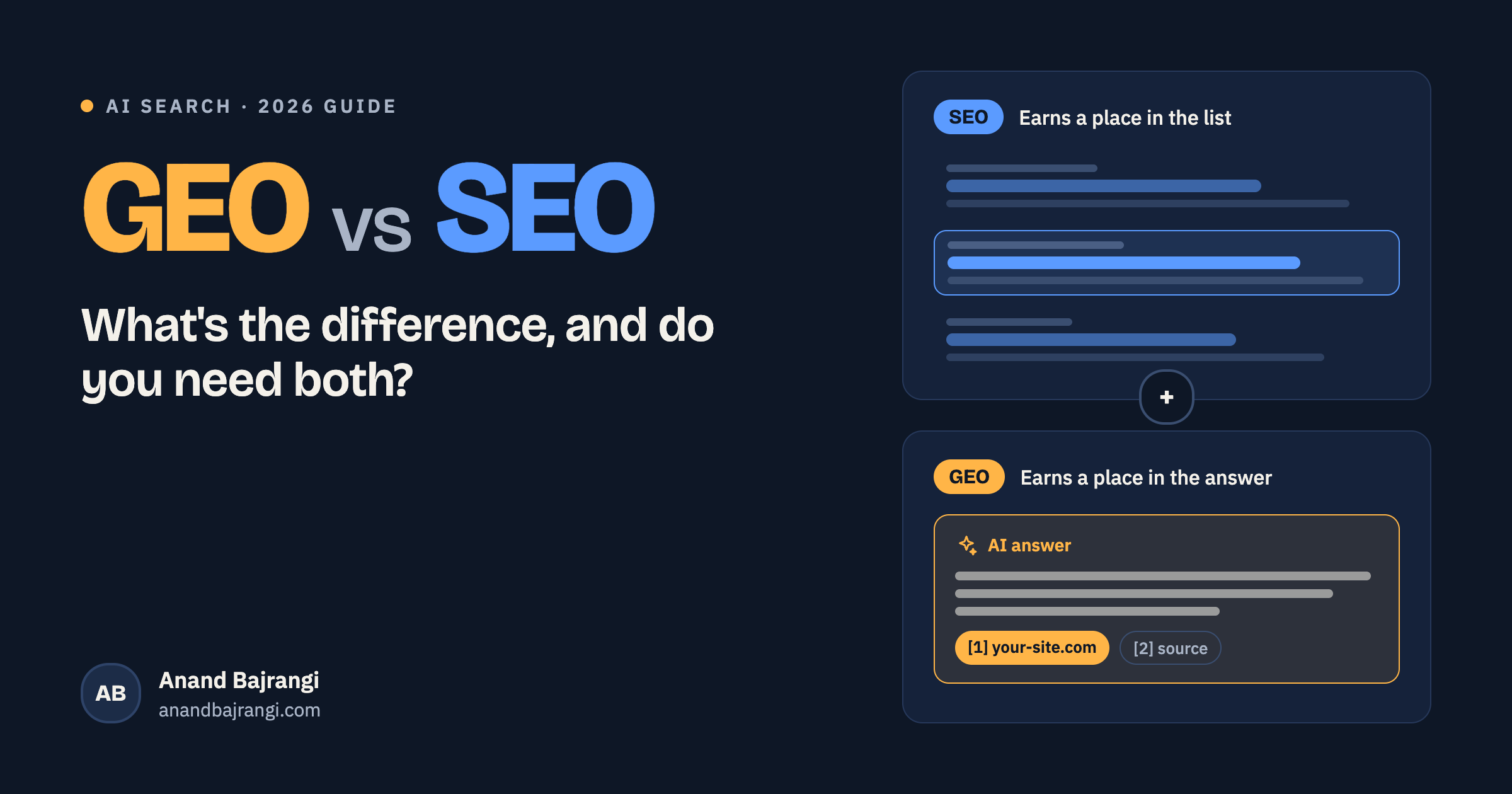
Short answer: SEO (search engine optimization) helps your pages rank in search results so people click through to your website. GEO (generative engine optimization) helps your content get pulled into, and cited by, AI-generated answers in Google AI Overviews, AI Mode, ChatGPT, Perplexity and Gemini. They are not rivals: AI answers are built largely from pages search engines already crawl and index, so GEO is a layer on top of good SEO. Most businesses need both, and SEO comes first.
If you run a small business, a clinic, a law firm or a content site, you have probably heard some version of “SEO is dead, now you need GEO.” It isn’t, and you don’t need to start over. What has changed is where people read the answer: more and more of it now appears on the search page or inside an AI chat, before anyone clicks.
This guide explains, in plain language:
- what SEO and GEO each mean today, and where the term GEO came from
- exactly where they overlap and where they really differ
- how AI search engines decide which websites to cite
- whether your type of business needs both, and what to do first
- how to measure AI visibility with tools you already have
What is SEO in 2026?
SEO is the work of making your website easy for search engines to find, understand and rank, and attractive enough that people click. The goal is a visible link to your page in the results, and a visit that turns into a call, a booking or a sale.
Every search engine works in three stages, and SEO supports each one:
- Crawling: bots such as Googlebot discover your pages by following links and reading your XML sitemap. Read more in how search engines work.
- Indexing: the engine stores and understands what each page is about. A page that is not indexed cannot rank anywhere, including in AI answers.
- Ranking and serving: for each search, the engine picks the most relevant and trustworthy pages and orders them.
The work itself still falls into three familiar pillars:
- Technical SEO: crawlability, indexing, site speed, mobile-friendliness, HTTPS, structured data.
- On-page SEO: content that matches search intent, clear titles and headings, internal links.
- Off-page SEO: backlinks, brand mentions, reviews and your Google Business Profile.
What has changed is the results page around your link. An AI-generated summary now often sits above the blue links, and simple questions get answered before anyone scrolls. SEO still decides whether your page is eligible to appear at all, in the links and in the AI summary. That is why GEO starts here.
What is GEO (generative engine optimization)?
GEO is the practice of making your content easy for AI systems to find, trust and quote when they write an answer. Success means your brand, your page or your facts appear inside the AI’s answer, ideally with a clickable citation back to you.
Where the term GEO came from
The term comes from a research paper, GEO: Generative Engine Optimization, by Pranjal Aggarwal of IIT Delhi and colleagues from Princeton University. It was first posted in November 2023 and published at the ACM SIGKDD conference (KDD 2024) in Barcelona. The team built a test set of 10,000 search queries across 25 topics, then measured how nine different rewrites of a web page changed its visibility in AI answers.
| Change to the page | What it means | Effect on visibility in AI answers |
| Cite sources, add quotations, add statistics | Back claims with named sources, expert quotes and numbers | Best results: about 30–40% more visibility |
| Improve fluency, make it easy to understand | Clearer, simpler, better-flowing writing | 15–30% more visibility |
| Authoritative tone | More persuasive, confident language | No significant improvement |
| Keyword stuffing | Repeat the query’s keywords more often | Little to no gain; about 10% worse when tested on Perplexity |
Two findings matter most for smaller websites. First, lower-ranked pages gained the most: adding cited sources lifted the visibility of a page ranked fifth on Google by 115%, while the top-ranked page lost about 30%. Second, what worked varied by topic, so there is no single GEO trick.
Treat these numbers as direction, not law. The tests fed the top five Google results to an older OpenAI model (GPT-3.5), and today’s AI search engines have changed a lot since 2023.
Where GEO applies
“Generative engines” are search tools that write an answer instead of only listing links. The ones that matter most today:
- Google AI Overviews: the AI summary at the top of a normal Google results page.
- Google AI Mode: Google’s conversational search mode, built for longer questions and follow-ups.
- ChatGPT search, Perplexity, Gemini and Microsoft Copilot: AI assistants that search the web and cite sources in their replies.
You will also see the labels AEO (answer engine optimization), LLMO (large language model optimization) and AI SEO. They describe roughly the same goal with different emphasis. Google’s own position, covered below, is that all of it is still SEO.
GEO vs SEO: side-by-side comparison
The simplest way to remember the difference: SEO earns you a place in the list, GEO earns you a place in the answer.
| SEO | GEO | |
| Main goal | Rank a page and win the click | Get your content selected, quoted or cited inside an AI answer |
| Where you appear | Blue links, local map pack, image and video results | Google AI Overviews and AI Mode, ChatGPT, Perplexity, Gemini, Copilot |
| What competes | Your whole page against other pages | Your passages, facts and brand mentions against other sources |
| What the searcher sees | Your title and snippet, then they click to read | A written summary that may name or link you, often without a click |
| Typical query | Shorter keyword searches | Longer, conversational questions with follow-ups |
| What helps most | Relevance, links, technical health, page experience, E-E-A-T | Everything SEO needs, plus clear, specific, well-sourced facts and a consistent brand presence across the web |
| How you measure it | Rankings, impressions, clicks, CTR, organic conversions | AI impressions in Search Console, AI referral visits in GA4, citation and mention tracking |
| How mature it is | 25+ years, with official documentation from search engines | A few years old; engines change fast and work mostly as black boxes |
Notice the “What helps most” row. GEO doesn’t replace the SEO column; it adds to it. A page that can’t be crawled, indexed or trusted won’t be cited by an AI answer either.
How AI search engines decide which websites to cite
AI search engines search first and write second. Google says its AI Overviews and AI Mode are rooted in its core ranking and quality systems, and pull content from its Search index using two techniques: retrieval-augmented generation (also called grounding) and query fan-out (Google Search Central).
How an AI answer is built: one question becomes several searches, and only pages that pass the index checks can be cited in the answer.
In practice, the process runs in four steps:
- The question is split into several searches. This is query fan-out. Google’s own example: “how to fix a lawn that’s full of weeds” can fan out into searches like “best herbicides for lawns”, “remove weeds without chemicals” and “how to prevent weeds in lawn”.
- Each search retrieves pages from an index. Only pages that can be crawled, are indexed and are eligible to show a snippet can be retrieved.
- The model reads the retrieved passages and keeps the ones that best answer each part of the question.
- It writes the answer and links the pages that support it. Google says this lets AI features show a wider, more diverse set of links than a classic results page (Google Search Central).
Three practical lessons follow from this:
- You can be cited without ranking #1 for the main keyword. If your page is the best answer to one of the fan-out sub-questions, it can still be pulled in.
- Anything that blocks indexing also blocks citations. A noindex tag, a robots.txt block or a nosnippet tag removes the page from AI answers too.
- Each AI engine has its own gatekeeper. Google uses Googlebot and the Search index. ChatGPT search relies on OpenAI’s OAI-SearchBot crawler: OpenAI says sites that block it will not be shown in ChatGPT search answers, while blocking its training crawler, GPTBot, does not affect search (OpenAI). Microsoft Copilot draws on Bing. Check your robots.txt and firewall rules before you block any AI bot.
Where GEO and SEO overlap (most of it)
Google’s answer to “GEO vs SEO” is direct. Its July 2026 guide to generative AI search says optimizing for AI search “is optimizing for the search experience, and thus still SEO” (Google Search Central). Google also states there are no additional technical requirements and no special schema needed to appear in AI Overviews or AI Mode.
Here is where the two disciplines are the same work:
- Crawling and indexing. To be shown as a link in AI Overviews or AI Mode, a page must be indexed and eligible to show a snippet in Google Search. Fix your indexing issues and txt first.
- Helpful, original content. Google says unique, useful content will likely influence your presence in AI search more than anything else. It contrasts “commodity” content, such as generic tip lists anyone could write, with content built on first-hand experience. This is classic E-E-A-T.
- Clear structure. Logical headings, short sections and header tags help readers and machines find the right passage.
- Images and video. Google says that if you already follow image and video SEO best practices, you are already optimizing for generative AI search. See image SEO.
- Local and product data. AI answers can pull from Google Business Profile and Merchant Center. A complete, accurate Google Business Profile helps you in the map pack and in AI answers.
- Structured data. It isn’t required for AI features, but it still helps with rich results. It must always match the visible text on the page (structured data basics).
- Genuine reviews, brand mentions and quality backlinks build the trust both systems look for. Google warns that chasing inauthentic mentions doesn’t help.
If you already do good SEO, you have done most of the GEO work. What’s left is the smaller set of differences below.
Where GEO and SEO really differ
The overlap is large, but GEO does change six things about how you write and what you track.
- Passages compete, not just pages. A search engine ranks your whole page. An AI answer lifts a sentence, a definition, a number or a step. Write key statements so they still make sense when quoted on their own: name the subject, give the specific fact and say where it comes from. You don’t need to chop your page into tiny pieces; Google says its systems understand pages that cover several topics.
- Evidence matters more than keywords. In the GEO study, adding sources, expert quotes and statistics raised visibility the most, while keyword stuffing did nothing or made things worse. A sentence like “most clinics see results in a few months” is easy to skip. “Of the [number] clinic websites we audited in [year], [number] had no LocalBusiness schema” is easy to cite, once you fill it with your own real data.
- Your reputation off your site counts more. AI answers summarize what the whole web says about you: reviews, forum threads, directory listings, YouTube videos and news mentions. Consistent business details everywhere, real reviews and genuine mentions shape how an AI describes you.
- Questions are longer and come with follow-ups. People ask AI tools full questions, then refine them. Cover the obvious next questions on the same page: costs, comparisons, timelines, risks, “is it right for me”. Don’t create a separate thin page for every variation; Google treats that as scaled content abuse.
- Success is measured differently. In SEO, a ranking that brings no clicks feels like failure. In AI search, being named or cited still builds trust, even when the reader doesn’t click. Google says clicks from pages with AI Overviews tend to be higher quality, with visitors spending more time on site.
- More engines, less control. Google documents its systems; most AI assistants document far less, and they change quickly. ChatGPT, Perplexity and Copilot each use their own crawlers or indexes, so being visible in Bing and allowing the right bots matters beyond Google.
Do you need both GEO and SEO?
Yes, almost every business needs both, but in a set order: SEO foundations first, then GEO habits built into every page you publish. You don’t need a separate “GEO budget” to start. How much weight GEO deserves depends on how your customers search.
| Business type | SEO priority | GEO priority | What to do first |
| Local clinic, doctor or dentist | High: most patients still search “near me” and use the map pack | Medium and rising: patients ask AI about symptoms, treatments and costs | Complete your Google Business Profile, earn reviews, list consistently on health directories, and show doctor credentials on every service page (local SEO for clinics) |
| Law firm | High: local and practice-area searches drive cases | High: people ask AI whether they need a lawyer and what a case is worth | Attorney bios with credentials, practice-area pages that answer specific questions for your state, reviews (law firm SEO guide) |
| E-commerce store | High: category and product searches | Medium to high: AI answers compare products and pull product data | Accurate Merchant Center feed, full product specs, clear shipping and return policies, genuine reviews |
| B2B, SaaS or agency | Medium to high | High: buyers ask AI for “best tools” and shortlists | Honest comparison pages, original research, case studies, presence on review sites and in industry discussions |
| Blog or content site | High | High, and defensive: simple informational questions are the most likely to be answered without a click | Publish first-hand, non-commodity content and original data, and build direct channels such as email |
If your SEO foundations are weak (pages not indexed, slow site, thin content, no reviews), GEO tactics won’t save you. Fix those first with the technical SEO checklist and on-page SEO checklist, then layer on the steps below.
GEO + SEO action plan: 10 steps
Work through these in order. Steps 1–3 are pure SEO hygiene; steps 4–9 are where GEO adds something new.
- Make sure every engine can reach you.
- In Google Search Console, check that your important pages are indexed and nothing carries an accidental noindex or nosnippet
- In Search Console, go to Settings → Search generative AI and confirm your site is set to “Include”. It is the default, but check it (Google).
- Verify your site in Bing Webmaster Tools too, since Copilot relies on Bing.
- Check that robots.txt, your CDN and your firewall don’t block Googlebot, Bingbot or OAI-SearchBot.
- Choose topics by questions, not just keywords. Collect the real questions customers ask: Search Console queries, “People also ask” boxes, sales calls, WhatsApp enquiries. Group them into one strong page per topic.
- Fix the basics that decide eligibility: speed, mobile layout, HTTPS, internal links and Core Web Vitals.
- Answer first, explain second. Open each section with one or two sentences that directly answer its heading. Then add the detail, examples and caveats.
- Make your claims citable. Add specific numbers, dates, named sources and short quotes from real experts, such as your own doctors, lawyers or engineers. Link to the primary source for every statistic.
- Show who is behind the content. Add author bios with real credentials, a “medically reviewed by” or “legally reviewed by” line on health and legal topics, and first-hand photos, screenshots or case results.
- Use structure that helps people scan. Descriptive headings, comparison tables, numbered steps and a short FAQ built from questions people really ask.
- Add structured data that matches the page. Organization, LocalBusiness (or MedicalClinic, LegalService), Person for authors, Article and Product where relevant. It is not required for AI features, but it helps Google understand who you are.
- Build your presence beyond your website. Keep your business name, address and phone identical everywhere. Earn real reviews. Get mentioned in local news, industry sites and communities by being useful, never by posting spam.
- Refresh what matters. Update statistics, prices, and dates at least once a year, and show a visible “last updated” date.
If you do restrict AI bots, be precise. This robots.txt example keeps a site open to search engines and ChatGPT search while opting out of OpenAI model training only:
User-agent: OAI-SearchBot
Allow: /
User-agent: GPTBot
Disallow: /
Without any rules, all of these bots are allowed by default. Only add lines like these if you have a reason to block something.
How to measure GEO and SEO results
You can now measure Google AI visibility for free. Since August 31, 2026, every website in Search Console has a Generative AI performance report showing impressions from AI Overviews and AI Mode (Search Console Help).
| What to track | Where to find it | What it tells you |
| AI impressions by page, country and device | Search Console → Generative AI performance report | Which pages Google shows as links in AI Overviews and AI Mode, and whether that is growing |
| Image-led AI searches | Same report, “Web: multimodal” filter | Visibility from Google Lens, Circle to Search and image uploads |
| Clicks, CTR and queries | Search Console → Performance report (Web) | Your overall organic results; clicks from AI features are counted here inside normal web traffic |
| Visits from AI assistants | GA4 → Reports → Acquisition → Traffic acquisition, filtered by session source | Real visits from ChatGPT, Perplexity, Gemini, Copilot and Claude |
| Brand demand | Search Console queries containing your brand name | Whether being mentioned in AI answers is making more people search for you |
| Citations and mentions | A monthly manual test, or an AI visibility tool | Whether AI assistants name and link you for your key questions |
Two practical tips:
- To isolate AI assistant traffic in GA4, filter session source with a regular expression such as chatgpt|openai|perplexity|gemini|copilot|claude. Clicks from Google’s own AI Overviews and AI Mode still appear as google / organic, so use Search Console for those.
- Run a monthly prompt test. Write down 15–20 questions your customers really ask. Each month, ask them in ChatGPT, Perplexity, Gemini and Google AI Mode, and note whether you are mentioned, linked or missing, and who is cited instead.
Be careful with tools that promise guaranteed AI rankings. Google says no third-party tool has access to its internal ranking or AI systems, so treat any tool’s “AI score” as an estimate.
6 GEO myths to ignore
GEO attracts a lot of confident advice. Google’s 2026 guide addresses several of these claims directly (Google Search Central).
- Myth: “SEO is dead, switch to GEO.” Reality: Google’s AI features retrieve pages through its core ranking systems. Weak SEO means weak GEO.
- Myth: “You need an llms.txt file.” Reality: Google Search ignores llms.txt and similar AI text files. Creating one neither helps nor harms your Google visibility. It is fine to keep one if another service you care about uses it.
- Myth: “Chop your content into small chunks for AI.” Reality: Google says there’s no need; its systems can find the relevant part of a page that covers several topics. Write for your readers.
- Myth: “Add special AI schema.” Reality: there is no special schema for AI features. Use normal structured data for normal reasons.
- Myth: “Get mentioned everywhere, by any means.” Reality: paid or fake mentions and forum spam don’t help, and spam systems are designed to filter them out. Earn real mentions.
- Myth: “Blocking GPTBot keeps you out of ChatGPT.” Reality: GPTBot is OpenAI’s training crawler. ChatGPT search uses OAI-SearchBot, so blocking GPTBot doesn’t remove you from ChatGPT search answers, and blocking OAI-SearchBot does (OpenAI).
The GEO study adds one more: keyword stuffing, the oldest SEO shortcut, gave little to no gain in AI answers and performed about 10% worse than doing nothing when tested on Perplexity.
Frequently asked questions
Is GEO replacing SEO?
No. AI search engines retrieve pages from search indexes before they write an answer, so a page that isn’t indexed or trusted can’t be cited. GEO is a layer on top of SEO, not a replacement for it.
What is the difference between GEO and AEO?
AEO (answer engine optimization) began with featured snippets and voice assistants, which give one direct answer. GEO focuses on AI tools that write a fresh answer from several sources. Today the two terms overlap so much that most people use them interchangeably.
Does Google penalize GEO?
Not when it means better content. Adding sources, data, clear structure and real expertise is exactly what Google recommends. Mass-producing pages for every query variation or buying fake mentions breaks Google’s spam policies, whatever you call it.
How long does GEO take to work?
There is no fixed timeline. A page must first be crawled and indexed, and AI answers change often, so visibility can shift from week to week. Authority and reputation build over months, just as in SEO.
Can a small business compete in AI search?
Yes, and it may have an advantage. In the original GEO study, lower-ranked pages gained the most from adding citations, quotes and statistics, while the top-ranked page lost visibility. Specific, local, first-hand content is hard for big generic sites to copy.
Do I need different content for ChatGPT and Google?
No. Write one strong page for people. What differs is access: make sure each engine’s crawler (Googlebot, Bingbot, OAI-SearchBot) can reach the page.
Can I stop Google from using my content in AI Overviews?
Yes. In Search Console, the Search generative AI control lets you exclude your site from AI Overviews, AI Mode and generative AI features in Discover. If you do, you also lose all impressions and traffic from those features. The control doesn’t affect your normal rankings.
The bottom line
GEO vs SEO is not a choice between two strategies. SEO makes your pages eligible and trusted; GEO makes them the easiest source for an AI to quote. Do both in that order:
- Fix your SEO foundations first: indexing, speed, helpful content, reviews and links.
- Then write every page so it can be cited: answer first, add real data and sources, and show your expertise.
- Measure both: clicks in Search Console and GA4, plus AI impressions in the new Generative AI report.
The businesses that win in AI search won’t be the ones chasing the newest acronym. They will be the ones with the clearest, most trustworthy answers to their customers’ questions.
Want to know how visible your website is in Google and in AI answers? Get a free SEO audit and I’ll show you where you stand.
Sources
- Aggarwal, P. et al., GEO: Generative Engine Optimization, KDD 2024 (full paper: arXiv HTML)
- Google Search Central, Optimizing your website for generative AI features on Google Search, last updated July 10, 2026
- Google Search Central, AI features and your website
- Search Console Help, Generative AI performance report (Search)
- Search Console Help, Search generative AI control
- OpenAI, Overview of OpenAI crawlers