
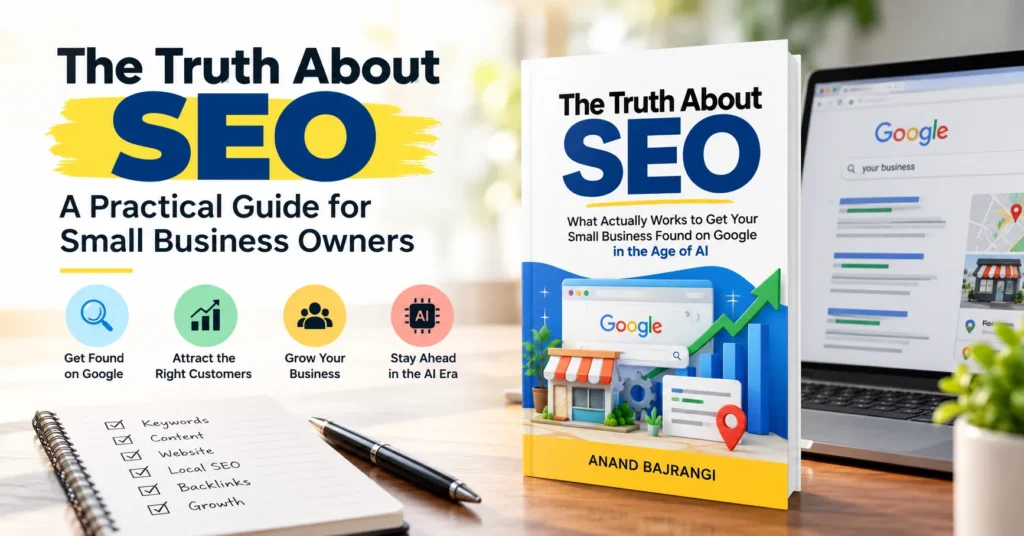
SEO should help your business get found by the right customers—not leave you confused by technical terms, ranking promises and conflicting advice. Search engine optimization (SEO) is the process of improving your website so search engines can discover and understand it, and so people can find useful information about your products or services.
For a small business, good SEO is not about getting the highest possible number of visitors. It is about reaching people who are looking for what you offer, answering their questions and making it easy for them to contact you or buy from you.
This guide explains what works, what to avoid and how to build a practical SEO plan. It is based on the central idea behind my book, The Truth About SEO: What Actually Works to Get Your Small Business Found on Google in the Age of AI: understand the basics, focus on customers and make decisions using evidence rather than promises.
What SEO really means for a small business
SEO helps search engines understand your website and helps potential customers discover it when they search for relevant products, services or information. It includes technical improvements, useful content, local visibility and building a credible online presence.
Imagine that you run a plumbing business in Melbourne. A person searches for “emergency plumber in Melbourne”. Your goal is not simply to make your website appear for the word “plumber”. You want the right service page or local business profile to appear for a relevant search, explain what you do and give the customer a clear way to call you.
That is the business purpose of SEO: relevant visibility that can lead to enquiries, bookings and sales.
How Google discovers and ranks pages
Search engines generally need to discover a page, crawl it and decide whether to index it before it can appear in search results. When someone searches, Google’s systems select and order results based on many signals, including relevance and quality. Not every page that is crawled will be indexed, and indexing does not guarantee a ranking.
- Discovery: Google finds URLs through links, sitemaps and other discovery methods.
- Crawling: Googlebot fetches a page so Google can process its content and resources.
- Indexing: Google analyses the page and may store it in its index.
- Serving results: When a person searches, Google’s systems select results that are relevant to the query and context.
For a practical explanation, read how search engines work, along with the guides to website crawling and indexing issues.
The three main areas of SEO
1. Technical SEO
Technical SEO helps search engines access and understand your website. It also supports a reliable experience for visitors. Start with:
- Important pages returning the correct HTTP status and not being blocked accidentally.
- Useful XML sitemap and sensible robots.txt settings.
- Correct canonical URLs and indexability settings.
- Mobile-friendly layouts and secure HTTPS connections.
- Fast, stable page experiences and working navigation.
- Clear site architecture and relevant internal links.
You do not need to fix every technical warning reported by every tool. Prioritise issues that stop important pages from being crawled, indexed, used or understood. Follow the technical SEO checklist and learn about Core Web Vitals.
2. On-page SEO and content
On-page SEO is about making each page useful and clear for its intended audience. A strong page should:
- Focus on a clear topic and match the reason behind the search.
- Use a descriptive page title and a clear main heading.
- Explain the service, product or question in plain language.
- Include helpful details, examples, limitations and next steps.
- Use descriptive subheadings, readable paragraphs and relevant images.
- Link naturally to related pages on your website.
- Give visitors a useful next action, such as calling, requesting a quote or viewing a product.
Learn more in the on-page SEO guide and content optimization guide.
3. Off-page SEO and reputation
Off-page SEO includes activities that help people and search engines understand your business’s reputation beyond your own website. Relevant editorial links, real customer reviews, credible industry references and genuine brand mentions can support trust and discovery.
Do not buy bulk links or use automated link schemes. Focus on useful relationships, strong resources and legitimate reasons for other websites to reference your business. Read backlinks explained and what is off-page SEO?
Keyword research: understand what customers are looking for
Keyword research is not a contest to find the biggest search-volume number. It is a way to understand the words and questions people use when they need a product, service or solution.
For each important topic, consider:
- Relevance: Does this search relate to something your business actually offers?
- Intent: Is the person learning, comparing options or ready to contact a provider?
- Location: Does the search have a local or service-area requirement?
- Competition: What type of pages currently appear, and can you create a genuinely better resource?
- Business value: If this visitor finds you, is there a realistic path to a lead or sale?
For example, “what is roof restoration?” is usually an informational search. “Roof restoration quote in Brisbane” shows a stronger service need. Both can matter, but they need different pages and calls to action.
Use customer conversations, your Search Console queries, competitor research and keyword tools to build a topic plan. Start with our guides to keyword research, search intent and finding low-competition keywords.
Create service pages that help customers decide
A common small-business website problem is putting every service on one general page. If customers search for different services, a single page may not answer their specific questions well enough.
A useful service page should explain:
- What the service includes and what it does not include.
- Who the service is suitable for.
- Which locations or areas you serve, where relevant.
- How the process works and what customers should expect.
- What makes your business qualified to provide the service.
- Answers to common questions, including relevant costs or factors that affect pricing.
- A clear contact, booking or quote option.
Create separate pages only when the services or customer needs are meaningfully different. Do not publish dozens of near-identical location pages with only the suburb name changed. Each page should provide real local value.
Local SEO: help nearby customers find your business
If your business serves a specific city, region or neighbourhood, local SEO deserves attention. A practical local SEO foundation includes:
- Google Business Profile: Claim and verify the profile, select accurate categories, add services and keep business details current.
- Consistent business information: Use the correct business name, address and phone number on your website and important directories.
- Reviews: Ask genuine customers for honest feedback and respond professionally. Never buy reviews or offer rewards for positive ratings.
- Local website content: Explain your service area, local experience and the practical details customers need.
- Relevant local references: Build real relationships with local organisations, suppliers and industry publications.
Do not create fake locations or use a virtual office to appear in areas where you are not eligible. Follow Google’s Business Profile rules. Explore the local SEO off-page guide for more ideas.
Backlinks: quality and relevance matter more than volume
A backlink is a link from another website to yours. Relevant editorial links can help people discover your business and provide useful context about your content. But there is no safe number of links that guarantees a first-page ranking.
Good ways to earn relevant links include:
- Publishing original research, useful guides or tools that others may reference.
- Contributing expert commentary to relevant publications.
- Building genuine relationships with suppliers, associations and local organisations.
- Creating useful resources for your customers and industry.
- Correcting broken links when your resource is a genuinely suitable replacement.
Avoid link farms, automated link packages, irrelevant guest-post networks and keyword-rich links created at scale. Read backlink quality vs quantity before investing in link building.
SEO in the age of AI: what has changed?
People increasingly use AI-powered search experiences and assistants to explore questions, compare options and find sources. Google also provides AI features within Search. This changes how some people discover information, but it does not mean that businesses should abandon SEO.
Google’s guidance for AI features points website owners back to its existing Search fundamentals. There is no special schema or secret file that guarantees inclusion in AI answers. Important pages still need to be accessible, indexable and useful. For AI search, make your expertise and evidence easy to understand:
- Answer the question clearly near the start of a relevant section.
- Support factual claims with trustworthy sources and real evidence.
- Show who created the content and why they are qualified to discuss it.
- Include original experience, examples, research or useful analysis.
- Keep your business information and important pages accurate.
- Allow the crawlers for the services where you want to be discoverable, based on your own content-use preferences.
AI systems can make mistakes and their answers can change. Do not promise customers guaranteed AI citations or claim that a particular GEO trick will secure visibility. Read SEO in the Age of AI and GEO vs SEO for more detail.
How to measure whether SEO is helping your business
Rankings alone do not tell you whether SEO is working. Measure visibility and business outcomes together.
| What to measure | Where to look | Why it matters |
|---|---|---|
| Impressions and clicks | Google Search Console | Shows how often pages appear and receive clicks from Google Search. |
| Queries and landing pages | Google Search Console | Shows which searches and pages are attracting visibility. |
| Organic sessions | Google Analytics 4 | Shows visits attributed to organic search. |
| Leads and sales | GA4, CRM or sales system | Shows whether visits lead to enquiries, bookings or purchases. |
| Local actions | Google Business Profile performance | Can show customer interactions such as calls, website visits and direction requests, depending on available reporting. |
| AI referrals and citations | Analytics and repeatable AI prompt checks | Helps you understand emerging discovery paths, but should be interpreted carefully. |
Set a baseline before making changes. Compare similar date ranges, consider seasonality and check whether tracking is working. A ranking increase is useful only when it supports the right audience and business goals.
How long does SEO take?
There is no fixed timeline for SEO results. A new page may be discovered quickly but take longer to earn visibility. Results depend on factors such as the website’s history, competition, technical condition, content quality, demand and the work being implemented.
Some technical fixes can make pages accessible sooner, but they do not guarantee rankings. Building useful content and a trusted reputation usually takes ongoing work. Be cautious of anyone promising a specific ranking or a guaranteed traffic result by a fixed date.
SEO myths that can waste your money
Myth 1: More keywords automatically mean better rankings
Repeating keywords unnaturally does not make a page useful. Write naturally, cover the topic clearly and use the language your customers understand.
Myth 2: Every business needs thousands of backlinks
There is no universal backlink target. Relevance, quality and the overall value of your website matter more than chasing a large number.
Myth 3: SEO guarantees the number-one position
No SEO provider can honestly guarantee a specific Google ranking. Search results change and Google controls its ranking systems.
Myth 4: Publishing more pages always brings more traffic
Publishing many thin, repetitive or unhelpful pages can waste resources and create quality problems. Publish when you have something useful to add.
Myth 5: AI-generated content automatically ranks or automatically fails
Google’s guidance focuses on the quality and purpose of content, not simply whether automation was used. Content produced mainly to manipulate rankings can violate spam policies. Human review, accuracy, originality and real value matter.
Myth 6: SEO is a one-time project
Websites, competitors, customer needs and search experiences change. Review performance and maintain important pages as part of normal business activity.
How to avoid SEO scams and choose an SEO provider
Before hiring an agency or consultant, ask for a clear explanation of the work and how results will be measured. Be careful with providers who promise:
- Guaranteed first position or a fixed number of rankings.
- Thousands of backlinks in a very short time.
- Instant organic traffic or guaranteed leads without understanding your business.
- Secret relationships with Google or access to private ranking factors.
- Reports that show rankings but hide traffic, leads, costs or actual work completed.
Ask these practical questions instead:
- What will you review before recommending a strategy?
- Which pages and search topics will you prioritise, and why?
- What work will be completed each month?
- How will you report clicks, qualified enquiries and conversions?
- Will I retain access and ownership of my website, analytics and Search Console?
- How do you build links and ensure the methods follow search engine policies?
A good SEO partner should explain risks, set realistic expectations and connect the work to your business goals.
A practical 90-day SEO action plan for small businesses
Days 1–30: Build the foundation
- Set up or review Google Search Console and analytics tracking.
- Check indexability, sitemap, robots.txt, redirects and important technical errors.
- List your main services, products, target customers and service locations.
- Research relevant customer searches and group them by intent.
- Improve your most important service or product pages.
- Review your Google Business Profile if you serve local customers.
Days 31–60: Improve content and customer experience
- Publish or improve pages that answer important customer questions.
- Add clear service details, proof, useful examples and calls to action.
- Improve internal links between related guides and service pages.
- Review mobile usability, page performance and contact forms.
- Build a process for requesting and responding to genuine customer reviews.
Days 61–90: Build authority and measure progress
- Publish one or more genuinely useful resources based on customer needs.
- Develop relevant partnerships and legitimate opportunities for editorial mentions.
- Review Search Console queries, pages, clicks and impressions.
- Check organic leads and sales, not just visits.
- Identify pages that need better content, stronger internal links or technical fixes.
- Prepare the next 90-day plan based on evidence from the first period.
This is a starting framework, not a promise that every business will achieve a particular ranking or traffic level in 90 days. Adjust the workload to your website, market and available resources.
Who should read The Truth About SEO?
I wrote The Truth About SEO: What Actually Works to Get Your Small Business Found on Google in the Age of AI for people who want to understand SEO without getting lost in jargon or unrealistic claims.
It may be useful for:
- Small business owners and local service providers.
- Startup founders and entrepreneurs.
- Freelancers and consultants.
- Marketing professionals and beginners learning SEO.
- Website owners who want to understand what an SEO agency is doing.
The book covers search engine basics, keyword research, service pages, technical SEO, backlinks, local SEO, AI and a structured 90-day action plan. It is intended as a practical learning resource, not a promise of guaranteed rankings.
Get your copy of the book
The Truth About SEO: What Actually Works to Get Your Small Business Found on Google in the Age of AI is available as an ebook.
Google Play Books:
Read the book on Google Play
Amazon India:
Buy the book on Amazon India
If you want to improve your website, start with the basics: understand your customers, publish useful information, make your website technically sound, build genuine trust and measure what leads to business results.
Frequently asked questions about SEO for small businesses
Can a small business do SEO without an agency?
Yes. Business owners can handle many basics, such as improving service information, maintaining a Google Business Profile, collecting genuine reviews and monitoring Search Console. Technical or competitive projects may need specialist support.
Is SEO free?
Organic search listings do not require paying Google for each click, but SEO still takes time and resources. Costs may include staff time, content, development, tools or professional services.
Should I focus on SEO or paid advertising?
They serve different roles. Paid ads can provide visibility while a campaign is active. SEO can build longer-term organic visibility but usually requires consistent work. The right mix depends on your budget, sales cycle and business goals.
How many keywords should one page target?
There is no fixed number. Build a page around one clear topic and the related questions that belong together. Avoid forcing unrelated keywords onto the same page.
Do I need a blog for SEO?
Not every business needs a large blog. Publish articles when they answer real customer questions, explain your expertise or support a buying decision. Useful service and product pages may be more important than frequent blog publishing.
Does Google Business Profile help local SEO?
A complete and accurate Google Business Profile helps eligible businesses appear in Google Maps and local search experiences. Keep details current and follow Google’s eligibility and representation guidelines.
Can AI replace SEO?
No. AI is changing how people search and consume information, but businesses still need discoverable websites, useful content and credible information. Keep improving your SEO foundations while adapting to new search experiences.
Final thoughts
SEO does not need to be mysterious. You do not need to chase every new tactic, publish hundreds of pages or buy large backlink packages. You need to understand what your customers are searching for, create the best useful answer you can, make your website accessible and build a reputation people can trust.
Measure progress with real data and keep improving. That is a more reliable approach than chasing shortcuts or guaranteed rankings.