
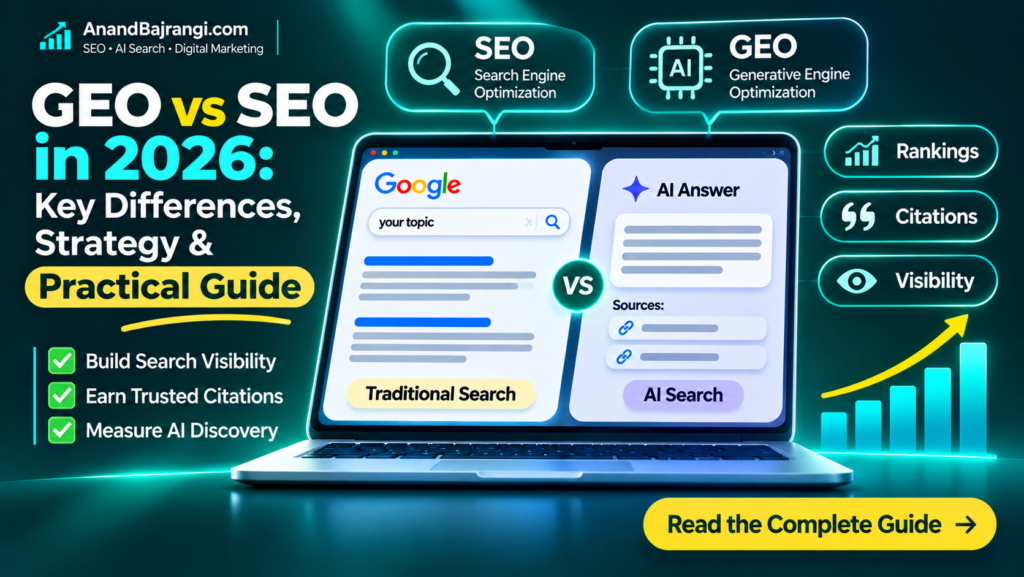
Quick answer: SEO helps your website appear in traditional search results. Generative Engine Optimization (GEO) is the work of making your content useful, clear and credible enough to be discovered, selected or cited in AI-generated answers. They are not competing strategies. Strong technical SEO, helpful content and a trusted online presence are the foundation for visibility in both.
If you have heard that “SEO is dead” and every business now needs GEO, do not rush to replace your SEO strategy. Search engines and AI assistants are changing how people discover information, but the basics still matter: your pages must be accessible, understandable and genuinely useful.
This guide explains the difference between SEO and GEO, what current search platforms say about AI visibility, and a practical plan you can use for a business website, local service, e-commerce store or content site.
What is SEO?
Search Engine Optimization (SEO) is the process of improving a website so search engines can discover, understand and show its pages for relevant searches. The aim is to earn qualified visibility and bring visitors who may become leads, customers or readers.
SEO work usually covers three connected areas:
- Technical SEO: Make pages crawlable and indexable. Improve site structure, mobile usability, page experience, HTTPS and performance. See the technical SEO guide.
- On-page SEO: Publish useful content that matches search intent. Use clear titles, headings, descriptive URLs and relevant internal links. Read the on-page SEO guide.
- Off-page SEO: Build a real reputation through relevant links, genuine mentions, reviews and other credible references. Learn more in the off-page SEO guide.
SEO is not simply adding keywords to a page. It is making the best answer easy to find, understand and trust.
What is GEO?
Generative Engine Optimization (GEO) is a commonly used term for improving the chance that a website, brand or piece of information is discovered, referenced or cited by AI-powered search and answer experiences.
Examples include:
- Google AI Overviews: AI-generated summaries that can appear within Google Search.
- Google AI Mode: A conversational search experience for questions, comparisons and follow-up exploration.
- ChatGPT search: ChatGPT responses that search the web and may include links to sources.
- Perplexity and Microsoft Copilot: AI experiences that can retrieve and cite web content.
- Gemini: Google’s AI assistant, which can use web information in supported experiences.
GEO is not a single ranking system with a public checklist. Each product has its own systems, data sources and ways of selecting information. The practical approach is to publish reliable content, maintain strong SEO foundations and make your expertise easy to verify.
SEO vs GEO: the key differences
| Area | SEO | GEO |
|---|---|---|
| Main objective | Improve visibility in search results and earn relevant clicks. | Improve the chance of being referenced or cited in AI-generated answers. |
| Where visibility appears | Organic listings, local results, images, videos and other search features. | AI summaries, conversational answers and AI search citations. |
| What is evaluated | Page relevance, quality, accessibility, reputation and many other signals. | Relevant information that an AI product retrieves and chooses to use; selection methods differ by platform. |
| Content focus | Meet search intent with complete, useful pages. | Make accurate answers, evidence and context clear within useful content. |
| Measurement | Search impressions, clicks, CTR, rankings and conversions. | AI citations and mentions, AI referral visits, assisted conversions and relevant platform reports. |
| Best starting point | Technical health, helpful content and relevant authority. | The same SEO foundations, supported by clear evidence and a recognisable brand. |
The distinction is useful, but it should not be exaggerated. GEO does not replace SEO, and there is no guaranteed formula that makes an AI system cite a particular page.
How AI search can find and cite website content
AI search experiences can retrieve information from web indexes and other sources, then use that information to prepare a response. Google’s documentation explains that AI Overviews and AI Mode may use a technique called query fan-out: a user’s question can lead to several related searches across subtopics. The system can then surface supporting pages from a wider range of sources.
For Google AI features, a page must meet Google’s Search technical requirements and be indexed and eligible to appear with a snippet. Google says there are no additional technical requirements or special schema needed specifically for AI Overviews or AI Mode. Meeting the requirements does not guarantee that a page will be shown.
Other platforms work differently. For example, OpenAI documents OAI-SearchBot as the crawler used to surface websites in ChatGPT search. OpenAI says sites that opt out of OAI-SearchBot will not be shown in ChatGPT search answers, although they may still appear as navigational links. GPTBot is a separate crawler used for potential model training. These controls should not be confused.
Official references: Google: AI features and your website and OpenAI: Overview of OpenAI crawlers.
Where SEO and GEO overlap
Most of the work that supports GEO is familiar SEO work. Google’s guidance says the same SEO fundamentals remain relevant for AI features. Focus on the following:
- Allow discovery and crawling: Check robots.txt, server rules, CDN settings and internal links. Do not accidentally block important pages.
- Make important pages indexable: Review noindex directives, canonical tags and Search Console indexing reports.
- Answer real questions: Understand what your customers need to know and create content that solves the problem clearly.
- Show first-hand experience: Include original examples, practical steps, genuine case studies and relevant expert input.
- Make information easy to understand: Use descriptive headings, concise explanations, lists and comparison tables where they help readers.
- Keep business information accurate: Maintain consistent details on your website, Google Business Profile and important directories.
- Use structured data correctly: Add relevant schema when it describes visible page content and supports an appropriate search feature. There is no special GEO schema required.
- Support claims with evidence: Link to primary sources for statistics, laws, medical information and technical claims. Keep facts and dates current.
Explore related resources: E-E-A-T in SEO, robots.txt, structured data and schema markup and internal linking.
What should you do differently for GEO?
You do not need to rewrite every page for AI. Instead, improve the usefulness and clarity of the content you already need for your audience.
- Put the direct answer near the top. Start a section with a clear response, then explain the reasoning, context and exceptions.
- Use specific, verifiable information. Replace vague claims with real data, named sources, dates and examples. Never invent statistics or customer results.
- Explain who is responsible for the content. Add accurate author details and relevant professional credentials. For health, legal and financial topics, use qualified review where appropriate.
- Cover the complete decision. Include relevant costs, limitations, comparisons, risks and next steps instead of creating many thin pages for similar questions.
- Build a trustworthy brand beyond your website. Earn genuine customer reviews, useful industry coverage and relevant links. Avoid paid fake mentions, spam and mass-produced profile links.
- Make key information accessible in text. Do not hide essential facts only inside images, videos or interactive elements.
- Keep content maintained. Review important pages when products, regulations, prices, platform features or research changes. Update dates only when the content has genuinely been reviewed.
Google specifically advises against chasing GEO shortcuts such as unnecessary AI text files, special AI schema, forced content chunking or inauthentic mentions. Its systems are designed to reward useful content and filter spam, not reward an acronym or a formatting trick. See Google’s guide to generative AI features in Search.
Does your business need SEO, GEO or both?
Most organisations should continue investing in SEO and apply GEO-friendly content practices as part of the same programme. The balance depends on how customers research and choose your service.
| Business type | Practical priority | What to focus on |
|---|---|---|
| Local businesses | SEO first; strengthen AI discoverability alongside it. | Google Business Profile, service-area pages, genuine reviews, accurate contact details and clear answers to local customer questions. |
| Healthcare practices | Strong SEO and high standards for accuracy and trust. | Qualified authors and reviewers, clear service information, credentials, patient-friendly explanations and ethical claims. |
| Law firms | SEO and reputation building, with useful educational content. | Jurisdiction-specific guidance, attorney profiles, citations to primary legal sources and clear disclaimers. |
| E-commerce | Product and category SEO, with complete product information. | Accurate product data, specifications, pricing, availability, shipping and returns information, plus genuine reviews. |
| B2B and SaaS | SEO plus evidence-led decision content. | Original research, transparent comparisons, use cases, case studies and detailed product documentation. |
| Blogs and publishers | SEO plus distinctive editorial value. | Original reporting, first-hand experience, expert commentary, useful analysis and direct audience relationships. |
A practical 30-day SEO and GEO action plan
Week 1: Check your foundations
- Verify the website in Google Search Console and Bing Webmaster Tools.
- Review indexing, robots.txt, canonical tags, sitemap and important internal links.
- Check that important pages load properly on mobile and that essential content is available as text.
- Review whether your site settings allow the AI search experiences you want to appear in.
Week 2: Improve your most important pages
- Choose five pages that support your main services, products or audience questions.
- Make each page’s purpose and direct answer clear near the beginning.
- Add genuine examples, author information, relevant evidence and useful FAQs.
- Improve internal links and remove outdated or unsupported claims.
Week 3: Strengthen your reputation
- Improve your business profiles and keep core business details consistent.
- Ask real customers for honest reviews without offering rewards for positive ratings.
- Look for relevant partnerships, expert contributions and legitimate industry coverage.
- Publish original insights that other websites may find useful to reference.
Week 4: Measure and refine
- Record organic clicks, impressions, CTR and conversions in Search Console and analytics.
- Check available AI search reporting in Search Console for your property.
- Review referral traffic from AI assistants in your analytics platform.
- Test a consistent set of real customer questions across relevant AI tools and record whether your brand or pages are cited. Treat these tests as directional because answers can vary.
- Choose the next pages to improve based on business value and actual performance data.
How to measure SEO and AI visibility
| Metric | Where to check | What it tells you |
|---|---|---|
| Organic impressions, clicks and CTR | Google Search Console Performance report | How your pages perform in Google Search overall. |
| Search queries and landing pages | Google Search Console | Which topics bring visibility and which pages need improvement. |
| AI feature visibility | Search Console AI reporting, where available | Performance data for supported Google generative AI experiences. |
| AI assistant referral sessions | GA4 or another analytics platform | Visits that arrive from AI assistant referrals when the source is identifiable. |
| Leads and sales | CRM, analytics and conversion tracking | Whether search visibility contributes to business outcomes. |
| AI citations and brand mentions | Repeatable manual prompt checks or specialist monitoring tools | Whether selected AI experiences mention or link to your business for important questions. |
Do not treat one AI answer or a third-party “AI visibility score” as a ranking measurement. AI responses can change by prompt, location, time and product. Use repeatable checks and connect them to traffic, leads and sales.
Common GEO myths to avoid
- “SEO is dead.” No. Search fundamentals remain important for both traditional and AI-powered discovery.
- “You must publish an llms.txt file.” Google says it does not use llms.txt as a special requirement for Search or AI features.
- “Every article must be split into tiny chunks.” There is no such requirement. Organise content for readers and the topic.
- “There is special schema for GEO.” Google says no special structured data is required for AI Overviews or AI Mode.
- “More online mentions always mean better visibility.” Focus on genuine, relevant reputation. Spam and inauthentic mentions are not a sound strategy.
- “A tool can guarantee AI citations.” No legitimate tool can guarantee that an independent AI system will cite a particular page.
Frequently asked questions
Is GEO replacing SEO?
No. GEO is a newer term for work aimed at improving visibility in generative AI experiences. Strong SEO fundamentals remain important, especially for Google’s AI features.
What is the difference between GEO and AEO?
AEO usually means Answer Engine Optimization and can include featured snippets, voice answers and direct-answer experiences. GEO focuses more specifically on generative AI systems. The terms overlap, and there is no universally agreed boundary between them.
Does Google require special GEO techniques?
No special optimization or schema is required for AI Overviews or AI Mode. Google recommends following its existing technical and content best practices.
Does structured data help with GEO?
Use structured data when it accurately describes visible page content and supports an appropriate search feature. Google says special structured data is not required for its AI features.
Should I block GPTBot or OAI-SearchBot?
They have different purposes. OpenAI documents OAI-SearchBot for ChatGPT search and GPTBot for potential model training. Review the official crawler documentation and decide based on your publishing and content-use preferences.
How long does GEO take to work?
There is no reliable fixed timeline. Crawling, indexing, reputation and AI product behaviour all affect visibility. Track progress over time rather than expecting a guaranteed result in a set number of days.
Can a small business appear in AI answers?
Yes, it is possible, but not guaranteed. A small business can publish useful local expertise, clear service information, original examples and trustworthy evidence. These improvements also help potential customers who visit the website directly.
Final thoughts: build one strong search strategy
SEO and GEO should not be treated as two separate marketing systems fighting for budget. SEO helps people and search engines discover your website. Clear, evidence-led content and a trustworthy brand can also make your information more useful to AI-powered search experiences.
- Start with SEO: fix crawlability, indexing, site structure and helpful content.
- Improve answer quality: give direct answers, cite reliable sources and show real experience.
- Build genuine authority: earn relevant reviews, references and industry recognition.
- Measure outcomes: track visibility, qualified visits, leads and sales—not just AI mentions.
The best long-term strategy is simple: create the most useful and trustworthy resource for your audience, make it easy to discover, and measure whether it helps your business.
Want to understand where your website stands? Request a free SEO audit to review your technical SEO, content and search visibility.