
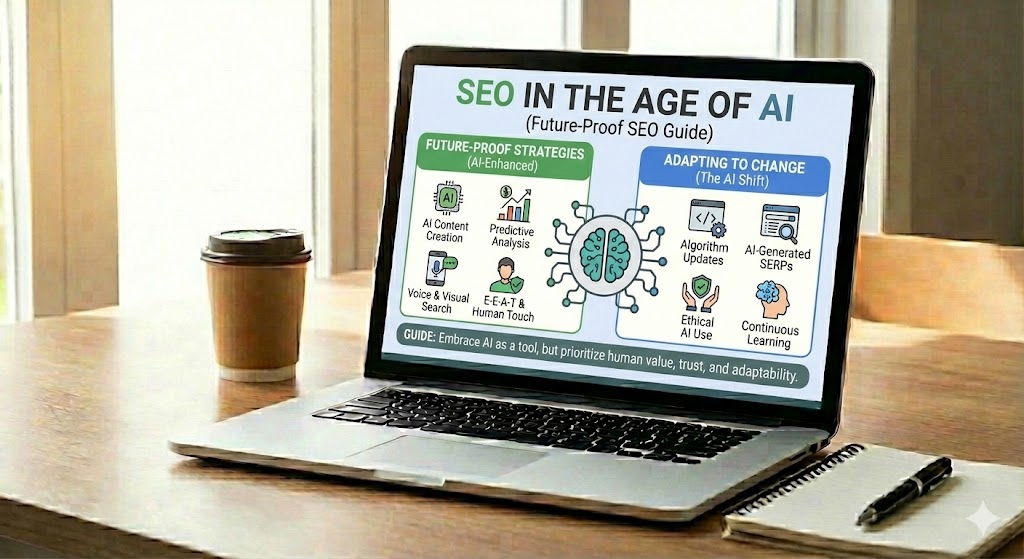
Quick answer: SEO is still relevant in the age of AI. Google’s AI Overviews and AI Mode use information from Google Search and link to supporting websites. Google’s current guidance says the same core SEO foundations apply: make pages crawlable and indexable, publish original and useful information, and give people a good experience. There is no special AI schema, “AI file” or guaranteed shortcut that makes a page appear in an AI answer.
Related technical development: Read about the proposed AI training control in robots.txt and how publishers may communicate training preferences to participating AI providers.
AI is changing how people discover information, compare services and make decisions. But the practical work for website owners is not to abandon SEO and chase every new acronym. It is to build a website that deserves to be found, understood, trusted and visited.
In this guide, we explain what has changed, what remains important, and how businesses, publishers and SEO teams can adapt their work without wasting time on unproven tactics.
1. What does SEO mean in the age of AI?
Search engine optimization (SEO) is the process of improving a website so search engines can discover, understand and show its pages to people looking for relevant information, products or services.
In the age of AI, people may find information through traditional search results, AI-generated summaries, conversational search experiences and other answer tools. The interface is changing, but websites still need to provide accessible, useful information. AI systems also need sources they can retrieve and evaluate.
That means modern SEO has two connected goals:
- Earn search visibility: help the right pages appear for relevant searches.
- Earn meaningful visits and trust: give people a good reason to click, read, contact, subscribe or buy.
2. What has changed in search?
AI Overviews and AI Mode
Google AI Overviews can provide an AI-generated summary for some searches, with links to relevant websites. AI Mode supports longer questions and follow-up exploration. The features do not appear for every query, and the sources and links can vary between searches.
For a website, this creates both an opportunity and a challenge. A useful page may be discovered as a supporting source, but a person may also get part of an answer without clicking through. Do not assume every AI appearance will produce a visit. Measure the outcomes that matter to your business.
People ask more detailed questions
Conversational tools make it natural to ask a detailed question, add constraints and ask follow-ups. A customer might move from “best accounting software” to “compare accounting software for a small retail business with two branches”. Your content should address the real decision, not just repeat a broad keyword.
More content is being produced
AI tools make it easier to create drafts and summaries. This also makes it easier to publish large volumes of similar, low-value pages. Google’s spam policies address scaled content abuse when many pages are created mainly to manipulate search rankings, regardless of whether people, automation or a combination produced them.
3. What has not changed?
Search engines still need to discover, crawl, render, index and evaluate web pages. A technically blocked page or a page that provides little value does not become useful simply because it mentions AI-related terms.
- Discovery: search engines find URLs through links and other discovery paths, including XML sitemaps.
- Crawling: automated crawlers request pages, subject to access rules, server availability and technical limits.
- Rendering: systems process page content and, where needed, JavaScript.
- Indexing: search engines decide whether and how a page should be stored and represented.
- Ranking and selection: systems determine which results or supporting links are useful for a particular query.
For a deeper explanation, read our guides to how search engines work, website crawling and indexing issues and fixes.
4. Do you need special SEO for AI Overviews and AI Mode?
For Google’s AI features, Google says there are no additional technical requirements or special optimizations beyond the normal requirements for appearing in Search. A page must be indexed and eligible to appear with a snippet. Meeting those requirements does not guarantee that Google will crawl, index or show a page.
You do not need special schema, an AI-only text file or a separate version of your content to qualify for AI Overviews or AI Mode. Keep using structured data where it is appropriate for your website and eligible search features, and make sure it accurately reflects visible page content.
This is an important distinction: you can improve the quality and accessibility of your website, but no agency or tool can honestly guarantee a citation in an AI-generated answer.
5. A practical SEO strategy for the age of AI
Step 1: Start with the audience and its real questions
Talk to customers, sales teams and support teams. Review Search Console queries, site-search terms, customer emails, reviews and sales calls. Identify the problems people are trying to solve, the comparisons they make and the concerns that stop them from taking action.
Group questions by intent. Someone learning about a topic needs a clear explanation. Someone comparing providers needs differences, trade-offs and evidence. Someone ready to buy needs pricing information, service details, availability and a clear next step.
Step 2: Give a clear answer, then explain it properly
Make the main purpose of each page clear near the beginning. Use descriptive headings and a logical order. Answer the central question directly, then add the detail, examples, limitations and next steps that a reader needs.
Do not force every answer into a short paragraph or a fixed word count. A comparison, tutorial, service page and research article need different formats. Choose the format that best helps the reader complete the task.
Step 3: Add first-hand experience and original value
Do more than rewrite information that is already available on other websites. Add original analysis, practical examples, product tests, screenshots, process details, lessons from real projects or interviews with people who know the subject.
For example, an SEO agency could explain how it diagnosed a crawl problem, what it changed and how it measured the result. Remove client-identifying details unless the client has agreed to share them. Never invent case studies, results or testimonials.
Step 4: Make authorship and trust clear
Show who is responsible for the content. Use accurate author information, relevant qualifications or experience, editorial review where appropriate, and clear contact or company details. Cite primary sources for important claims and update information when it changes.
These practices support the broader principles often discussed under E-E-A-T: experience, expertise, authoritativeness and trust. E-E-A-T is a useful quality framework, not a simple score that a website can add to a page.
Step 5: Build a useful internal-link structure
Connect related pages so visitors can move from an introduction to a detailed guide, comparison or service page. Use descriptive anchor text and link only when the destination genuinely helps the reader.
A topic cluster can have one comprehensive guide supported by focused articles. Avoid creating dozens of near-identical pages just to target small keyword variations. Review our internal linking strategy for practical guidance.
Step 6: Keep technical SEO healthy
Check that important pages can be crawled and indexed. Review robots.txt, canonical tags, redirects, XML sitemaps, mobile usability, HTTPS, page speed and server errors. Make important information available as text and use relevant images or video when they improve the page.
Use structured data only when it fits the content and the relevant search feature. The markup must match what visitors can see. It does not guarantee a rich result or an AI citation. Explore our guides to Core Web Vitals and structured data and schema.
Step 7: Build a real reputation beyond your website
Earn relevant editorial coverage, genuine customer reviews, useful industry relationships and links from websites that make sense for your audience. Focus on work that people would value even if search engines did not exist. Avoid paid or manipulative link schemes and fabricated mentions.
6. What should different types of businesses do?
Local and service businesses
- Keep your Google Business Profile accurate, including services, hours, contact details and service areas.
- Publish clear service pages that explain who you help, what is included, where you work and how customers can contact you.
- Ask customers for honest reviews and respond professionally.
- Show real project examples, team expertise, service processes and locally relevant information.
- Keep business details consistent across important directories and trusted local sources.
Ecommerce websites
- Write accurate product descriptions with specifications, sizing, compatibility and use cases.
- Use original product photographs and helpful demonstrations where possible.
- Keep price, stock, shipping, returns and merchant information current.
- Make product variants and category navigation understandable to users and crawlers.
- Use relevant product structured data and Merchant Center features correctly.
Publishers, bloggers and content teams
- Prioritise topics where you can add expertise, reporting, analysis or a genuinely useful perspective.
- Review older articles for accuracy, outdated advice, broken links and missing context.
- Combine overlapping pages when doing so creates a better resource for readers.
- Use clear authorship and cite original research or official documentation.
- Do not publish unreviewed AI drafts or mass-produce pages that add no meaningful value.
7. A sensible way to use AI in SEO
AI can support research, outlining, clustering, content briefs, data analysis, coding assistance and editing. Treat it as an assistant, not as a replacement for subject knowledge or editorial responsibility.
- Use AI to organise research, but verify facts against reliable sources.
- Use it to create an outline, then add original examples and expert input.
- Review every claim, statistic, quotation, link and recommendation before publishing.
- Protect confidential client and customer information.
- Do not create pages at scale simply to capture search variations.
The key question is not whether AI helped create a page. It is whether the finished page is accurate, original, useful and made for people.
8. How to measure SEO performance as search changes
Do not judge success using rankings alone. Use a combination of visibility, engagement and business outcomes.
- Search Console: review clicks, impressions, click-through rate, queries, pages and search appearance data available in your property.
- Analytics: measure engaged visits, lead forms, calls, purchases, revenue and other meaningful conversions.
- Business reporting: compare lead quality, sales pipeline, customer acquisition and revenue with your SEO work.
- AI visibility checks: monitor relevant AI search experiences as a qualitative research exercise, but remember that answers can vary by query, location, language and time.
Google reports traffic from AI features in Search Console’s overall Performance reporting under the Web search type. Use the available filters and reports in your property, and avoid assuming that every AI-related visit or citation can be isolated as a separate metric. For business outcomes, connect search data with analytics and CRM reporting.
9. GEO, AEO and SEO: what do the terms mean?
You may see the terms AEO (answer engine optimization), GEO (generative engine optimization) and LLMO (large language model optimization). They are industry terms used to describe efforts to improve visibility in answer engines and AI-powered systems. Definitions vary between practitioners.
These labels can help teams discuss new discovery channels, but they are not a replacement for a sound SEO strategy. Google’s guidance describes optimization for its generative AI search experiences as part of the broader work of optimizing for Search. Read our comparison: GEO vs SEO.
10. A 30-day action plan
| Time | Priority | Actions |
|---|---|---|
| Week 1 | Technical health | Review Search Console, important URLs, indexing, crawl access, sitemaps, redirects and mobile experience. |
| Week 2 | Content quality | Choose priority pages, check search intent, update inaccurate information and add original examples or evidence. |
| Week 3 | Site structure | Improve internal links, connect related resources and strengthen important service, product or category pages. |
| Week 4 | Measurement | Review clicks, impressions, conversions and lead quality. Record a baseline and set the next improvement priorities. |
Frequently asked questions
Is SEO dead because of AI?
No. Search is evolving, but websites still need to be discoverable, technically accessible and useful. Google says its AI search features are built on its core Search systems and that SEO best practices remain relevant.
Do I need special schema to appear in Google AI Overviews?
No. Google says there is no special schema or additional markup required for AI Overviews or AI Mode. Use structured data when it accurately describes visible content and supports an eligible search feature.
Does publishing AI-written content hurt SEO?
Using AI as a writing or research aid does not automatically make content harmful. The finished content must be accurate, useful and compliant with Search policies. Producing many low-value pages mainly to manipulate rankings can violate Google’s scaled content abuse policy.
Can I guarantee that ChatGPT or Google will cite my website?
No. AI answers and their source links can change. You can improve your site’s quality, accessibility, reputation and relevance, but no legitimate SEO method can guarantee a citation or a specific position.
Should I create an llms.txt file for Google?
Google’s current guidance says you do not need an llms.txt file or other special AI text file for inclusion in Google Search’s generative AI features. Other services may have their own guidance, so check the documentation for each platform you want to support.
How long does it take to see results?
There is no fixed timeline. Search engines need to recrawl and process changes, and performance depends on competition, site condition, content quality and demand. Track progress over time rather than expecting an immediate ranking change.
Final thoughts
The age of AI does not remove the need for SEO. It raises the value of useful information, technical clarity, original experience and trust. Focus on helping people make better decisions, keep your website easy to access and measure the results that matter to your business. These are stronger long-term priorities than chasing a new AI ranking trick.