
This guide is for people who are new to SEO for Beginners and want a clear, simple path to follow. You may be a small business owner, a student, or someone who just built a new website. If you feel lost when you hear words like algorithm or organic search, this guide will help you understand them in plain language.
You will learn what SEO is, how search engines find and sort web pages, and how to choose the right words people type into search boxes. You will also see how to write helpful content, improve your pages, and fix simple technical issues so search engines can see your site.
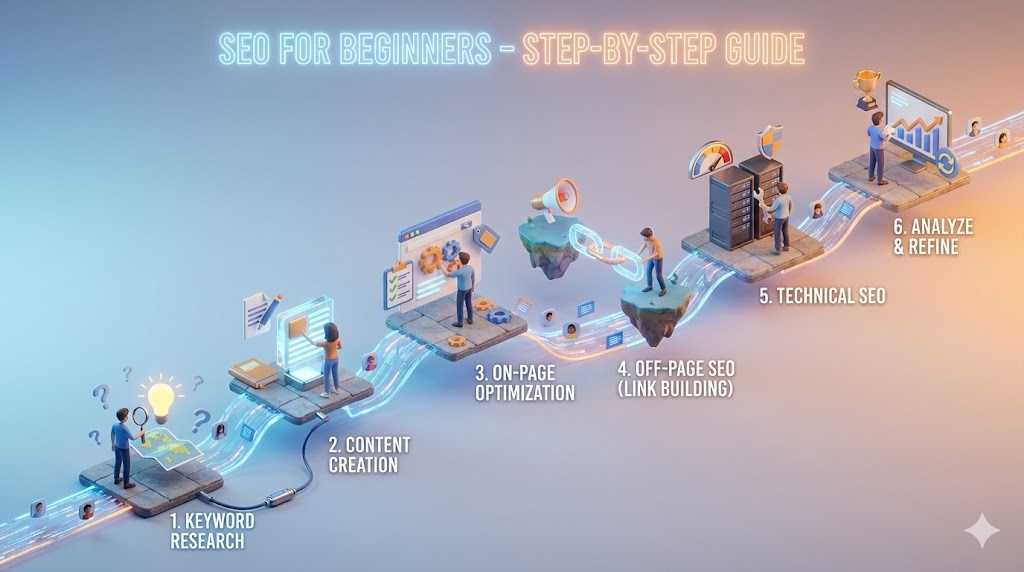
Step by step, you will discover how to optimize your pages, build trust with other sites, and track what is working over time. By the end, you will have a structured checklist you can follow, even if you have never done SEO before, so you can start improving your visibility in search results in a steady, simple way.
Comprehensive SEO for Beginners: A Structured Step-by-Step Guide
Many sites stay invisible not because they are bad, but because there is no clear plan behind them. Instead of guessing what might work, you can follow a simple routine that you repeat for every page. This section turns scattered SEO advice into one structured process you can apply again and again.
Begin by writing down a short checklist you will follow every time you publish or update a page. Include items such as your target search phrase, the page goal, and the main user question. When each new page passes the same checks, your whole site becomes easier for both people and search engines to understand.
To keep your work organized, group tasks into three daily habits: planning, improving, and checking. Planning means choosing topics and basic keywords. Improving means editing titles, text, and links. Checking means reviewing simple data like visits and time on page. Over time, this routine builds a strong base without needing advanced tools.
- Plan: choose a clear topic and one main search phrase.
- Write: answer the user’s question in plain language.
- Polish: fix headings, links, and basic structure.
- Review: look at results and update weak pages.
When you feel stuck, improve just one small thing at a time, such as making the title clearer or adding one helpful example. These tiny but steady changes often matter more than rare big overhauls because they build a habit of continuous optimization. Step by step, your site becomes more useful, and that usefulness is what search engines aim to reward.
Understanding the Basics of SEO for Beginners
Before you dive into tools or tactics, it helps to understand what SEO is really trying to do. Every search begins with a question and ends with a result, and your job is to make your pages the best possible match in between. Once you see this simple flow, the rest of the guide feels more natural and less overwhelming.
At its heart, SEO is about helping search engines match a page with the right person. The goal is not tricks; it is to make your pages clear, easy to read, and easy to find so they can appear for the searches they truly deserve.
There are three basic ideas to keep in mind as you start:
- Relevance: how closely your page matches what a person is looking for.
- Quality: how helpful, trustworthy, and easy to read your content is.
- Access: how easily search engines can reach and understand your pages.
These simple concepts guide every future action: choosing a topic, picking words, writing text, and improving your site structure. When you feel unsure later, return to this base and ask, “Does this change make my page more relevant, higher quality, or easier to access?”
How Search Engines Work and Why It Matters
Knowing the basics of relevance, quality, and access naturally leads to the next question: how do search engines actually use this information? Behind every result page is a system constantly discovering, storing, and sorting billions of pages. By understanding that system, you can see where your site might be getting stuck.
Imagine a huge library where new books appear every second. How does the librarian know what each book is about and which one to hand you when you ask a question? That is very close to how modern search systems behave on the web.
Behind every result page, three main actions happen again and again: crawling, indexing, and ranking. Understanding these actions helps you see why some pages get seen and others stay invisible.
Crawling is when automated programs, often called bots or crawlers, travel from link to link, discovering new and updated pages. Indexing is the step where the system stores and organizes information it has found, a bit like making detailed cards in a catalog. Ranking happens when someone searches, and the system decides which indexed pages to show first based on relevance, quality, and many other signals.
- Crawling: finding pages through links and sitemaps.
- Indexing: saving and understanding page content.
- Ranking: ordering results to answer a searcher’s need.
For SEO for Beginners, this matters because each step can fail or succeed. If bots cannot reach your page, it will not be indexed. If it is indexed but unclear, it may not rank for the right searches. Your job is to make every page easy to discover, simple to understand, and clearly useful so it can earn its place in results over time.
Keyword Research Fundamentals for SEO for Beginners
Once you know how search engines discover and rank pages, the next step is to speak the same language as your audience. The words people type into the search box are the bridge between their questions and your answers. Keyword research helps you find those words before you create or update a page.
Have you ever written a page that felt useful, but almost nobody visited it? Often the missing piece is choosing the right words people actually type into the search box. Keyword research is how you discover those words before you start writing or updating a page.
Think of this step as simple listening. Instead of guessing what people want, you look at real phrases they use and then shape your content to match their needs. This makes your pages more relevant and gives search engines clear signals about when to show them.
At a basic level, you are trying to find three things: the main phrase your page should target, a few close variations, and simple questions your reader might ask. Together, these guide your titles, headings, and examples so the page feels like a direct answer, not a random article.
- Main keyword: the central phrase that sums up the topic.
- Supporting phrases: similar searches with slightly different wording.
- Question keywords: phrases that start with “how,” “what,” or “why.”
Begin with everyday language. Ask yourself, “If I needed this, what would I type?” Then check how people actually phrase it using simple tools or search suggestions. Over time, this habit turns random writing into purposeful content that can steadily earn more organic visits.
Creating Helpful, User-Focused Content
Finding the right keywords is only useful if the page that follows truly helps the reader. Search engines increasingly reward content that satisfies real needs, not just pages that repeat phrases. This section shows how to turn your topics and keywords into clear, practical answers.
Think about the last time you stayed on a page and actually finished reading it. It probably answered your question clearly, without wasting your time. That is the kind of user-focused content that can slowly earn trust from both people and search engines.
Instead of asking, “How do I rank?”, start by asking, “What does the visitor really need right now?” When every page is built around that need, your keywords, structure, and examples become tools to help the reader, not tricks to chase rankings.
At a simple level, a helpful page usually does four things well:
- States the main question early in the text.
- Gives a clear, direct answer near the top.
- Adds details, steps, or examples for people who want more.
- Guides the reader to a next action, such as a related page or a simple checklist.
For example, a guide on “how to fix a leaking tap” should show the basic fix in a few short steps before diving into tools, causes, or advanced tips. In this way, the most important help comes first, and extra detail supports the main answer instead of hiding it.
On-Page Optimization Techniques for SEO for Beginners
Even strong content can underperform if the page itself is hard to scan or understand. On-page optimization is about presenting your helpful content in a way that is easy for both people and search engines to read. By adjusting a few visible elements, you can make each page clearer and more focused.
Have you ever clicked a result that looked promising, only to find a messy page that was hard to read? On-page work is about shaping each page so both visitors and search systems can quickly see what it offers and why it matters.
Instead of changing your whole site at once, focus on one page at a time. By improving titles, headings, text, and links in a consistent way, you turn plain pages into clear, focused answers that can better earn visibility.
Begin with your page title and main heading (H1). Include your main phrase once, keep them short, and make them promise a simple benefit. Next, use lower headings to break long text into small parts so readers can scan and find what they need fast.
Inside the text, place your main phrase and a few related terms in a natural way, without repeating them too often. Add internal links that point to other helpful pages on your site so crawlers and people can move through your content like a clear path instead of a dead end.
Essential Technical SEO Elements for a Healthy Website
Good structure and clear content still need a solid technical base to be seen. Behind every page, there are quiet settings and files that control how easily search engines and users can access your site. Paying attention to a few simple technical checks helps protect all the work you put into your content.
Pages can be clear and well written yet still stay hidden if simple “behind the scenes” issues block them. A few basic checks on how your site is built can prevent these quiet problems and keep your content visible.
For beginners, focus on a small set of core technical SEO elements that affect how easily bots and people use your site. You do not need to be a developer; you only need to know what to watch for and when to ask for help.
First, make sure search systems can actually reach your pages. Check that a basic sitemap exists, your important URLs return a normal 200 status code, and you are not blocking key pages with a wrong robots.txt rule or noindex tag.
Next, protect user experience. A healthy site loads fast, works on phones, and avoids broken links. Simple habits like compressing large images, using short, clean URLs, and fixing “404 not found” errors go a long way toward keeping your technical base strong.
Tracking, Measuring, and Improving Your SEO Over Time
After putting content, on-page, and technical pieces in place, the final step is to see what actually changes. Tracking simple numbers helps you understand which efforts pay off and which need adjustment. This turns SEO from guessing into a repeatable learning process.
Have you ever updated a page and then simply hoped it would “do better”? To move beyond hope, you need a light, simple way to see what is changing. Basic tracking turns random tweaks into a clear learning loop you can repeat.
Start with a few core signals: total visits from search, which pages get the most views, and which phrases bring people in. You do not need complex dashboards; a simple weekly note in a spreadsheet is enough for beginners to spot patterns.
To keep things clear, focus first on page-level trends. Look at which pages slowly gain visits, which stay flat, and which fall. When a guide is slipping, ask if the topic is outdated, the answer is unclear, or a newer, stronger page on your own site is competing with it.
Over time, build a small habit loop:
- Check: review visits and main search phrases once a week.
- Guess: write down one simple reason a page might be weak.
- Change: improve titles, add missing answers, or tighten text.
- Wait: give it a few weeks, then see if the trend moves.
This patient cycle shows you what actually helps instead of what only sounds good. As Peter Drucker famously noted, “What gets measured gets managed,” and the same idea quietly powers steady, beginner-friendly SEO for Beginners growth.
Bringing Your SEO for Beginners Steps Together
All of these steps connect into one simple habit: plan what you publish, make it genuinely useful, present it clearly, support it with a healthy site, and then watch what happens. Effective SEO for Beginners is not about tricks, but about small, consistent improvements that make your site easier to find and easier to trust.
The key message is that SEO for Beginners works best as a repeatable habit: plan your topics, write clear answers, polish your pages, and review simple results over time. You do not need complex tools or deep knowledge of algorithms to begin; you only need to keep taking small, consistent steps so your site can grow from almost invisible to steadily discoverable, one improved page at a time.