
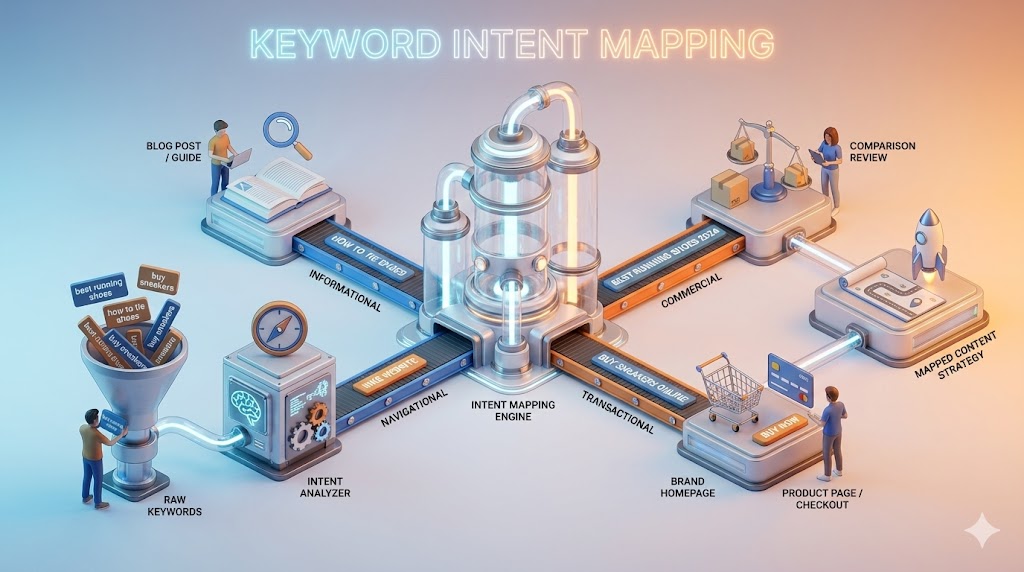
When people search online, they are not just typing words; they have a goal or a reason behind every search. Keyword intent mapping is the process of matching these search goals to the right pages on your website. Instead of guessing what users want, you use a simple, clear system to connect each keyword to the page that best answers the search.
This matters because search engines like to show results that truly match what the user wants. When you use keyword intent mapping, you make it easier for search engines to understand your pages, and easier for visitors to find what they need. As a result, your pages can gain better visibility, more clicks, and more helpful traffic.
For beginners in SEO, learning how to map intent is a key skill. It helps you avoid confusing your visitors, stops you from targeting the wrong keywords, and supports a more logical website structure. By focusing on the real reason behind each search, you build pages that serve both users and search engines in a clear, organized way.
Keyword Intent Mapping
Before diving into tactics, it helps to understand the basic idea behind keyword intent mapping. Think of your site as a library and your content as shelves that need clear labels.
Imagine sorting books in a library so every visitor quickly finds the story they want. Keyword intent mapping does something similar for your website: it helps place each search phrase on the page that answers it best.
Rather than looking only at how many people search a phrase, this method considers what those people plan to do next. Are they trying to learn, compare, or buy? By matching that hidden goal to the right content, you create a clearer path for both users and search engines.
At the core of this process is a simple idea: one main intent per page. Each important phrase is assigned to a page that fits a clear purpose, such as explaining a topic, promoting a service, or selling a product. This avoids confusion, cuts down on competing pages, and supports a more logical site structure.
- Informational phrases are usually mapped to guides or blog posts.
- Commercial phrases often fit comparison or review-style content.
- Transactional phrases work best on product, category, or sign-up pages.
Over time, a good keyword intent map becomes a living document. You can update it as you add new pages, remove old ones, or discover fresh search patterns from your audience.
Introduction
Once you see how mapping works in theory, it is easier to notice it in practice. Every search that feels perfectly answered usually has careful planning behind it.
Have you ever typed a question into a search bar and landed on a page that felt exactly right? That match is not an accident; it often comes from careful planning behind the scenes.
In SEO, keyword intent mapping is the method used to connect what people want with the page that serves them best. It focuses on the purpose behind a search, not just the words that appear on the screen.
This planning helps search engines decide which of your pages should show for a given query. When each phrase is linked to a clear goal, your content becomes easier to understand, faster to navigate, and more likely to earn trust.
- Clear matches between queries and pages support higher click-through rates.
- Focused content reduces confusion and keeps visitors on your site longer.
What Is Keyword Intent Mapping?
After understanding why intent matters, the next step is to define what this process actually looks like on your site. At its heart, it is about giving every key phrase a specific place to belong.
Have you ever noticed that some pages feel like they were written just for the question you had in mind? That “perfect fit” usually comes from a planned connection between search phrases and specific pages.
Keyword intent mapping is the method of creating that connection on purpose. It gives you a clear system so every important phrase has a defined “home” on your site.
At its simplest, keyword intent mapping means taking a list of phrases and deciding which page should answer each one. You look at what the searcher wants to do—learn, compare, or act—and link the phrase to a page built for that goal.
This approach turns a random list of phrases into a structured plan for your content. Instead of several pages chasing the same idea, each page has a focused role, which makes your site easier for both visitors and search engines to understand.
Why Keyword Intent Mapping Is Important for SEO
Knowing what mapping is makes it easier to see why it matters so much for search performance. When intent and pages line up, both rankings and user experience tend to improve.
Search engines try to show the page that will feel like the “right answer” for each query. When your site is planned around clear search goals, that match becomes much easier.
By lining up phrases with pages in a smart way, you help both people and algorithms move from question to solution with less guesswork and fewer clicks.
One major benefit is stronger rankings for the correct pages. Instead of several URLs competing for a similar term, your map tells search engines which page is the main result, which supports cleaner indexing and less keyword cannibalization.
This clarity also improves user experience. Visitors land on content that matches what they had in mind, which usually leads to longer visits, more page views, and lower bounce rates because the next step is obvious.
- Better visibility for targeted phrases on the most relevant pages.
- More qualified traffic because each page serves a specific stage of the journey.
- Higher conversions as transactional terms go to offers, forms, or product pages.
Types of Search Intent Used in Mapping
To put this into practice, you need a simple way to categorize what people are trying to do. Grouping phrases by intent type gives your content plan structure and clarity.
Have you ever wondered why two phrases that look similar can need completely different pages? The answer usually lies in the type of intent behind each search, not in how many people search it.
When planning your keyword intent mapping, it helps to group phrases into clear intent types. This makes it easier to decide whether a query should lead to a guide, a comparison, or a purchase page.
The four main types used in mapping are:
- Informational – the user wants to learn something.
- Commercial – the user is comparing options before a decision.
- Transactional – the user is ready to take action, often to buy or sign up.
- Navigational – the user is trying to reach a specific site or page.
In practice, intent matters more than search volume. A lower-volume phrase with clear buying intent can bring more value than a popular term that only shows curiosity, because it aligns better with the action your page is built to support.
How Keyword Intent Mapping Works (Step-by-Step)
Once you know the main intent types, you can start building a map that connects real queries to real pages. A clear, repeatable process keeps this from becoming overwhelming.
Have you ever looked at a long list of phrases and wondered what to do with them all? This is where a clear, step-by-step system turns random ideas into a simple plan for your site.
The goal in this stage is to move from raw phrases to a tidy map that shows which query belongs on which page, and where you still need new content.
First, collect phrases from tools, your own analytics, and real customer questions. Put them into a sheet so you can see them side by side, and group very similar phrases together to keep things tidy.
Next, identify the goal behind each phrase by checking words like “buy,” “compare,” or “how to,” and by studying the current top results. This helps you mark each term as informational, commercial, transactional, or navigational.
Once the goal is clear, match each group to a page type such as a guide, comparison article, or product page, then link it to an existing URL or mark it as a “new page” idea.
- Guides and FAQs for learning-focused searches.
- Comparison posts for research and evaluation.
- Offer or product pages for action-focused queries.
To finish, check for overlap so the same main phrase is not assigned to several pages. If two URLs chase the same term, decide which should be the primary page and adjust the other to focus on a different, more specific phrase.
Keyword Intent Mapping vs Keyword Stuffing
As you plan content around intent, it is useful to contrast this structured approach with older, less effective tactics. One of the most common is keyword stuffing.
Have you ever landed on a page where the same phrase appears over and over, but you still do not get a clear answer? That kind of page usually comes from keyword stuffing, not from a careful plan.
Instead of repeating a phrase many times, keyword intent mapping focuses on using the right words in the right place. The idea is to match a search goal to a page, then write naturally to solve that need.
In practice, stuffing tries to push rankings by volume of terms, while mapping builds a clean structure where each query has a clear home. Search engines now reward pages that give helpful answers, not pages that simply repeat phrases.
- Mapping = organized pages, clear purpose, better user trust.
- Stuffing = awkward text, higher risk of penalties, poor experience.
“Write for people first, then for algorithms.” – Rand Fishkin
Common Keyword Intent Mapping Mistakes and Who Should Use It
Even with a solid process, small missteps can weaken your map and your results. Recognizing these patterns early makes it easier to keep your structure clean as your site grows.
Have you ever felt that your content is “good” but still not getting the right visitors or results? Often, the problem is not the topic itself, but how search goals are assigned to pages. Small planning errors can quietly weaken even strong content.
Many of these issues are easy to avoid once you know what to look for. By spotting common traps early, you can keep your keyword intent map clean, focused, and much easier to maintain over time.
One frequent mistake is mixing several main intents on a single page. For example, trying to teach a full beginner guide while also pushing a hard sale can confuse both users and algorithms. Another issue is chasing only high-volume phrases and ignoring low-volume terms that show clear buying or sign-up intent.
- Assigning the same core phrase to multiple URLs, which can lead to keyword cannibalization.
- Skipping navigational terms and failing to optimize for branded or “login”-style searches.
- Not updating the map as new pages launch, leaving gaps and overlaps.
- Forcing keywords into the wrong page type, such as putting “buy” terms on long guides instead of offer pages.
- Ignoring real user data from search queries, on-site search, or support tickets.
These planning gaps affect different site types in different ways. Understanding who benefits most helps you decide how much time and detail your own map deserves.
Content and blog sites gain clarity by assigning informational and commercial topics to clear, separate articles. Service businesses can use mapping to decide which phrases belong on core service pages, and which should live in case studies or FAQs. For e‑commerce stores, intent mapping is vital to divide terms between category hubs, product detail pages, and buying guides.
Even small portfolios, local sites, and niche communities can profit from a simple map that shows which page is meant to rank for which goal‑driven phrase. As your site grows, this early discipline prevents confusion and keeps your structure easy to scale.
Bringing Keyword Intent Mapping Into Your Everyday SEO
By this point, the value of mapping should feel clearer: it is less about tricks and more about organizing your site around what visitors actually want. The final step is to treat it as an ongoing habit, not a one-off task.
Keyword intent mapping turns random search phrases into a clear plan for your site. By linking each keyword to a single, focused page based on what the user wants to do, you create a structure that is easier for both people and search engines to understand.
Instead of chasing volume or repeating terms, you work with intent‑driven content: informational topics feed guides, research queries support comparison pages, and high‑intent phrases power your key product and service pages. This keeps your site organized, reduces keyword cannibalization, and supports stronger rankings, better user journeys, and more meaningful actions.
As your website grows, think of your map as a living document rather than a one‑time task. Review real user data, refine your intent groups, and adjust pages so each one still answers a clear search goal. In the long run, keyword intent mapping becomes a natural way to plan content that feels “exactly right” the moment a visitor arrives.