
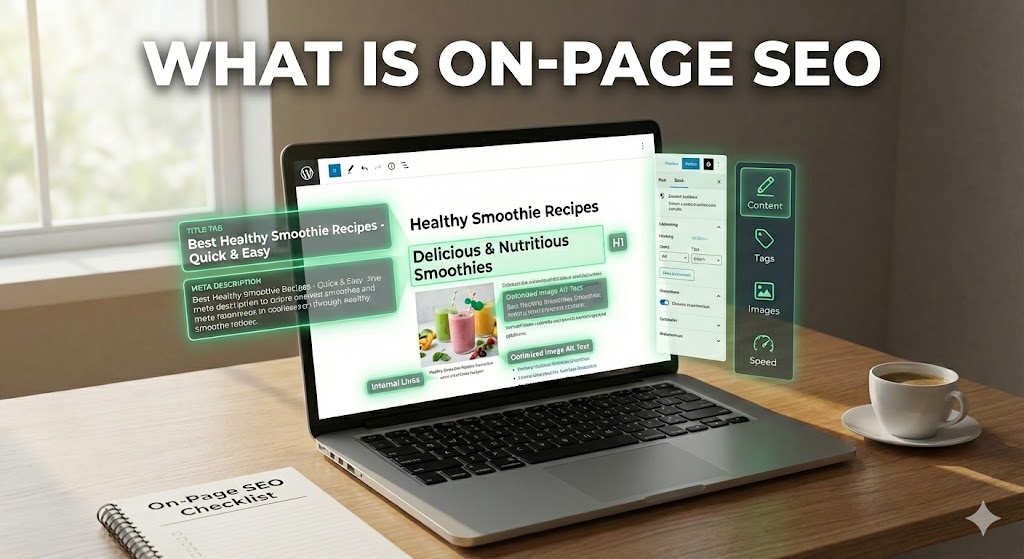
On-page SEO is the practice of improving the parts of a web page that you can control so that search engines and people can both understand it better. It focuses on the words, structure, and small technical details that tell search engines what your page is about and why it is useful. When done well, on-page SEO helps your page become more visible for important searches.
This process matters because search engines, using complex algorithms, scan each page to decide where it should appear in search results. If your page is not clearly written, well-structured, or easy to use, it is less likely to appear high in those results. Good on-page SEO makes your content easier to find, easier to read, and easier to trust.
For beginners, learning on-page SEO is a key first step in digital marketing. You do not need to be a programmer to understand it. By focusing on clear content, smart keywords, clean code, and a good user experience, you can slowly improve how your pages perform. Over time, these improvements can bring more visitors, more clicks, and better results for your website.
What is On-Page SEO?
Before learning tactics and tools, it helps to understand what on-page SEO actually covers. At a basic level, it is about making every single page on your site as clear and useful as possible for both humans and search engines.
Imagine a librarian trying to place your book on the right shelf. If the cover, title, and chapters are clear, the book is easy to find. On-page SEO works the same way for your web pages.
Rather than changing the whole website at once, this practice improves each page so search engines can match it to the right searches. It looks at specific elements on that page, such as the title, text, images, and links inside the content.
At its core, on-page SEO means shaping a page so that both people and search engines quickly see what it offers. When these signals line up, the page can earn higher visibility for the terms it deserves. This makes every optimized page a small, focused asset that supports your wider digital strategy.
Introduction to What is On-Page SEO
Once you know what on-page SEO is, the next step is understanding how it affects real search results. Even small adjustments can change where a page appears and how users respond to it.
Have you ever wondered how two very similar pages can appear in completely different positions on a search results page? Often, the difference comes down to how carefully each one has been tuned on a very small, detailed level. This fine-tuning is where on-page SEO truly shows its power.
Instead of looking at your website as one big object, this approach examines each page as a separate asset with its own job to do. By adjusting specific signals on that page—from the main heading to the way images are described—you help search engines build a clear picture of its purpose. At the same time, these changes make it easier for visitors to scan, understand, and trust what they are reading.
In practice, learning what on-page SEO is means learning how to connect three things: the searcher’s intent, the words they type into the search bar, and the information you present on the page. When all three line up, the page has a much better chance to appear for the right queries and to keep users engaged once they arrive.
- Search engines use these on-page signals to decide how relevant your page is.
- Readers rely on the same signals to decide whether to stay, scroll, or leave.
What Is On-Page SEO and How It Works
Understanding the concept is one thing; seeing how it functions behind the scenes is another. This is where on-page SEO turns from theory into a practical process that search engines can interpret.
Think of each page on your site as a small shop on a busy street. Some shops are easy to spot, clearly labeled, and simple to walk through. Others feel confusing. On-page SEO is the process of making each “shop” clear, tidy, and welcoming so both search engines and visitors know exactly what is inside.
Behind the scenes, search engines send out crawlers that read your page’s code and content. They look at elements such as the title tag, main headings, body text, URLs, and internal links. These parts act like clues that explain the main topic, how detailed the page is, and how it connects to the rest of your website.
As these clues are collected, algorithms try to match your page to real searches. When signals like keywords in headings, logical structure, and helpful content all point in the same direction, the page is judged more relevant. This can lead to higher positions for terms that truly fit what the page offers.
- Clear structure helps crawlers index your content faster and more accurately.
- Relevant wording shows which questions your page tries to answer.
- Engagement signals (time on page, low bounce) hint that users find it useful.
Why On-Page SEO Is Important for Your Website
Knowing how on-page SEO works naturally leads to the question of why it matters so much. The answer lies in the long-term impact it has on your visibility, audience quality, and results.
Have you ever published a page that you were proud of, only to see almost no visitors arrive? Often, the problem is not the idea itself, but how clearly that idea is presented to both people and search engines. This is where careful on-page work turns quiet pages into useful traffic sources.
For your site as a whole, strong on-page optimization acts like a foundation. It gives every article, product page, or service description a clear role and a clear topic. Over time, this clarity helps build steady, targeted traffic instead of random visits that never turn into results.
- Higher search visibility: well-optimized pages are easier for crawlers to understand and index correctly.
- Better user experience: clean structure, readable text, and logical navigation help visitors find what they need quickly.
- Stronger relevance signals: focused wording and consistent topics show exactly which searches a page should match.
- Improved conversions: when content matches searcher intent, more readers become subscribers, leads, or customers.
Main Elements of On-Page SEO You Need to Know
Once you recognize the value of on-page SEO, the next step is to understand its main building blocks. These core elements appear on every page and work together to shape how it is interpreted.
When you look closely at any high-performing page, you will notice a set of shared building blocks. These elements quietly guide search engines and readers, turning a simple piece of content into a clear, trustworthy resource that deserves to rank.
Below are the main pieces you can adjust on each page. By improving them one by one, you create a strong, consistent signal about what your content covers and why it matters.
Content quality is the heart of on-page work. Clear, original text that answers real questions keeps people reading and sends positive signals to search engines. Short, focused sections and simple language make it easier for visitors to scan and find what they came for.
Alongside strong writing, technical details such as the title tag, URL, and image descriptions act as labels. When these labels use natural, relevant terms, they confirm the page’s topic and support better visibility.
- Content that solves a problem or explains a topic in depth.
- Descriptive titles and URLs that show what the page is about.
- Helpful internal links that guide readers to related information.
On-Page SEO vs Off-Page SEO: Key Differences
After exploring the main elements on a page, it helps to see how they fit within the larger SEO picture. On-page and off-page efforts play different roles but ultimately support the same goals.
When two sites compete for the same search term, why does one rise above the other? Often, the answer lies in how well both on-page and off-page SEO are handled and how they support each other.
Both aim to improve visibility, but they work in very different ways. Understanding this contrast helps you see where to spend time when you cannot fix everything at once.
On-page SEO focuses on what lives directly on your page: the content, HTML tags, URL structure, and internal links. These are things you fully control. You can edit text, adjust headings, improve readability, and add descriptive alt text for images at any time.
By contrast, off-page SEO deals with signals that mostly happen away from your site. This includes backlinks from other domains, social mentions, and overall online reputation. You can influence these, but you cannot directly edit them like a paragraph on your page.
- On-page: content quality, title tags, meta descriptions, internal linking, page experience.
- Off-page: earned links, brand mentions, reviews, and other external trust signals.
In practice, you start by getting your own pages in order, then work on building authority beyond your site. Together, these sides of SEO create a stronger, more balanced presence in search results.
Common On-Page SEO Mistakes Beginners Make
Even with a clear understanding of on-page SEO, small errors can still hold back your progress. Many of these mistakes are easy to fix once you know what to look for.
Have you ever felt confused when a well-written page still does not show up in search results? Often, the issue is not effort, but a few quiet errors that send mixed signals to search engines. By spotting these early, you can fix them before they limit your growth.
Many first-time optimizers focus only on adding keywords and forget other critical on-page details. The points below highlight frequent mistakes that hold pages back, even when the main idea is strong.
- Keyword stuffing: repeating the same phrase too often, making text sound unnatural and harming readability.
- Missing or weak title tags: using vague titles that do not clearly state the main topic.
- No meta descriptions: leaving search snippets to be auto-generated instead of writing a clear, helpful summary.
- Poor heading structure: skipping logical H1–H2–H3 order, which confuses both readers and crawlers.
- Unclear URLs: using long, random strings instead of short, descriptive paths.
- Thin or copied content: offering very little original value on the page.
- Images without alt text: missing simple descriptions that support accessibility and topical relevance.
Who Should Focus on On-Page SEO and Related Topics
Once common mistakes are clear, it is natural to ask who should spend time fixing them. The truth is that on-page SEO is not reserved for experts or large companies.
Have you ever thought that SEO is only for big brands with large teams? In reality, any site that wants steady, free traffic can benefit from simple on-page improvements, even if it is run by one person.
Creators who publish articles or tutorials should care deeply about clear structure, headings, and internal links so readers and crawlers can follow their ideas. Small business owners, on the other hand, rely on descriptive title tags, service pages, and local terms to appear when nearby customers search.
Online shops gain a lot from optimized product pages that use helpful descriptions, clean URLs, and image alt text that explains what is being sold. Even portfolio sites or personal profiles can use focused keywords and readable layouts to stand out in crowded result pages.
- Blogs and news sites that want more readers.
- Local businesses trying to appear in area-based searches.
- E‑commerce stores aiming to sell more products.
- Service providers and freelancers who need qualified leads.
Bringing On-Page SEO Together for Lasting Results
All of these ideas—from definitions and elements to mistakes and use cases—come together in a simple goal: make every page as clear, helpful, and focused as possible. When you do that consistently, search engines and readers both benefit.
On-page SEO is about giving every page on your site a clear purpose, strong structure, and helpful content so both readers and search engines can easily understand it. By focusing on individual pages as separate assets, you build a site where each part supports your overall goals instead of leaving your rankings to chance.
As you improve titles, headings, URLs, internal links, and descriptions, you send consistent, trustworthy signals about what your pages offer and who they are for. Over time, this careful alignment between searcher intent, chosen keywords, and on-page details creates a better user experience and more reliable visibility in search results.
Whether you run a blog, a small business site, an e‑commerce store, or a personal portfolio, on-page SEO is a skill you can learn and apply step by step. Start with a single page, fix the most common issues, and keep refining to build steady, qualified, long-term traffic that supports your wider digital strategy.