
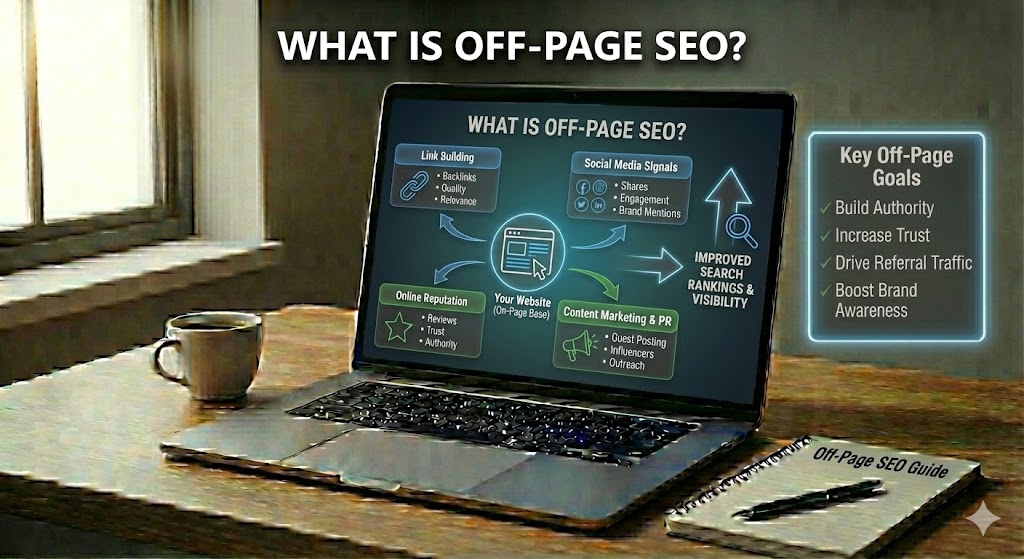
When people think about SEO, they often imagine changing words, images, and code on a website. But search engines also look at what happens outside your site. Off-page SEO is about all the actions that happen away from your own pages, yet still help your site look more trusted and useful.
To rank pages, search engines try to measure how much other people on the internet trust, talk about, and recommend your website. They do this using signals like links, mentions, and reviews, which work like votes of confidence from the rest of the web.
Because of this, SEO is not only about fixing titles, improving speed, or adding good content on your site. Even a well-built website can struggle to rank if no one links to it, talks about it, or shares it. Off-page SEO helps your site show real-world value and popularity, which search engines use to decide how high to place your pages in the results.
What Is Off-Page SEO?
Before digging into techniques, it helps to be clear on what off-page SEO actually covers. This part focuses on the basic meaning and main role of off-page signals in shaping how search engines view your site.
Think about how people talk about a shop in your town. Even if the shop looks nice inside, what others say about it outside the building changes how much you trust it. Search engines do something very similar to websites.
Off-page SEO means all the steps that help your site look trusted, but happen on other websites, not your own. It is about how much the wider web recommends you through links, mentions, and reviews.
Instead of changing titles, text, or speed on your pages, this area of SEO looks at outside signals. These signals tell search engines if your site is worth showing to more people because others find it useful, share it, or point to it.
- Links from other pages act like votes.
- Mentions and reviews show real-world trust.
- Shares and discussions signal popularity and interest.
What Is Off-Page SEO: Simple Definition and Core Idea
Once you understand the basic meaning, it helps to look at the core idea behind off-page SEO. This section explains the concept in simple terms so you can see how all the different signals fit together.
Imagine your site as a person at a party. What matters is not only how they look, but also what others say about them when they walk away. This outside chatter is where off-page SEO truly lives.
At its core, off-page SEO is a simple idea: search engines listen to the wider web to decide how much they can trust you. They check how often other sites point to you, talk about you, and react to your work.
In plain words, off-page SEO is all the signals that happen away from your own pages but still shape your reputation. These signals tell algorithms whether your site looks like a quiet side street or a busy town square everyone visits and recommends.
- Backlinks show that other sites are willing to vouch for you.
- Public mentions and reviews act like digital word-of-mouth.
- Shares and discussions hint that your content sparks real interest.
How Search Engines Use Off-Page SEO Signals
Knowing what off-page SEO is makes it easier to see how algorithms treat these signals. Here, the focus shifts to how search engines turn links, mentions, and reactions into a kind of reputation system for your site.
Why does one page rise above millions of others that say almost the same thing? The answer often lies in how many strong signals from the wider web point back to it, not just in what is written on the page itself.
Modern algorithms treat these outside signals as a kind of reputation score. By looking at who links to you, who talks about you, and how people react, search engines can guess which pages deserve to be placed near the top.
First, backlinks are measured in more than one way. Algorithms check how many links you have, how trusted the linking sites are, and whether the topics match your own content. A few links from well-known, closely related sites often help more than hundreds of weak, random links.
Second, other off-page signs add extra context. Things like public mentions, reviews, and discussions help machines understand if a site looks helpful, local, safe, or expert. Together, these different signals form a picture of your site’s overall authority and popularity in the eyes of search engines.
Why Off-Page SEO Is Important for Your Website
Understanding how search engines use signals naturally leads to the question of why they matter so much. This section connects off-page work to real outcomes like rankings, traffic, and user trust.
Why do some pages with a simple design still appear above more beautiful sites in search results? The answer often lies in how much the rest of the web is willing to back them up. This outside support is where the real strength of off-page work starts to show.
When other sites, people, and platforms point to your pages, they send clear signals that your content is worth noticing. These signals quietly shape how search engines judge your trust, relevance, and authority compared with thousands of similar pages.
Strong activity away from your own domain brings several direct benefits:
- Higher authority in the eyes of search engines, thanks to quality backlinks and mentions.
- Better rankings for important pages, which can lead to steadier, free traffic over time.
- Increased trust from users who see reviews, discussions, and recommendations on other platforms.
Because these signals are harder to fake than simple on-page edits, they often act as a more reliable test of real-world value. That is why consistent, careful off-page effort is a core part of any long-term SEO strategy, even for small sites just starting.
Key Elements of Off-Page SEO Basics
After seeing why off-page work matters, it helps to break it down into its main building blocks. The points below highlight the basic elements that most beginners focus on first.
Why do some pages quietly rise in search results while others stay hidden, even when their content looks similar? The difference often comes from a few core actions that happen away from the site itself. These actions form the basic building blocks of off-page SEO and give your pages a stronger reputation across the wider web.
At a beginner level, it helps to think in terms of a simple toolkit. Each tool supports trust in a slightly different way, but together they create a clear signal that your site is active, recommended, and worth visiting.
- Backlinks from other domains that point users and crawlers to your pages.
- Brand mentions where your name appears, even without a clickable link.
- Social activity, such as shares and discussions, that surface your content to new people.
- Reviews and ratings that shape how safe, useful, or reliable your business looks.
None of these elements works in isolation. When search engines see several of them lining up in the same direction, they gain stronger evidence that your site offers real value, not just well-written text and clean code on a single domain.
Off-Page SEO vs On-Page SEO: Main Differences
To plan a balanced strategy, you need to see how off-page efforts compare with the work you do on your own site. This part sets the two side by side so you can understand their different roles and limits.
Have you ever fixed titles, headings, and images on a page, yet rankings barely moved? Often the reason is that search engines judge both what is inside your site and what happens around it across the web.
This section explains how these two areas work together, where they differ, and what you can realistically control in each one when planning your strategy.
On-page SEO is everything you adjust directly on your own pages: text, headings, internal links, structure, and technical parts like speed. These are fully under your control and mostly affect how clearly search engines can read and understand your content.
Off-page SEO, in contrast, focuses on external signals such as backlinks, reviews, and brand mentions. You influence these, but you cannot fully control them because they rely on decisions made by other people and websites.
- On-page: content quality, keyword use, internal linking, HTML tags, page experience.
- Off-page: links from other domains, public mentions, ratings, social sharing.
A useful way to compare them is to think of on-page work as building a strong product, while off-page efforts act like reputation and recommendations that prove that product is valued in the wider web.
Safe vs Risky Off-Page SEO Practices
Knowing the difference between off-page and on-page makes it easier to choose safe tactics. This section highlights which actions usually help in the long run and which ones can quietly damage your site.
Have you ever wondered why some sites grow slowly but steadily, while others jump fast and then suddenly disappear from search results? The difference often comes from how carefully they choose their off-page tactics.
When you try to build trust and authority outside your site, some methods help you in the long run, while others can cause serious damage. It is important to know which actions are considered safe and which ones search engines see as risky or manipulative.
Safe approaches usually follow search engine rules and focus on real people. They include:
- Earning natural backlinks by publishing useful, shareable content.
- Building real relationships with other site owners and communities.
- Collecting honest reviews from real customers over time.
Risky tactics try to trick algorithms instead of serving users. These might involve:
- Buying links in bulk or joining link schemes and private networks.
- Spamming comments and forums just to drop links.
- Generating fake reviews to inflate ratings unnaturally.
In practice, safe off-page work grows slowly but is stable, while risky shortcuts can bring quick gains followed by penalties or sharp ranking drops. Choosing patient, user-first methods protects your site’s long-term visibility and keeps your reputation clean.
Common Off-Page SEO Mistakes Beginners Make
Even with good intentions, it is easy to fall into habits that hold your results back. The points below show typical beginner mistakes so you can avoid them early.
Have you ever felt busy “doing SEO” but saw almost no change in results? Often the problem is not a lack of effort, but a few hidden habits that quietly hold your site back.
This part looks at frequent errors people make when they first start with off-page SEO. By spotting these early, you can save time, avoid penalties, and build a cleaner, stronger reputation across the web.
- Relying on cheap bulk link packages instead of earning a few quality links.
- Placing links in spammy comments and forums that add no real value.
- Using the same anchor text over and over can look manipulative.
- Ignoring local listings and basic citations for businesses that serve a real location.
- Forgetting to monitor backlinks, so toxic links stay in place for years.
- Chasing only quantity over relevance, with links from unrelated topics.
- Trying to boost ratings with fake or paid reviews instead of real feedback.
Bringing It All Together: Off-Page SEO as Your Site’s Reputation System
All of these ideas point to one main theme: off-page SEO works like your site’s reputation across the wider web. While on-page work shapes what happens inside your pages, off-page signals show search engines how much others trust, value, and recommend what you publish.
By understanding the core idea of outside signals, how algorithms turn them into a kind of authority score, and why they matter for rankings, you can see off-page SEO as more than just “building links.” It is a mix of backlinks, mentions, reviews, and social attention that together prove your site deserves a visible place in search results.
Focusing on safe, long-term practices, avoiding common beginner mistakes, and pairing strong on-page work with careful off-page efforts helps you build a website that is both well-structured and openly supported by the online community around it.