
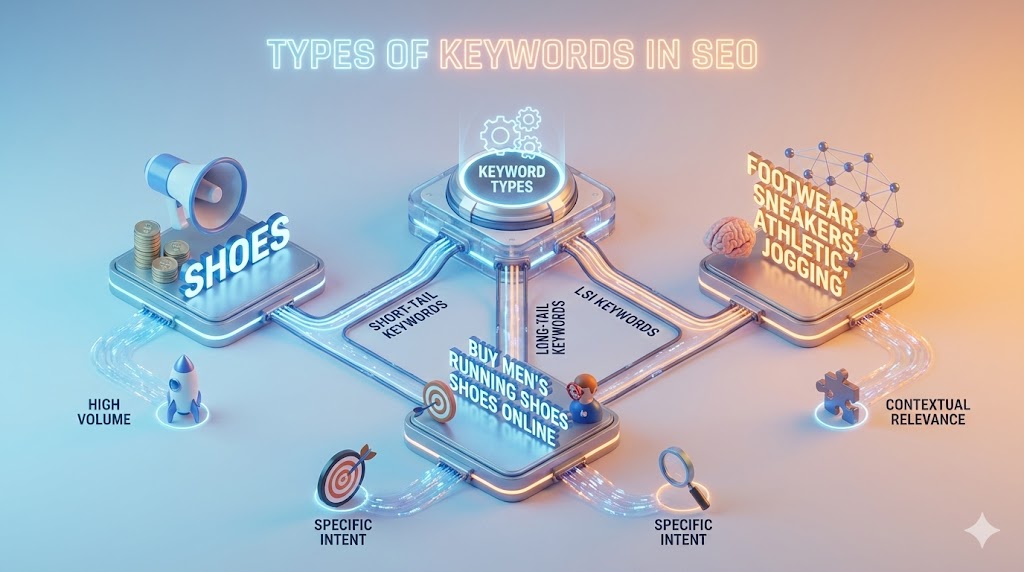
When people use a search engine, they do not all search in the same way. Some type very short phrases, while others write full questions or very specific details. This means that keywords are not all the same, and each type sends a different signal about what the user really wants.
If you want your pages to appear in the right searches, you must understand these different keyword types. Choosing the wrong type of keyword can bring the wrong visitors, or no visitors at all. When you learn how each keyword type works, you can match your content to real user needs, improve click-throughs, and make your site easier for search engines to understand.
This guide walks through the main types of keywords in SEO, how they behave, and when to use each one. By the end, you will know how to plan content that fits user intent, from early research all the way to purchase, using simple rules you can apply to any website.
Have you ever noticed how some searches sound like quick notes, while others look more like full questions? This difference is not random. It shows that people are at different stages of thinking and buying, and search engines read these signs very carefully.
To work with this, it helps to group terms into clear categories. Below you will see the main types of keywords in SEO you will use again and again, each with its own role in reaching the right visitors at the right moment.
Introduction to Types of Keywords in SEO
Before diving into specific categories, it helps to understand why keyword types matter in the first place. Every search phrase carries a hidden message about what the user expects to find and how close they are to taking action.
Think about how you search when you are just curious, compared to when you are ready to buy something today. Your words change, and so does the hidden message behind them. That hidden message is what different keyword types try to capture.
In SEO, these types act like labels that tell you how close a person might be to taking action, and what kind of answer they expect. By learning these groups, you can decide when to write a simple guide, when to create a product page, and when to compare options in depth.
Instead of treating every phrase as equal, you begin to see a map made of search intent, query length, and purpose. This map helps you choose whether you need a how‑to article, a review, or a checkout page, so each visit is more likely to be useful for both the user and your site.
What Are Keywords in SEO?
Clarifying what keywords actually are makes it easier to understand the different types you will work with. At their core, they are the bridge between what people search for and the pages search engines choose to show.
Imagine trying to find a book in a huge library without any labels. Online search would feel the same without clear words and phrases that tell search engines what each page is about.
In simple terms, keywords are the words or short phrases people type into a search box when they want to find something online. They can be a single word like “shoes” or a full phrase like “how to tie running shoes”. These terms act as a link between a person’s question and the pages that might answer it.
Search engines scan your page and look at places like the title, headings, and body text to understand which searches it should match. When your content uses the same language as your audience, the system can more easily decide:
- What topic your page covers
- Which user problems it can solve
- How relevant it is compared to other pages
So, choosing and placing keywords wisely helps search engines connect the right searcher with the right page at the right time.
Main Types of Keywords in SEO by Length and Intent
Once you know what keywords are, the next step is to see how they differ in shape and purpose. One simple way to do this is by looking at both how long a phrase is and what the user seems to want.
Have you ever wondered why some search phrases are just one word, while others look like full sentences? That difference is not only about style; it shows how clear, how urgent, and how strong a user’s intent really is.
To make smart SEO choices, it helps to look at both phrase length and user intent at the same time. This way, you can see whether a term is broad and early‑stage, or narrow and close to action, and then design your pages to fit those needs.
By length, you will often work with three simple groups: short‑tail (1–2 words), medium‑tail (about 2–3 words), and long‑tail (3+ words). Each group can carry different intent signals such as learning, comparing, or buying. For example:
- Short‑tail + informational: “nutrition” – a broad learning query
- Medium‑tail + commercial: “best running shoes” – research before purchase
- Long‑tail + transactional: “buy red running shoes size 9” – ready to order
When you mix these angles together, you get a simple rule: shorter terms usually have wider reach but weaker intent clarity, while longer phrases often bring fewer, but more focused, visitors. This combined view will guide how you structure both your basic guides and your detailed product or service pages.
Intent-Based Types of Keywords in SEO
Looking at length is helpful, but it does not fully explain what a searcher wants from you. To go deeper, you can classify keywords by the user’s underlying goal or search intent.
Imagine you could read a person’s mind just from the words they type. That is what intent-based keyword types try to capture: the hidden goal behind every search.
Instead of only looking at how long a phrase is, you also look at why someone is searching. Are they learning, comparing, or ready to buy? This intent view helps you choose the right page format and call to action.
Most queries fall into four simple intent groups:
- Informational – the user wants to learn something
- Navigational – the user wants to reach a specific site or page
- Commercial – the user is comparing options before buying
- Transactional – the user is ready to act, usually to purchase or sign up
When you map your phrases to these buckets, you can align content type, depth, and offers with real needs, which often leads to higher clicks and better conversions.
How to Choose the Right Keyword Type for Your Content
Knowing the main keyword types is only useful if you can apply them to real pages. The key is to connect each piece of content with a clear desired outcome and then select phrases that match that goal.
Have you ever written a page that got visits but almost no sign‑ups or sales? Often, the issue is not the topic itself, but that the keyword type does not match the page’s real goal.
To avoid this, start by asking a simple question: What action do I want the visitor to take? Your answer will guide which keyword type fits best.
If your aim is to teach or explain, focus on informational and long‑tail phrases like “how to clean white sneakers”. For guiding people to a specific page, use navigational or branded terms such as “login account page”.
When the main goal is sales or leads, prefer commercial and transactional queries like “best budget laptop for students” or “buy wireless mouse online”. You can use a small list to check alignment:
- Learn something? Use informational, usually longer phrases.
- Compare options? Target commercial terms.
- Ready to act? Choose clear transactional keywords.
Common Mistakes When Choosing and Using Keywords
Even with a solid understanding of keyword types, small missteps can quietly limit your results. Paying attention to frequent errors helps you protect the work you put into research and content creation.
Have you ever felt that you are doing everything “right” with SEO, yet results stay flat? Often the problem lies not in effort, but in a few hidden habits that quietly weaken your keyword strategy.
Below are some frequent errors that even careful site owners make. By spotting and avoiding them, you can let your best pages perform closer to their true potential.
One major issue is chasing only high‑volume short phrases like “shoes” or “insurance”. These broad terms are very competitive and often bring visitors who are not interested in what you really offer. Balancing them with specific long‑tail phrases creates more realistic opportunities to rank and convert.
Another common mistake is ignoring search intent. Targeting a transactional term such as “buy gaming laptop” with a simple blog post confuses users and search engines alike. The opposite is also true: using a hard‑sell page for a clearly informational query makes people leave quickly.
Many beginners also fall into the trap of keyword stuffing, repeating the same term in every second line. Modern search engines can read context; they prefer natural language, related phrases, and clear structure over forced repetition. At the other extreme, some pages barely mention their main topic at all, leaving algorithms unsure what the content is about.
Finally, it is easy to skip ongoing checks. Never updating old pages, forgetting to track which terms actually bring leads, or failing to remove outdated phrases means your site slowly drifts away from what people now search for. Regularly reviewing performance helps you keep your corpus aligned with real user needs.
Related SEO Topics and Next Steps
Understanding keyword types is a strong starting point, but it is only one part of a complete SEO workflow. To turn theory into consistent results, you need supporting skills and processes around it.
Once you can spot different keyword types, the next question is simple: what should you learn and do next? The ideas below point you to related areas that turn this basic knowledge into a full, repeatable SEO process.
Each topic opens another piece of the puzzle, from finding phrases to measuring how well they perform. Use them as a checklist for building a stronger, more complete strategy over time.
- Keyword research tools and methods for discovering new opportunities and checking search volume.
- On-page SEO basics such as titles, headings, and internal links that support your chosen phrases.
- Search intent analysis to match each term with the right content format and depth.
- Content clustering and topic hubs that group related queries around a central page.
- Competitor keyword analysis to see which terms others rank for and where gaps exist.
- Tracking rankings and conversions so you know which terms really drive results.
- Updating and refreshing content as language, trends, and user needs change.
“In SEO, progress comes from small, steady improvements, not one perfect keyword.” – Rand Fishkin
Bringing Keyword Types Together for a Clear SEO Strategy
Bringing everything together, keyword types become most powerful when you use them as a simple framework for planning content. Instead of guessing, you match phrases, pages, and user needs on purpose.
When you see keywords as simple “search terms,” it is easy to miss their real power. By now, you have seen that different types of keywords in SEO each carry their own message about what a user wants, how close they are to taking action, and what kind of page they hope to find.
The big idea is simple: do not treat all keywords the same. Combine what you know about length, intent, and purpose to decide whether a page should teach, guide, compare, or sell. This shift turns random keyword use into a basic strategy you can repeat on any site, in any niche, as both user behavior and search algorithms evolve.
As you keep improving, remember that strong SEO rarely comes from one perfect phrase. It comes from many small, smart choices about which keyword types to target, how to avoid common errors, and when to refresh old pages so they still match real needs. Use these ideas as your map, and keep testing, adjusting, and learning as your corpus of content grows over time.