
When people talk about backlinks in SEO, they often think all links are the same. In reality, not every backlink sends the same signal to search engines. Some links can help your pages rank higher, while others mainly exist for users to click and visit your site.
To understand this better, you need to learn about two main types of backlinks: DoFollow and NoFollow. These are simple settings in the HTML code of a link, but they make a big difference in how search engines like Google treat that link. You can think of them as two different “roads” that search engines can follow in different ways.
In this article, you will see what DoFollow and NoFollow backlinks are, how they work, and why both types matter for your website. By the end, you will know how to use them wisely, avoid basic mistakes, and build a backlink profile that looks natural, safe, and trustworthy to search engines.
Types of Backlinks (DoFollow vs NoFollow)
Backlinks may look similar on the surface, but under the hood, they behave differently for search engines. Two of the most important link types you will encounter are DoFollow and NoFollow, each sending a distinct signal about trust and authority.
Imagine two doors pointing to your website: one tells search engines, “come in and count this,” the other says, “just visit, but do not use this for judging.” That is the basic idea behind DoFollow vs NoFollow links. In this part, you will see how each type behaves, what signal it sends, and where you usually find it, so you can build links that look natural and safe.
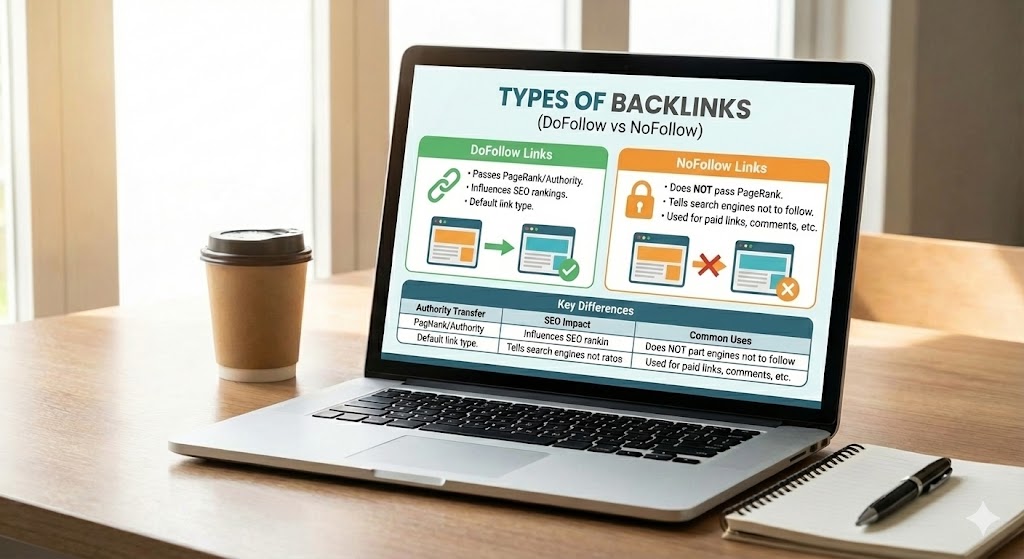
DoFollow links are the default type of backlink. When a normal hyperlink has no special attribute added, search engines can follow it and pass link equity (sometimes called PageRank). These links can support your rankings when they come from relevant, trusted pages.
NoFollow links use a small HTML attribute (rel=”nofollow”) that tells search engines not to pass full ranking power. They still help people discover your pages and can bring useful referral traffic, even if their direct ranking impact is lower.
Introduction to DoFollow vs NoFollow Backlinks
Before you focus on getting more links, it helps to understand what each backlink is actually saying to search engines. Two links can look identical in your browser yet play very different roles in how your site is evaluated.
Have you ever wondered why two links that look almost the same in your browser can send very different signals to search engines? Behind each clickable word, there is a tiny piece of code that tells Google how to treat that link. Understanding this hidden message is key if you want to guide your site’s growth instead of leaving it to chance.
In simple terms, DoFollow vs NoFollow is about whether a link should help pass reputation and authority, or simply act as a pathway for users. This setting shapes how link equity moves across the web and how “safe” your backlink profile looks. When you learn how these two behaviors work in real situations, you can decide when to encourage search engines to “count” a link and when to keep things more neutral.
DoFollow Backlinks and How They Help SEO
Once you know the basic difference between DoFollow and NoFollow, it becomes easier to see why SEOs care so much about one of them. DoFollow links are often treated as the core signals that transfer authority across the web.
Think of the web like a classroom where every recommendation counts. When one trusted site points to another with a special kind of link, it is almost like saying, “this page did its homework.” That digital recommendation is what gives DoFollow links their power.
These backlinks matter because they quietly move authority, trust, and relevance from one page to another. When used wisely, they can help search engines see your pages as more useful and reliable than competing results.
From an SEO view, a DoFollow link can:
- Pass link equity that supports rankings over time
- Help search engines discover and crawl deeper pages on your site
- Signal topical relevance when it comes from related content
For example, a detailed guide about on-page optimization linking to your basic SEO tutorial with a DoFollow link can boost both visibility and perceived authority, especially when similar signals come from multiple trusted sources.
NoFollow Backlinks and Why They Exist
After seeing how powerful DoFollow links can be, it may seem odd that anyone would limit a link’s SEO impact. However, not every link on the web is meant to act as a full recommendation.
Why would a website owner ever choose to limit the SEO power of a link? At first, this sounds strange, especially when you have heard how valuable backlinks can be. Yet over time, the web became so full of links that search engines needed a way to tell which ones were trusted recommendations and which were simply there for users or for safety.
NoFollow backlinks were created as a kind of protective filter. By adding the rel=”nofollow” attribute, site owners can say, “we mention this page, but we are not vouching for it as a ranking signal.” This helps reduce spam abuse, manage legal risk, and keep search results more honest.
- User-generated areas like comments and forums, where anyone can post links
- Paid placements or sponsorships that must not pass full ranking power
- Untrusted or unknown sources where the site owner prefers caution
Used wisely, NoFollow links keep your site looking transparent, ethical, and natural in the eyes of search engines.
DoFollow vs NoFollow: Key Differences and SEO Value
Once you understand each link type on its own, the next step is to compare how they behave side by side. This contrast helps you decide when to seek strong recommendations and when to keep signals more neutral.
At first glance, two hyperlinks can look identical, yet they can send very different signals to search engines. Understanding how these signals differ helps you decide which links should carry strong recommendations and which should stay more neutral.
Instead of thinking one type is “good” and the other “bad,” it is more accurate to see them as two tools for different jobs. Each plays a role in how your site gains visibility, trust, and traffic.
When people compare DoFollow vs NoFollow, they are really talking about how much SEO value a link can transfer and how search engines treat that connection between pages.
- DoFollow links: pass most link equity and can directly support rankings.
- NoFollow links: send weaker ranking signals but still aid discovery and traffic.
Used together in a balanced way, these link types create a backlink profile that looks credible, natural, and safe to modern algorithms.
Why Both DoFollow and NoFollow Backlinks Matter
Looking only at SEO value can make you focus too heavily on DoFollow links, but search engines expect a more realistic mix. Real websites naturally attract many different kinds of backlinks, not just the most powerful ones.
Have you noticed that the most trusted sites on the web do not rely on just one type of link? A healthy website usually earns a mix of signals, some that push rankings and others that simply show normal user behavior. This mix is what helps you look credible and safe instead of artificial.
Both link types support your site in different ways. One focuses more on authority and rankings, while the other protects you, manages risk, and still brings real visitors. Together, they form the kind of backlink profile search engines expect from a genuine website.
A varied link profile can:
- Make your site appear more natural and trustworthy to algorithms
- Reduce the risk of penalties from aggressive link building
- Combine ranking power with steady referral traffic and visibility
As SEO expert Rand Fishkin often notes, “Links should look like the web created them, not like an SEO did.” Mixing DoFollow vs NoFollow links helps you match that real-world pattern.
How Search Engines Handle DoFollow vs NoFollow Links
Understanding why both link types matter becomes clearer when you look at how search engines process them. Behind every crawl and index update, algorithms are quietly judging which connections deserve more weight.
Have you ever wondered what actually happens inside Google when it “sees” a link on a page? Behind the scenes, algorithms quietly decide which connections should boost authority and which should stay mostly as simple paths for users.
Search engines use link signals to map the web, decide which pages to trust, and how strongly to rank them. The small difference between a DoFollow and a NoFollow attribute changes how much weight that connection carries in this hidden map.
With DoFollow links, crawlers are encouraged to follow the URL, add it to their index, and pass significant link equity. Over time, many such signals from trusted, relevant pages can increase a site’s perceived authority and help it compete for harder keywords.
When the rel=”nofollow” attribute appears, robots usually still see the link, but treat it as a weaker hint. They may crawl the target, yet they pass little or no ranking strength, using it mainly as a discovery cue and a sign of normal web activity rather than a strong vote of confidence.
Building a Healthy Backlink Strategy with DoFollow vs NoFollow
Knowing how search engines respond to each link type allows you to be more intentional with your link building. A balanced strategy aims for sustainable growth rather than chasing every possible backlink.
Imagine your backlink profile as a garden. If you only water one type of plant, the whole space looks odd and may not survive changes in weather. In the same way, a safe strategy blends powerful recommendations with neutral, supportive links so your site can grow steadily over time.
Instead of chasing every possible backlink, it helps to plan which connections should carry strong SEO value and which should exist mainly for users, safety, and transparency. This balance makes your link pattern look human, not engineered.
A practical approach usually includes:
- Prioritising a smaller number of high‑quality DoFollow links from relevant, trusted pages
- Allowing and even welcoming NoFollow links from places like comments, profiles, and sponsored mentions
- Labeling paid or controlled placements correctly to stay within search engine guidelines
Many specialists agree that how a link is earned matters more than its label. As Marie Haynes often notes, “Natural, helpful links tend to survive every update.” When you treat DoFollow and NoFollow as complementary tools, you reduce risk, support rankings, and still gain steady, real traffic.
Bringing Your Backlink Strategy Together
Seeing DoFollow and NoFollow as part of one system makes it easier to plan a realistic, long-term approach to link building. Instead of chasing only one type, you can aim for a mix that reflects how the web naturally works.
Understanding DoFollow vs NoFollow backlinks shows that links are more than just clicks; they are signals of trust, relevance, and safety. DoFollow links act as stronger recommendations in the eyes of search engines, while NoFollow links provide context, protection, and steady referral traffic.
Rather than focusing on sheer volume, build a backlink profile that favours quality over quantity, labels paid or untrusted links correctly, and supports real users. When you use DoFollow and NoFollow links with clear intent, your overall link profile is more likely to stay authentic, resilient, and future‑proof in a constantly evolving SEO landscape.