
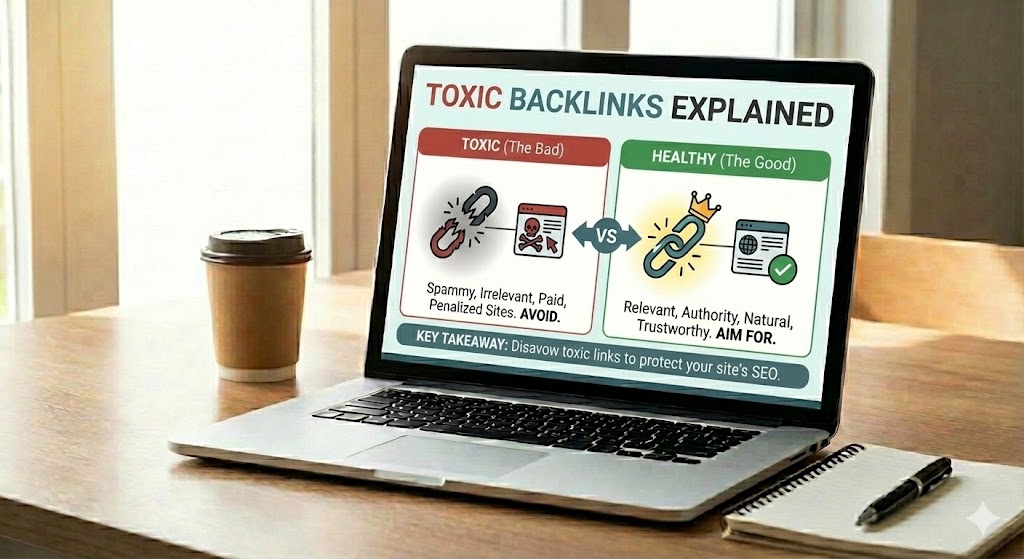
Toxic backlinks are links from other websites that point to your site but do more harm than good. They often come from spammy, fake, or very low-quality pages. Instead of helping your site grow, these links can send bad signals to search engines about your content and your reputation.
Search engines, like Google, use backlinks to measure how trustworthy and useful a website is. When many high-quality sites link to you, your site can look more important. But when you collect toxic backlinks, search engines may see your site as trying to trick the system, a practice sometimes described as manipulative link building.
If your site has too many toxic backlinks, you can face serious SEO problems. Your pages may drop in search rankings, you may lose organic traffic, and in worse cases, your site can be hit by a manual or algorithmic action that makes it very hard to appear in search results. This guide will explain, in simple terms, how toxic backlinks work, why they appear, and what you can do to stay safe.
Toxic Backlinks Explained
Messy pages full of random links and strange text are more than just unpleasant to look at. When those pages point to your own site, they can quietly damage your online reputation and search visibility over time.
In this part, we take a closer look at what makes some links actively harmful instead of simply unhelpful. Understanding these details helps you decide which backlinks to keep and which ones to remove or disavow.
At a basic level, a backlink turns toxic when it clearly exists only to manipulate rankings, not to help real users. Typical signs include links from link farms, auto-generated pages, or hacked sites that publish nonsense content packed with outgoing URLs.
- Hidden or sneaky placement inside footers, sidebars, or invisible text.
- Mass-produced patterns where hundreds of domains use the same anchor text.
- Zero topical relevance, such as a gambling page linking to a local school blog.
Toxic Backlinks Explained: What They Are
To understand toxic backlinks more clearly, it helps to think in terms of reputation. Imagine someone loudly recommending your shop in a crowded market, but that person is known as a scammer; their praise does not help your reputation, it makes people doubt you.
These harmful links are not just “bad quality.” They are created in a way that clearly tries to cheat ranking systems instead of serving real readers. A typical toxic link comes from pages filled with auto-generated text, stolen articles, or endless lists of unrelated URLs that no normal visitor would trust.
In practice, a backlink becomes toxic when the linking page, its context, and its anchor text together send a strong signal of manipulative intent. For example, dozens of unrelated blogs all linking to you with the same keyword-heavy phrase, or a hacked site inserting hidden footer links to your pages, are strong red flags that search engines may treat as toxic behavior.
Why Toxic Backlinks Are Bad for SEO
Once you know what toxic backlinks are, the next step is seeing why they matter so much for visibility and traffic. The impact often builds slowly, but the long-term damage to your site can be significant.
When harmful links start pointing at your site, the trouble is not only about “looking bad.” These signals can quietly change how search engines measure your credibility, authority, and long‑term growth.
Instead of supporting your pages, toxic links can act like negative votes that push your content down in search results and make recovery slow and difficult.
One major issue is a clear loss of trust. Search engines may see a pattern of spammy links and decide your site is part of a manipulative network, even if you never asked for those links.
- Ranking drops for important pages or keywords over weeks or months.
- Less organic traffic, even though your content has not changed.
- Manual actions, where a human reviewer flags your site for unnatural links.
- Algorithmic demotions, where systems quietly devalue your pages.
- Reputation damage, as your brand appears on hacked, adult, or scam sites.
Over time, these effects can force you to spend more effort fixing problems than creating new, useful content.
Common Types of Toxic Backlinks Explained
Knowing that toxic backlinks are harmful is one thing; recognizing them in the wild is another. Different types of spammy links leave different footprints, and some are much riskier than others.
This part walks through the most common toxic backlink types you are likely to see in real audits, so you can quickly spot which links deserve the most attention and cleanup effort.
Many harmful links come from old-fashioned spam directories that list thousands of sites with no real topic or audience. These pages often show the same short descriptions, no useful content, and long lists of outgoing URLs on every page.
In a typical backlink profile, such directory entries appear as low‑value patterns: exact‑match anchor text, no traffic, and dozens of near‑duplicate domains created only to sell placement. When you see this, it usually points to past bulk‑submission tools or cheap listing services.
Another risky group are paid or manipulative links, where money, gifts, or exchange deals buy a followed link meant to change rankings. These often sit in sidebars, “resources” pages, or guest posts that exist only to host keyword‑stuffed anchors.
Because these links are designed to influence algorithms instead of helping users, they fit common definitions of unnatural link schemes. Over time, clusters of such URLs can lead to widespread devaluation or even manual review.
Toxic patterns also appear when your pages are promoted on irrelevant websites. For example, a health clinic heavily linked from casino blogs, adult forums, or foreign‑language article networks sends confusing signals about your site’s true topic.
Search systems increasingly look for topical relevance, so large numbers of off‑topic references may be treated as clear attempts to game the system rather than genuine recommendations.
Finally, some of the most dangerous sources are auto‑generated links produced by bots, hacked scripts, or mass article spinners. These show up on pages filled with nonsense text, machine‑mixed paragraphs, or random keyword blocks.
- Site‑wide footer or blogroll links injected by malware.
- Comment spam blasts across thousands of posts.
- Machine‑translated pages recycling the same anchor phrases.
Because these patterns are easy to detect at scale, they are often treated as strong evidence of manipulative intent, making them prime candidates for removal or disavowal during cleanup work.
How Toxic Backlinks Are Created and Spread
After seeing the main toxic link types, it helps to understand how they appear in your profile in the first place. Many of them spread automatically, which is why they can multiply so quickly.
Have you ever checked your backlinks and found dozens of strange websites you never talked to? That usually means harmful links are being created and copied without your control, often faster than you can track them.
In this section, we will look at how toxic backlinks are born, multiplied, and recycled across the web. Understanding these patterns makes it easier to stop problems early and avoid repeating the same risky choices.
Many problems start with aggressive link tactics. Buying bulk links, joining large link exchange rings, or using low‑quality SEO services can trigger networks of sites to point at you with the same anchor text, creating a clear trail of manipulative link building.
Once your URL enters one of these systems, it is often copied again and again. Auto‑submit tools push your pages into spam directories, scraped article sites, and cloned blogs, so a single bad decision can quickly spread across hundreds of domains.
Even if you never pay for links, your pages can still be dragged into trouble. Spammers sometimes insert random URLs into comment blasts, hacked templates, or spun posts simply to make their pages look “connected,” and your site becomes collateral damage.
These patterns are reinforced when scrapers copy entire pages, including existing outbound links. Over time, one original mention turns into a chain of duplicate, low‑trust backlinks that all repeat the same risky signals.
“Spam links rarely stay in one place; they replicate wherever automation can reach.” – Bill Slawski
How Search Engines Handle Toxic and Low-Quality Links
Once toxic backlinks start to appear and spread, search engines must decide what to do with them. Their response can range from simply ignoring certain links to applying strong filters or actions.
Have you ever wondered what actually happens inside a search engine when it finds a suspicious link pointing at your site? Behind the scenes, complex systems quietly decide which links help you and which ones should be ignored or even counted against you.
Modern algorithms try to separate natural recommendations from manipulative link patterns. Instead of trusting every backlink, they score each one based on the linking page, the anchor text, and the surrounding content, then decide how much weight it deserves.
In many cases, doubtful or weak links are simply devalued. This means they pass little or no ranking power, similar to turning down the volume on a bad signal so it does not influence results as much.
When patterns look clearly abusive, search engines may go further. They can flag a whole group of domains, lower their ability to pass trust, or apply stronger actions to sites that appear to be organizing or buying large‑scale link schemes.
- Link-level devaluation for single spammy URLs.
- Domain-level distrust for known link networks.
- Site-wide impact when a backlink profile looks engineered.
Only in more serious situations do you reach the stage of explicit penalties. These can be manual actions, reviewed by humans, or algorithmic filters that quietly reduce visibility until the unnatural patterns are cleaned up and, if needed, disavowed.
Toxic Backlinks vs Low-Quality Backlinks Explained
Not every suspicious-looking backlink is equally dangerous, and treating them all the same can waste time and energy. Separating truly harmful links from those that are merely weak makes cleanup work more focused.
Have you ever seen a backlink that looked odd, but you were not sure if it was actually dangerous? This is where it helps to separate truly toxic links from links that are simply weak or unhelpful. Knowing the difference keeps you from panicking about every strange URL you find.
A toxic backlink is one that shows clear signs of manipulation or spam, such as being part of a link scheme or coming from hacked, auto‑generated pages. A low‑quality backlink might come from a small, messy, or inactive site, but it was not created mainly to cheat search rankings.
In practice, search engines may penalize or heavily distrust toxic links, while they usually just ignore most weak links. You can think of them this way:
- Toxic links = active risk that can hurt your SEO if patterns are strong.
- Low‑quality links = little or no benefit, but often no serious danger.
This means not every poor backlink deserves a disavow; focus cleanup on obvious spam, schemes, and hacked sources first.
Spotting and Preventing Toxic Backlinks in Beginner SEO
For anyone new to SEO, learning how to read backlink reports is an essential skill. Early awareness helps you avoid panic and catch risky patterns before they grow.
Have you ever opened a backlink report and felt confused by a long list of strange domains? Learning to tell which ones are safe and which ones are risky is one of the first real skills in beginner SEO.
For early-stage sites, the goal is not to chase every odd link, but to quickly notice patterns that look like obvious spam and avoid choices that create more of them. With a few simple checks, you can stay out of most serious trouble.
A practical way to start is to scan new links for clear warning signs: pages full of unrelated outbound URLs, nonsense text, or anchors that repeat the same keyword many times. When two or three of these clues appear together, the backlink is usually unsafe.
- Domains with no real content, only long lists of links.
- Foreign‑language pages that have no connection to your topic.
- Comment or profile pages using over‑optimized anchor text.
Prevention is even more important than cleanup. Stick to natural mentions from relevant sites, avoid buying placements, and be careful with any service that promises hundreds of links fast. Slow, topic‑focused growth is almost always safer than shortcuts.
Building a Safer Backlink Profile for Long-Term SEO Health
All of these ideas come together in how you shape your backlink profile over time. A careful, long-term approach keeps toxic signals low and makes it easier for search engines to trust your site.
Understanding toxic backlinks explained means seeing that not every strange link is a crisis, but clear patterns of spammy, manipulative links can slowly damage your site’s trust and rankings. By learning what they are, how they spread, and how search engines react, you can protect your website before real problems appear.
The key is to focus on relevance, honesty, and real users. When your backlinks mainly come from useful, related pages, search systems have fewer reasons to doubt you, and weak or odd links are more likely to be quietly ignored. Strong SEO is less about chasing quick wins and more about avoiding choices that look like manipulative intent.
As you grow, keep checking your backlink profile, watch for obvious spam patterns, and stay away from any shortcut that promises fast rankings through mass links. With steady, careful habits, you can control toxic backlinks and support your site’s long‑term visibility and reputation with a healthier link profile.