
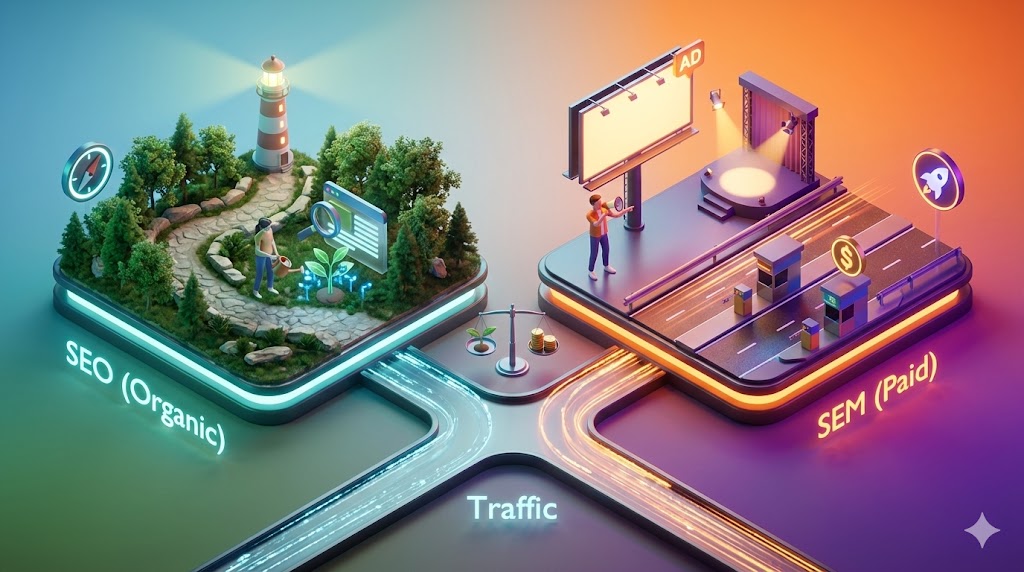
Many people mix up SEO and SEM because both aim to bring more visitors from search engines. They see a page of results and cannot easily tell which listings are free and which are paid, making it difficult to choose the right strategy for their goals and budget.
SEO, or Search Engine Optimization, is the process of improving a website so it appears higher in the free (organic) search results. It focuses on helpful content, clean site structure, and trusted links. The main aim of SEO is to build steady, long-term traffic without paying for each click.
SEM, or Search Engine Marketing, is a wider term that includes SEO but mainly refers to paid search ads. With SEM, you pay search engines to show your ad when people search for certain words. This method can bring fast, targeted visitors, but you must keep paying to stay visible.
By understanding the clear differences between SEO and SEM, you can decide which method to use, when to use it, and how to combine both for the best results.
SEO vs SEM – What’s the Difference?
Before diving into the details of each channel, it helps to see how they contrast side by side. The search results page you look at every day is where these differences become most visible.
When you search on Google or another engine, you often see a mix of listings with a small “Ad” label and others without it. That single screen is where the roles of SEO vs SEM become important to understand.
Both methods help you appear in search engines, but they work in very different ways. Knowing how they differ will help you choose the best approach for your goals, timing, and budget.
- SEO focuses on improving your site so it shows in unpaid, organic results.
- SEM mainly uses paid search ads to place you in sponsored results.
In simple terms, SEO is like planting a tree: it takes time to grow but can give shade for years. SEM is like buying fruit at the market: you get it right away, but only while you keep paying. Both can be powerful if you use them at the right moment and for the right reason.
Introduction to SEO vs SEM and Why They Are Confusing
Once you know there are both organic results and ads on the same page, it becomes easier to see why people mix these concepts up. The overlap in tools, tactics, and even language often blurs the boundaries between them.
Looking at a search results page can feel like reading a secret code. Some results have an “Ad” tag, others do not, yet all are mixed together in one long list. No wonder many people think SEO vs SEM are the same thing with different names.
Confusion grows because both methods use the same search box, the same users, and often the same keywords. On top of that, many articles and tools casually mix terms like organic search, paid search, and search marketing, which blurs the line even more for beginners.
Misunderstandings also arise because both activities can happen inside the same account on a search platform. You might improve landing pages for quality score in ads while also helping your organic rankings, so it feels like one single job instead of two related but different strategies.
- Shared goal: both want more visitors from search engines.
- Shared tools: both rely on keyword research, tracking, and testing.
- Different payment model: one pays per click, the other pays mainly with time and work.
Because of these overlaps, some teams say “SEM” when they really mean only paid ads, while others use it as a big term that includes SEO and ads together. This mix of meanings makes it hard for newcomers to know what they are actually learning, buying, or planning.
What is SEO and How Does It Work?
Having separated the concepts at a high level, it helps to look more closely at each one. Starting with SEO shows you how long-term visibility can be built without paying for every single click.
Have you ever wondered why some pages keep showing up again and again when you search, even though nobody is paying for those spots? That steady visibility comes from SEO working quietly in the background over time.
At its core, Search Engine Optimization is about making your pages easy for both people and search engines to understand. It sends clear signals about what each page is about so that search engines feel confident placing it in the right results.
Behind the scenes, SEO works through several connected parts that support each other. When these pieces line up, search engines see your site as more useful, trustworthy, and relevant than competing pages.
Some of the most important elements include:
- On-page optimization: using clear titles, headings, and text that explain the topic.
- Technical setup: fast loading, mobile-friendly design, and clean code that crawlers can read.
- Content quality: helpful answers that match what users are really looking for.
- Backlinks: links from other sites that act like votes of confidence.
Search engines use complex algorithms to read these signals and rank millions of pages. You cannot control the algorithm itself, but you can improve the signals it measures so your site has a better chance to appear higher for the right searches.
What is SEM and How Is It Different from SEO?
After seeing how SEO builds organic strength over time, the next step is to understand the paid side of search. SEM shows how you can buy visibility instead of slowly earning it.
Imagine you could skip the line and move straight to the front of search results, above the usual listings. That “front-of-the-line pass” is what SEM can offer when used correctly and within a clear budget.
Search Engine Marketing focuses on getting visibility through paid placements on search engines. The most common form is pay-per-click ads, where you bid on keywords and pay each time someone clicks. Unlike SEO, which earns visibility over time, SEM lets you switch traffic on and off almost like a light.
With SEM, you set campaigns, ad groups, keywords, and bids, then direct users to landing pages designed to match their search intent. Because you control spend and targeting, it is easier to test new offers, reach specific locations, and show different messages to different audiences.
SEM is different from SEO mainly in how you pay and how fast results appear: you buy immediate visibility instead of building it slowly. Both rely on relevance and quality, but SEM adds an auction layer, where a strong bid and a well-matched ad can place you above even highly optimized organic pages.
SEO vs SEM: Key Differences You Need to Know
With both concepts clearly defined, the real value comes from seeing how they behave in practice. Comparing them across a few core areas makes it easier to match each channel to your situation.
Standing in front of a new project, you might ask yourself whether to invest time building organic visibility or pay for quick exposure. Understanding the practical gaps between SEO and SEM helps you avoid wasting budget and effort.
Instead of repeating basic definitions, this section looks at how both methods behave in real use: how you pay, how fast they move, how stable the results are, and what risks they carry over time.
The most important contrasts appear in a few core areas: visibility control, cost pattern, data feedback, and long‑term value. Looking at each angle separately makes the overall picture much clearer.
- Control: SEM gives near instant on/off control; SEO changes more slowly.
- Cost: SEM cost scales with each click; SEO cost is mostly work up front.
- Stability: SEO can keep sending traffic even when you pause work; SEM stops the moment you stop paying.
- Testing: SEM is better for fast A/B tests; SEO is better for learning what users like over months or years.
When Should You Use SEO for Your Website?
Once you know how SEO and SEM differ, the next question is when each one makes the most sense. In many cases, SEO becomes the foundation that quietly supports your business for years.
Not every project needs paid ads from day one. Sometimes the smartest move is to build quiet strength in the background so your pages keep showing up long after early work is done.
You should lean on SEO when you want to build lasting visibility, reduce your cost per visit over time, and turn your site into a steady source of leads or sales instead of relying only on short bursts of traffic.
- Long-term goals: ideal if you plan to stay in your market for years and can wait months for strong results.
- Limited ad budget: helpful when you cannot pay for every click but can invest time in content and improvements.
- Evergreen topics: works best for questions and problems that people search for again and again over time.
- Building authority: useful when you need to be seen as a trusted expert through content, guides, and helpful resources.
- Improving user experience: SEO work on speed, structure, and clarity also makes your site easier for visitors to use.
When Is SEM the Better Choice?
While SEO focuses on the long game, some situations demand immediate traction. This is where SEM can step in as a flexible, fast-moving tool.
Have you ever needed results this week, not six months from now? That kind of pressure is where SEM often shines, because it can put you in front of searchers almost instantly if you set it up well and control your spend carefully.
Instead of slowly earning visibility, paid campaigns let you appear for chosen searches within hours. This makes SEM a strong fit in several specific situations where timing, testing, or tight targeting matters more than long-term growth.
- New websites or offers: helpful when you have little or no organic visibility yet but must start getting clicks and data quickly.
- Time‑sensitive campaigns: ideal for sales, seasonal events, product launches, or limited promotions that run only for a short period.
- Precise audience targeting: useful when you need to reach users in certain locations, on certain devices, or with specific search intents.
- Fast testing and validation: powerful for A/B testing landing pages, messages, and keywords before investing in long‑term SEO content.
- Competitive markets: practical when organic spots are crowded and paid listings are the only realistic way to appear at the very top.
How SEO vs SEM Work Together and Related Topics
Once the strengths of each channel are clear, the real opportunity lies in combining them. Used together, SEO and SEM can create a search strategy that is both resilient and responsive.
Imagine having both a strong engine and a turbo boost in the same car. One keeps you moving day after day; the other helps you speed up when you really need it. That is how SEO vs SEM can work together when planned as one combined strategy.
Instead of choosing only one, many teams blend both to balance short‑term wins with long‑term growth. The trick is knowing what each does best and letting them support, not fight, each other.
Used side by side, they can share keyword data, improve landing pages, and lower your overall cost per lead. For example, you can test offers quickly with paid ads, then turn the best‑performing ideas into long‑lasting organic pages.
- Use SEM first to discover which search terms convert.
- Turn winning terms into SEO content and evergreen guides.
- Let organic pages handle broad searches while ads focus on high‑value phrases.
This mix naturally opens doors to other areas of digital marketing that support search results. Some of the most closely related topics include:
- Keyword research and intent analysis
- Landing page optimization and A/B testing
- Conversion rate optimization for forms and checkouts
- Web analytics and attribution modeling
- Content strategy and information architecture
- Local search optimization for map and nearby queries
Bringing SEO and SEM Together for Smarter Search Marketing
By this point, the roles of both channels and how they support each other should be clear. The final step is to keep your focus on the bigger picture: a flexible search strategy that can adapt as your needs change.
SEO vs SEM is not a choice of right or wrong, but a question of timing, goals, and resources. SEO builds steady, low‑cost visibility by improving content, structure, and trust over time, while SEM delivers fast, targeted exposure through paid placements you can control like a switch.
The most effective approach is to treat SEO and SEM as partners, not rivals. Use SEM to gather quick data, validate offers, and drive urgent traffic, then feed those insights into SEO to grow durable organic reach. Over months and years, this mix helps you lower your average cost per visitor while still having the power to react quickly when markets, products, or priorities change.
As you plan your next steps, think in terms of search strategy as a whole: how users search, how your pages answer those needs, and how both algorithms and ad auctions see your site. With a clear view of SEO and SEM, you can set the right balance for today and adjust it confidently as your business and audience evolve.