
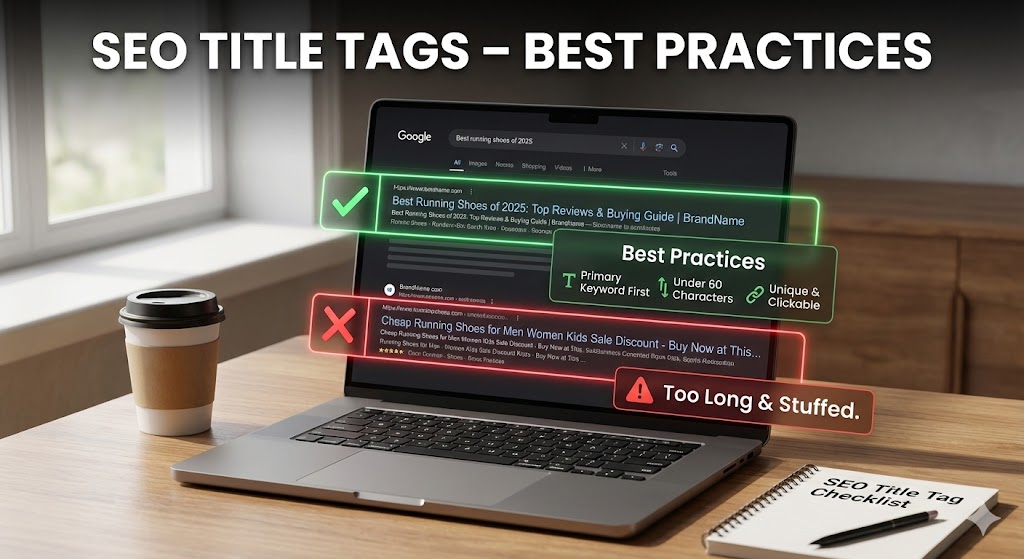
Title tags are short pieces of text that tell search engines and users what a page is about. They show up as the blue, clickable line in search results and at the top of your browser tab. When written well, they give a clear, fast snapshot of your page’s main topic.
For SEO title tags, small changes can make a big difference. A strong title tag helps search engines understand your content, which can improve how your page ranks. At the same time, it helps users decide whether to click your result or skip it.
Search engines use complex algorithms to read and rank web pages, and title tags are one of the first things they look at. A clear, focused title tag can lead to better visibility, more clicks, and more relevant visitors to your site. In this guide, you will learn step by step how to write title tags that are simple, accurate, and effective, even if you are just starting with SEO.
SEO Title Tags – Best Practices for Effective Search Optimization
Before diving into technical details, it helps to see title tags as your page’s first impression in search results. A few words decide whether someone chooses your content or scrolls past. With the right approach, that short line becomes a powerful asset.
Ever wondered why some search results grab your attention right away while others fade into the background? Very often, the difference comes down to the way their SEO title tags are written. With a few simple rules, you can turn a plain line of text into a strong signal for both users and search engines.
To get the best results, focus on a handful of practical habits. First, make sure each page has a unique, descriptive title that clearly says what the page is about. Include your main keyword early, but keep the wording natural and easy to read. Short, clear language usually beats long, confusing phrases.
- Place your primary keyword near the beginning when it fits naturally.
- Keep titles within about 50–60 characters to reduce the chance of being cut off.
- Avoid keyword stuffing; one main phrase and maybe a related term is enough.
- Write for people first, then adjust slightly for search engines.
Understanding SEO Title Tags
Once you know the basic best practices, it is useful to understand what title tags actually do. By seeing how they function for both search engines and humans, you can write them with more purpose and confidence. This foundation makes every later optimization step easier.
Imagine picking a book from a shelf using only the words on its spine. That short line of text helps you decide in a second if the book is worth opening. A page’s SEO title tag works in almost the same way for both search engines and people.
Instead of just being a label, a title tag acts like a summary and promise. It tells search engines what the page should rank for and tells users what they will get if they click.
A well‑built title tag has three key roles: it describes the topic, hints at the value of the content, and helps search systems place the page in the right results. Behind the scenes, crawlers read this line to quickly classify and compare your page with others.
- Structure: simple text placed inside the HTML <title> element.
- Audience: serves both algorithms and human readers at the same time.
- Goal: win a relevant impression and a click with just a few words.
Why SEO Title Tags Matter for Rankings and Clicks
Understanding how title tags work naturally leads to the question of why they matter so much. Their impact goes beyond basic labeling and directly touches both rankings and user behavior. Seeing this dual role helps you prioritize your effort where it counts most.
Think of a crowded search page where every result is fighting for a single click. In that split second, your SEO title tags act like a small ad that must convince both people and search engines that your page is the right choice.
From a search engine’s view, this line of text is a strong clue about topic relevance. When your wording matches what users search for, algorithms can more confidently place your page higher for that query, which often leads to more consistent visibility over time.
On the human side, a focused title can boost your click‑through rate (CTR). Clear promises such as “step‑by‑step guide” or “checklist” tell readers what they gain, helping your result stand out even when it is not in the very top position.
- Higher rankings: precise titles help search systems connect pages to the right searches.
- More clicks: engaging wording attracts attention in busy result lists.
- Better traffic quality: accurate phrasing filters out visitors who are not a good match.
Core Elements of an Effective SEO Title Tag
Once you see how much titles influence rankings and clicks, the next step is knowing what to include in them. A good title is not random; it is built from a few clear components that work together. Keeping these elements in mind turns writing into a repeatable process, not a guess.
When two pages cover almost the same topic, the one with the clearer, sharper line of text at the top usually wins the click. That edge does not come from tricks, but from a few solid elements working together in a small space.
To build a strong, reusable habit, it helps to know exactly what those elements are and how they interact. Think of them as parts of a simple formula you can apply to every new page you publish.
An effective title line usually combines a primary keyword, a clear topic description, and a short hint of user benefit, such as “guide,” “template,” or “checklist.” When needed, you can add a brand or site name at the end, separated with a dash or vertical bar. Together, these pieces create a compact message that is easy to scan, rank, and click.
Length and Formatting Guidelines for SEO Title Tags
After choosing the right elements, you still need to fit them neatly into the space search results allow. Length and formatting shape how your titles appear on different devices and how users perceive them. A few simple limits prevent strong ideas from being cut off or overlooked.
When space is tight, every character has to work hard. That is why clear rules for length and formatting make it much easier to write title lines that both display well and attract clicks.
Most search engines can comfortably show around 50–60 characters before cutting text off. This is not a strict rule, but more of a safe display range that keeps your main idea visible on most screens.
To stay inside this window, put the primary keyword and main benefit early, then trim extra words like “best,” “very,” or “really.” If your topic or brand name is long, test shorter variants so the most important phrase does not disappear in the middle.
- Keep vital words before character 50 whenever possible.
- Remove low‑value fillers and repeated terms.
- Use a simple divider like a dash or vertical bar before a brand name.
Clean formatting also helps. Use title case or sentence case consistently, avoid all caps, and skip special symbols that can look spammy or break in some browsers.
On-Page Optimization Techniques for Strong Title Tags
Good titles work best when the rest of the page supports them. By aligning headings, text, and links with your chosen topic, you send a clear, consistent message. This on‑page harmony makes it easier for both users and search engines to trust what your title promises.
When pages start competing for the same search term, small on-page details often decide which one wins the click. Careful tuning of nearby elements gives your SEO title tags stronger support and clearer context for both crawlers and readers.
Instead of treating the title as a single line floating on its own, connect it closely with the rest of the page. This alignment makes your topic easier to understand, reduces confusion, and can gently boost relevance without adding extra risk.
Begin by matching your main heading (H1) and title so they share the same core idea, even if the wording is not identical. Then reinforce that idea in your opening paragraph, using related phrases that feel natural, not forced, to confirm what the page is really about.
- Use the same primary topic phrase in the title, H1, and early body text.
- Organize content with clear subheadings so the promise in the title is fully covered.
- Align meta description, URL, and internal links with the title’s main focus.
Internal links can also support a strong title when they use descriptive anchor text that reflects the target page’s topic. Over time, this creates a clear map of themes across your site, helping search systems trust that each page really deserves the wording shown in its title line.
Common Pitfalls to Avoid with SEO Title Tags
Even with solid tactics in place, certain mistakes can quietly weaken your efforts. Recognizing these issues early saves you from losing clicks and diluting your message. Treat them as warning signs to check for whenever you publish or update a page.
Small mistakes in your SEO title tags can quietly reduce clicks, even when your content is strong. By spotting these issues early, you can fix them before they harm visibility or waste valuable impressions.
Many of these problems are easy to avoid once you know what to look for, from repeated wording to weak, vague phrases. Use the points below as a quick checklist whenever you publish or update a page.
- Duplicate titles across pages that make it hard for search engines to see which page is most relevant.
- Keyword stuffing that turns the line into an unreadable string of repeated phrases.
- Overly long titles where key words are cut off in results, hiding the main benefit.
- Vague wording like “Home” or “Products” that gives no clear topic or intent.
- Missing primary keyword, so search systems must guess what the page is about.
- Clickbait promises that do not match the content, leading to fast returns and lower trust.
- Ignoring mobile display and writing titles that look cramped or unclear on small screens.
Advanced Tips for Testing and Improving SEO Title Tags
After avoiding common pitfalls, you can push performance further with data-driven refinement. Testing different versions of your titles shows what your audience actually responds to. This ongoing fine-tuning keeps your pages competitive as search behavior shifts.
Ever looked at your analytics and wondered why a well‑written page still gets fewer clicks than expected? Often, the answer hides in how that page is presented in results, not in the body text itself. Careful testing of your SEO title tags can uncover small wording changes that lead to clear gains.
Instead of guessing, use simple tests and data to guide improvements. Over time, this turns your titles from one‑time decisions into a repeatable optimization process that keeps working as search behavior changes.
- Track click‑through rate (CTR), impressions, and average position for each key page.
- Rewrite low‑CTR titles to add clearer benefit statements or sharper topics.
- Test changes in batches, then wait long enough to see stable trends.
When adjusting wording, compare at least two versions: one focused on clarity, another on a slightly stronger value promise. As data comes in, keep the variant that brings more relevant visits and drop the weaker option to build a more effective pattern across your site.
Bringing Your SEO Title Tags Together for Lasting Results
All these practices come together to create titles that consistently support your search goals. Clear, honest wording aligned with your content and refined through testing gives every page a stronger chance to earn the right clicks. Over time, this steady approach adds up to better visibility and more relevant traffic.
Strong SEO title tags are not about tricks; they are about clear communication. When each page has a focused, honest title that matches its content, you help both users and search engines quickly understand what your site offers and why it deserves attention.
By combining sound structure, smart length and formatting choices, and careful on‑page alignment, your titles become reliable guides instead of random labels. Avoiding common errors and using data‑driven testing turns title creation into a simple, repeatable process rather than a one‑time guess.
As search behavior and algorithms continue to evolve, your best advantage is a habit of regular review, small experiments, and steady improvements. Keeping your SEO title tags focused on user needs ensures they quietly support rankings, attract qualified clicks, and reinforce the overall strength of your content.