
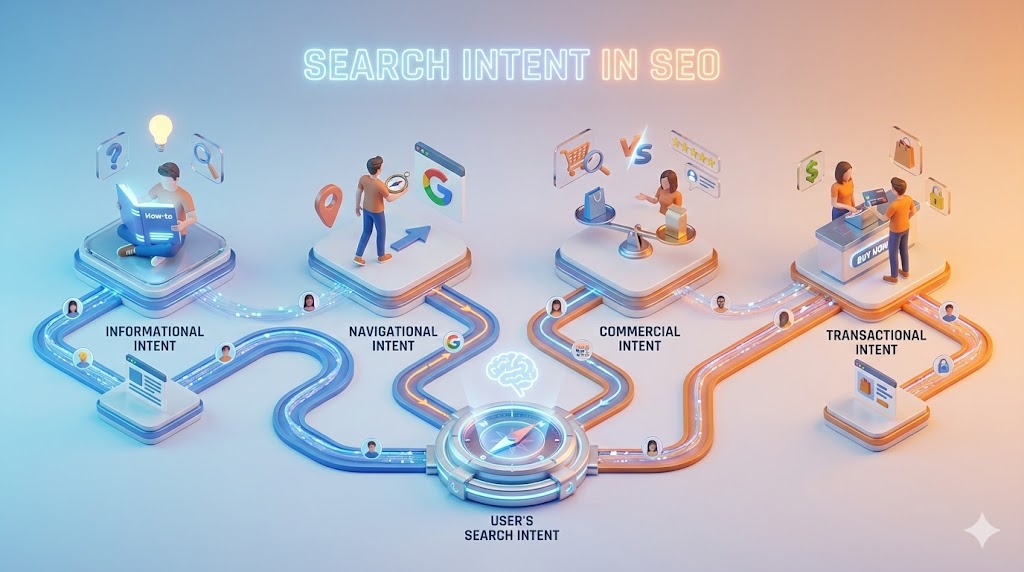
When people type words into a search engine, they always have a reason or goal in mind. This reason is called search intent. It is the real purpose behind a search, such as learning something, going to a website, comparing options, or buying a product. Even if two people use the same words, their intent can be different based on what they actually want to do.
Grasping this intent is very important in Search Intent in SEO because it helps you create pages that match what users really need. Modern search engines use advanced algorithms and machine learning to guess this intent and show the most helpful results. If your content does not fit the user’s goal, it is less likely to rank well.
By learning how to read search intent, you can decide what type of content to create, what angle to use, and how to structure your page. This makes your content more useful for visitors and sends strong signals to search engines that your page is a good answer. In this way, search intent becomes a core part of any effective SEO strategy.
Have you ever wondered why some pages rank even when they use fewer keywords than others? Often the difference lies in how well they match the user’s hidden goal behind the query, not how many times a phrase appears on the page.
Instead of focusing only on single words, modern Search Intent in SEO work looks at the context, format, and purpose of a search. This approach helps you decide whether to create a guide, a product page, a comparison, or another type of content that truly fits what people want to do next.
Defining Search Intent in SEO
Before you can optimize for intent, you need a clear picture of what it actually is. This section explains how to think beyond keywords and focus on the outcome users want when they search.
Picture two people typing the same phrase into a search box, but wanting totally different things. One may want to buy, the other just wants to learn. This hidden difference is exactly what this section will clarify.
Search intent in SEO is the specific goal a user wants to achieve when they type a query. It describes whether someone aims to learn, go somewhere, compare options, or take action (like signing up or buying). Instead of looking only at words, you focus on the action behind those words.
For SEO work, this means each page should be built around a clear, single intent. A tutorial that suddenly turns into a hard sales pitch often fails, while a focused, well-structured page fits what users expect and earns better rankings.
You can think of intent in simple groups that guide content creation:
- Learn something (guides, FAQs, explainers)
- Find a specific site or page (login pages, tools, platforms)
- Compare and research (reviews, “best of” lists)
- Complete an action (checkout, bookings, sign-ups)
Why Search Intent in SEO Matters for Rankings and Users
Once you understand what users are trying to do, the impact on rankings and experience becomes clearer. This part connects intent with how search engines judge relevance and how visitors react to your pages.
Imagine two pages targeting the same phrase: one is a deep, clear answer and the other is a random mix of facts and sales copy. The first often wins, even with fewer keywords, because it lines up with what people actually want to do.
Matching that hidden goal is what makes search intent in SEO so powerful. When your page fits the user’s purpose, search engines see higher engagement and treat your content as a relevant, trustworthy result.
From a ranking view, intent affects key signals: people stay longer, click more, and bounce less when content matches their needs. Over time, this tells algorithms your page is a strong answer for that query type, not just a page that repeats the same words.
For real users, good intent matching feels natural. A person researching gets a clear guide, while someone ready to buy lands on a simple checkout page. This reduces confusion, builds user satisfaction, and makes it easier for visitors to complete the actions that also matter to your business.
Core Types of Search Intent
Not every search reflects the same mindset. Some queries come from curiosity, others from urgency, and many from a stage in between. Understanding these patterns helps you align each page with the right user expectation.
Below are the four main types used in Search Intent in SEO. Each has its own typical wording, best content formats, and role in the customer journey, from first question to final action.
Informational intent appears when someone wants to learn or understand something. Queries often include words like “how,” “what,” or “why,” for example: “how to plant tomatoes,” “what is HTTPS,” or “why is my laptop slow.” These searches call for clear explanations, step‑by‑step guides, or short definitions, not aggressive sales content.
With navigational intent, users already know the place they want to reach and only need help getting there. Phrases such as “email login,” “online banking,” or “YouTube studio” show that the goal is to open a specific site or tool. Here, the winning result is usually a simple, direct page that loads fast and is easy to recognize.
People who show commercial investigation intent are comparing choices before deciding. They might search “best budget phone 2025,” “top SEO tools for beginners,” or “laptop A vs laptop B.” Content that works well includes comparison tables, pros and cons lists, and honest reviews that help readers choose.
Finally, transactional intent signals that the user wants to complete an action now, often a purchase or sign‑up. Typical examples are “buy running shoes online,” “book hotel in Paris,” or “subscribe to grammar checker.” In these cases, streamlined product or checkout pages with clear prices and calls‑to‑action usually perform best.
Informational, Navigational, Commercial, and Transactional Examples
Knowing the theory behind intent types is useful, but seeing them in real searches makes the concept easier to apply. This section walks through everyday examples so you can quickly recognize what users expect to find.
Have you ever looked at a search results page and noticed how some links are guides, others are product cards, and some are just login pages? That mix is not random. It reflects the dominant search intent behind the words people type.
To make this practical, the following examples show how the same topic can lead to very different queries and page types. By studying these patterns, you can plan content that fits what users expect to see when they search.
For informational intent, people want clear answers and explanations. Typical queries include “how to fix slow internet,” “what is machine learning,” or “benefits of drinking water.” Helpful pages might contain:
- Step‑by‑step tutorials with simple language
- Short definitions followed by deeper sections
- FAQs that solve common follow‑up questions
As usability expert Jakob Nielsen notes, “Users scan pages; they don’t read every word.” This means that for these searches, clear headings, lists, and quick answers matter as much as the text itself.
When intent is navigational, the person already knows where they want to go. They might type “email login,” “analytics dashboard,” or “school portal” because the address is hard to remember or faster to reach through a search box.
Here, strong results usually include:
- A recognizable brand or site name in the title
- Simple URLs that look trustworthy
- Pages that load fast and show the desired tool or login form right away
Trying to rank a long blog post for these phrases rarely works, because it does not match the direct, task‑focused goal of the user.
When intent shifts to commercial investigation, people start measuring options. Queries may look like “best budget headphones under 50,” “top vitamin D supplements,” or “standing desk vs office chair.” They are not buying yet, but they are close.
- Comparison tables that show specs and prices side by side
- Pros and cons lists for each option
- Real‑world use cases and simple performance notes
Content that wins here acts like a fair guide, not a loud ad, helping the reader move toward a confident decision.
In the case of transactional intent, someone is ready to act now. Searches such as “buy noise cancelling headphones,” “book dentist near me,” or “signup for online coding course” show a clear wish to pay, book, or register.
Effective pages for these terms share a few traits:
- Clear prices and simple product or service descriptions
- Short forms and visible call‑to‑action buttons
- Trust elements like reviews, guarantees, or secure payment badges
Trying to rank a long theory article for these phrases usually fails, because users expect a focused page that lets them complete the action with as few clicks as possible.
Practical Ways to Analyze and Classify Search Intent in SEO
Recognizing intent in theory is one thing; applying it to real keyword lists is another. Here you will see straightforward methods to turn raw phrases into a structured plan that matches user goals.
Have you ever looked at a keyword list and wondered which phrases need a blog post and which ones deserve a product page? That confusion is a sign that you need a clear way to analyze and classify intent before creating anything.
This section walks through simple, repeatable steps you can use to understand what people really want, using only basic tools and careful observation. By following them, you turn random keywords into a clear content plan that fits user goals.
A good starting point is the live results page. When you search a phrase, look closely at the first page and ask: What type of pages dominate? If most results are guides and FAQs, the dominant intent is usually informational. If you mainly see product cards and filters, it is often transactional.
To make this easier, you can note what appears most often:
- How‑to articles and definitions → usually learning‑focused
- Brand homepages and login screens → usually navigational
- “Best” lists and comparisons → often commercial research
- Shop or booking pages → usually action‑focused
Language patterns in the query also give strong clues. Words like “how,” “what,” or “why” tend to point to questions and explanations, while terms such as “buy,” “price,” or “near me” point toward immediate action. Phrases like “best,” “review,” or “vs” often show that the person is still comparing options.
Many specialists keep a simple sheet where they tag each phrase with one clear label. A basic setup might look like this:
- Column 1: keyword or phrase
- Column 2: observed dominant intent (info, nav, commercial, transactional)
- Column 3: best content type (guide, tool page, comparison, product page)
Over time, this habit turns into a fast mental skill. You stop guessing and start matching each query to one main goal, then build a page that serves that goal completely instead of mixing many different purposes into a single, confusing piece of content.
Common Mistakes When Working With Search Intent
Even with a solid grasp of intent types, it is easy to misapply them in real projects. This section highlights frequent pitfalls so you can avoid weakening both rankings and conversions.
Have you ever created a page that targeted a “good” keyword, but it still refused to rank or convert? Often the problem is not the topic itself, but how poorly the content fits real user intent. Avoiding a few frequent errors can save many hours of rewriting later on.
Below you will find typical traps that even experienced teams fall into. By spotting them early, you can design each page around one clear goal and give search engines a strong, consistent signal.
One major issue is trying to serve every type of intent on a single URL. A page that mixes long theory, comparisons, and a checkout button usually confuses visitors. Instead, keep informational, commercial, and transactional purposes on separate, focused pages that link to each other.
Another frequent mistake is copying the keyword without checking the live results. When teams skip the SERP, they often publish guides where users really want product cards, or sales pages where people only expect a short explainer.
Teams also misjudge intent by looking only at individual words like “buy” or “best” and ignoring context. A phrase containing “best” is not always commercial; sometimes users just want general recommendations. Careful reading of the full query prevents such misclassification.
Finally, many sites forget to update older content when user behavior shifts. Over time, a once‑informational query can gain stronger buying signals, and pages that never adapt slowly lose both rankings and engagement.
- Blended pages that chase all intents at once
- Ignoring SERP clues about what format users prefer
- Over‑reliance on single words instead of full phrases
- Outdated content that no longer matches how people search
- Weak internal links that do not guide users to the next logical step
Applying Search Intent Insights to Content, UX, and Conversion Optimization
Knowing what users want is only useful if it changes how you design pages. Here you will see how intent can shape content, layout, and navigation to support smoother journeys and stronger results.
Why do some pages feel “just right” the moment you land on them, while others make you click back in seconds? The difference often comes from how well the page was designed around a single, clear user intent instead of random guesses.
By turning intent research into concrete changes in content, layout, and calls‑to‑action, you can guide visitors from first click to final action with less friction. This section shows practical ways to use search intent in SEO to improve both user experience and conversions.
Start with the page itself. Once a query is tagged as informational, navigational, commercial, or transactional, adjust the headline, intro, and structure to match what visitors expect. A “how to” search should see a fast answer, clear steps, and only gentle internal links toward related tools or offers, not a screen full of banners.
For more action‑focused queries, flip that balance. Put key details, prices, and main buttons near the top, then add supporting text, FAQs, and trust signals below. This aligns the visual hierarchy with the visitor’s urgency and reduces extra scrolling before they can act.
- Informational pages → clear headings, summaries, and optional soft CTAs
- Commercial pages → comparisons, feature blocks, and visible “view offer” links
- Transactional pages → short forms, strong CTAs, and minimal distractions
Beyond layout, intent should shape how you guide people between URLs. A useful pattern is to create stepwise internal paths that match the natural journey: from learning, to comparing, to buying. For example, a guide about “how to choose a laptop” can link to a comparison page, which then links to focused product or booking screens.
When this flow is clear, visitors rarely feel pushed; they simply see the next logical step at the moment they are ready. Over time, this improves engagement metrics, lowers friction, and signals to search engines that your site handles the full journey in a structured, user‑friendly way.
Bringing Search Intent and SEO Together in Practice
Bringing everything together means treating intent as the starting point for every SEO decision. Instead of chasing keywords, you focus on the real goal behind every query and let that guide what each page should do.
Understanding search intent in SEO means looking beyond single words and recognizing whether users want to learn, find a specific page, compare options, or complete an action. When you analyze live results, avoid blended pages, and build each URL around one clear purpose, you help both users and search engines.
Ultimately, treating intent as a core design rule for topics, layouts, and internal links turns SEO into a structured way of serving real user needs, supporting stronger engagement, relevance, and long‑term growth as search behavior and machine learning‑driven algorithms continue to evolve.