
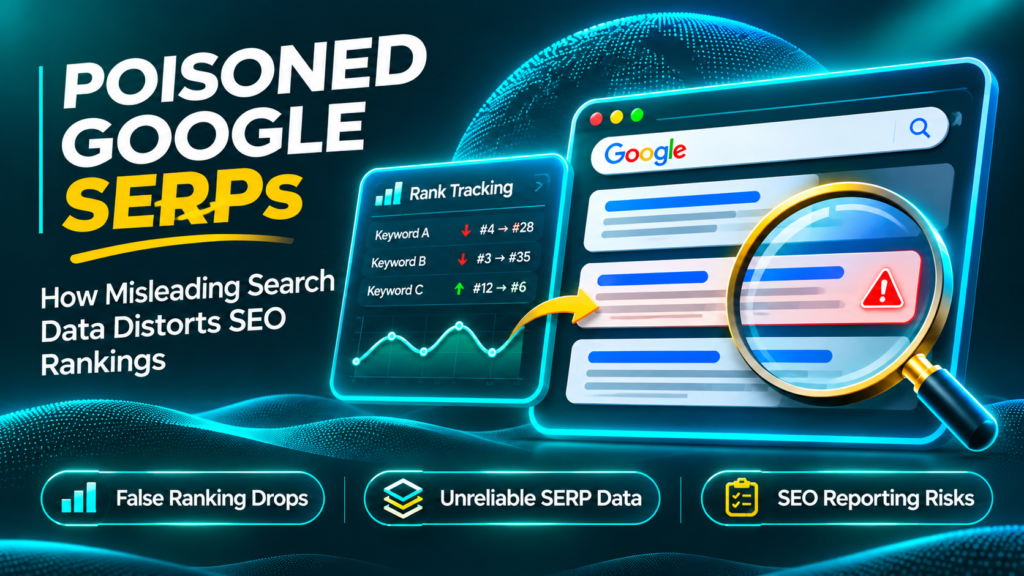
Poisoned Google SERPs describes a search-data problem reported by SEO platforms in 2026: some automated requests used to collect Google rankings returned complete-looking results pages that differed sharply from the websites normally ranking for those keywords. When rank-tracking tools collect and interpret these unusual pages, their reports can show misleading keyword movements—even when a website’s actual search performance has not changed in the same way.
For SEO professionals, the key issue is data reliability. A sudden ranking drop in a third-party platform should not automatically be treated as a Google penalty, an algorithm update or a real loss of organic visibility. The result needs to be checked against other evidence.
What Are Poisoned Google SERPs?
SERP stands for Search Engine Results Page. It is the page displayed after a search query.
In this industry issue, “poisoned” is the term used by Nozzle for an automated Google results page where fewer than half of the websites that usually appear for that keyword are present on the page being assessed. The page can still look like a normal search results page. The anomaly becomes visible when the collected results are compared with that keyword’s own historical pattern.
This is not the same as a website being hacked, malware appearing in search results, or malicious websites targeting search users. The topic here is misleading ranking data collected by automated SEO tools.
What Happened in 2026?
Nozzle’s research reports that automated requests to Google began failing more often from September 13, 2026. It says the first poisoned pages in its dataset appeared on September 20. The study compares each keyword’s collected results with its own baseline results from August 20 to September 9.
In its November 3 update, Nozzle reported that it had judged 68.7 million SERPs across 58 countries and desktop, iPhone and Android devices. Of those, 42.5 million were collected from September 13 onward.
Key findings from Nozzle’s research
- 27.6% average: Of desktop SERPs judged on both page one and page two since September 13, 27.6% were classified as poisoned on at least one of those pages.
- 68.6% peak: The highest daily figure for that measure was recorded on November 2, 2026.
- 0.28% baseline: The comparable rate in the study’s baseline period was 0.28%.
- 63.7% missing from the top 10: On poisoned SERPs, a site that usually ranked in the top 10 was missing from the top 10 in 63.7% of cases, compared with 2.6% in the baseline period.
- Page two was more affected: Nozzle found page two was poisoned about 1.5 times as often as page one in its desktop sample judged on both pages.
These numbers describe Nozzle’s own tracked sample and its definition of a poisoned SERP. They are not a measurement of every Google search, every country or every SEO platform. Other providers reported different rates because their samples, collection systems, filters and definitions differed.
Read the original Nozzle Poisoned Google SERPs research for its full methodology and country-level breakdown. Its November update reported India at 22.8% of judged SERPs in the study’s sample since September 13; this is a vendor-specific estimate, not a national Google-wide rate.
Why Do Poisoned SERPs Affect SEO Rank Trackers?
Rank-tracking tools collect search results for selected keywords, locations, languages and devices. They identify the ranking URLs and positions, then turn those observations into keyword reports, visibility charts and competitor comparisons.
If a collection request receives an unusual results page, a tracker may initially interpret those results as genuine rankings. That can create false drops, unexpected gains or missing competitors. Platforms have responded with different forms of validation, filtering, retries and reporting changes.
How Misleading SERP Data Can Affect SEO Work
1. False keyword ranking drops
A page that usually ranks in the top five may suddenly appear outside the top 100 in a tracking report. Without validation, the SEO team may assume that Google has demoted the page, even though the report may reflect an abnormal collection.
2. Unreliable competitor analysis
If familiar ranking domains disappear and unrelated URLs appear, competitor reports can become misleading. Teams may spend time analysing websites that are not genuine competitors for that search query.
3. Inaccurate visibility scores
Many platforms calculate visibility from tracked keyword positions. If the positions are wrong, visibility charts and share-of-voice comparisons can also be distorted.
4. Misleading client reports
Agencies may report ranking losses or gains that are not supported by organic clicks, impressions or conversions. This can create unnecessary concern and make monthly reporting less trustworthy.
5. Unnecessary SEO changes
Reacting too quickly can lead to avoidable title changes, content rewrites, URL removals or backlink campaigns. Before making changes, establish whether the ranking movement is real.
6. Historical reporting inconsistencies
If abnormal observations are stored as normal ranking data, historical charts may show artificial spikes or drops. Ask the provider whether it has reviewed or corrected affected historical records.
What Have SEO Platforms Reported?
Search Engine Land has reported that several SEO and SERP-data providers acknowledged abnormal Google results and described steps to reduce their impact. The companies do not all measure the issue in the same way, so their percentages should not be compared directly.
- Semrush: Reported adding checks to detect and exclude invalid results, adjusting data sources and recollecting results that may be inaccurate.
- Ahrefs: Reported filtering abnormal results, requesting replacement data and reviewing historical records that may have been affected.
- AccuRanker: Described comparing collected results with historical patterns and using additional checks or recollection when results look suspicious.
- SISTRIX: Reported additional quality checks and changes to on-demand updates to avoid bypassing those checks.
- DemandSphere: Reported adding visibility into error and sampling rates so customers can better understand the quality of ranking data.
These are summaries of provider statements reported by the industry press, not a guarantee that every platform has eliminated the problem. For details, read Search Engine Land’s report on Semrush and poisoned results and its guide to what is happening and what SEO teams can do.
How to Identify a Possible Poisoned SERP in Your Reports
Look for sudden, widespread changes
If many unrelated keywords show unusually large position changes at the same time, check whether the tracker has collected abnormal results. A widespread change is a reason to investigate, not proof of poisoning.
Check whether the ranking URLs make sense
Review the actual URLs and domains reported for important keywords. If familiar results are missing and unrelated pages appear, save the report and compare it with another collection.
Compare the same keyword over several collection dates
Look for a sudden change followed by a return to the previous pattern without corresponding website changes. This may indicate a collection anomaly, although genuine rankings can also fluctuate.
Compare with Google Search Console
Review clicks, impressions, queries, landing pages and average position in Google Search Console. If a third-party tracker reports a sharp decline while Search Console clicks and impressions remain broadly stable, investigate the discrepancy.
Search Console average position is not the same as a fixed-location rank check: it reflects impressions across users, locations, devices and search appearances. Use it as an independent performance signal, not a one-to-one replacement for rank tracking.
Check whether your provider flagged data-quality issues
Look for notices about delayed updates, filtered results, retries, sampling rates or known data collection problems. Contact support if a major ranking change is not explained.
How to Protect Your SEO Reporting and Decisions
1. Do not react to a single ranking snapshot
Treat a sudden drop as a signal to investigate. Wait for a validated follow-up collection and compare the movement with other performance indicators before changing a page.
2. Use Google Search Console for first-party search performance
Monitor organic clicks, impressions, CTR and query-level trends. Segment by page, country and device to understand whether actual search traffic is changing.
3. Validate priority keywords independently
For your most valuable commercial keywords, check results with the correct country, language, location and device settings. Manual searches can be personalized and location-dependent, so use them as a supporting check rather than absolute proof.
4. Compare tools, but understand their limitations
A second provider can help identify an outlier. However, providers may share collection infrastructure or data sources. Agreement between tools is useful evidence, but it is not a guarantee of accuracy.
5. Ask vendors about their data-quality process
Ask whether they compare current SERPs with historical results, detect unusual domains, retry suspicious requests, filter invalid observations and correct historical data. Prefer transparent explanations over unexplained ranking charts.
6. Separate measured performance from estimated rankings
In client reports, show rank-tracker trends separately from Search Console clicks and impressions, analytics sessions and conversions. If ranking data is under review, say so clearly rather than presenting it as a confirmed ranking loss.
Has Google Confirmed the Cause?
Google has not publicly confirmed that it deliberately serves altered search results to rank-tracking tools. Industry coverage has discussed technical changes and stronger restrictions that make large-scale automated collection more difficult. Some providers and researchers have suggested these changes may be related to the abnormal results, but that explanation has not been confirmed by Google.
The period also overlapped with Google’s September 2026 spam update. Genuine ranking changes and collection anomalies can occur at the same time. SEO teams should therefore avoid assuming that every ranking movement during this period has one cause.
Poisoned SERPs Are Not the Same as SEO Poisoning
The terms are easy to confuse, but they describe different issues.
| Poisoned Google SERPs | SEO poisoning |
|---|---|
| Abnormal or misleading results collected by automated rank-tracking systems. | Malicious manipulation of search visibility to promote deceptive or harmful pages. |
| Main concern: keyword position accuracy, SERP data and SEO reporting. | Main concern: search-user safety, scams, phishing or malware. |
| Does not, by itself, mean ordinary users are seeing malware or unsafe websites. | Can direct search users to harmful destinations. |
This article focuses on the first issue: inaccurate ranking data in automated SEO tools.
What Should SEO Professionals Do Next?
Rank tracking is still useful. It helps teams monitor keyword trends, compare search visibility and understand how pages perform for target locations. The lesson from poisoned SERPs is not to stop tracking rankings; it is to check the quality of the data before acting on it.
SEO teams should build a reporting process that combines validated rank tracking, Google Search Console, website analytics and business outcomes. This makes it easier to distinguish a real search-performance change from a problem in the collection process.
Final Thoughts
Poisoned Google SERPs highlight a serious data-quality challenge for SEO professionals. When automated tools collect abnormal results, keyword rankings, visibility charts and competitor reports can become misleading.
Before making major SEO changes, verify unusual ranking movements, compare historical results and review first-party performance data. Focus on the signals that matter to the business: qualified organic traffic, leads, sales and long-term visibility.
Reliable SEO decisions start with reliable data.
Frequently Asked Questions
What does “Poisoned Google SERPs” mean?
It is a term used for Google search results pages collected by automated systems that differ sharply from the websites that usually rank for the keyword. The issue can cause inaccurate ranking reports.
Does a poisoned SERP mean my website has lost its Google ranking?
No. A sudden drop in a third-party rank tracker may be caused by an abnormal collected SERP. Verify it with subsequent checks and Google Search Console before treating it as a real ranking loss.
Which SEO tools have discussed poisoned SERPs?
Industry reporting has covered statements and responses from Semrush, Ahrefs, AccuRanker, SISTRIX, DemandSphere and other SERP-data providers. Their detection methods and reported rates differ.
How widespread is the issue?
Nozzle’s November 3, 2026 update reported that 27.6% of desktop SERPs judged on both page one and page two since September 13 were poisoned on at least one of those pages. This is Nozzle’s sample and methodology, not a universal Google-wide rate.
How can I check whether my keyword ranking is accurate?
Review the ranking URLs, compare several collection dates, check provider data-quality notices and compare the trend with Search Console clicks, impressions and query performance.
Has Google confirmed that it is deliberately changing results for rank trackers?
No. Google has not publicly confirmed that it intentionally serves altered results to automated rank-tracking tools. The precise cause remains unconfirmed.
Should SEO agencies stop using rank trackers?
No. Rank trackers remain useful for monitoring trends. Agencies should use tools with quality checks and combine ranking data with first-party search performance and conversion data.
Is poisoned SERP data the same as SEO poisoning?
No. Poisoned SERP data concerns misleading results collected by automated rank trackers. SEO poisoning usually refers to malicious manipulation of search visibility to promote harmful or deceptive websites.