
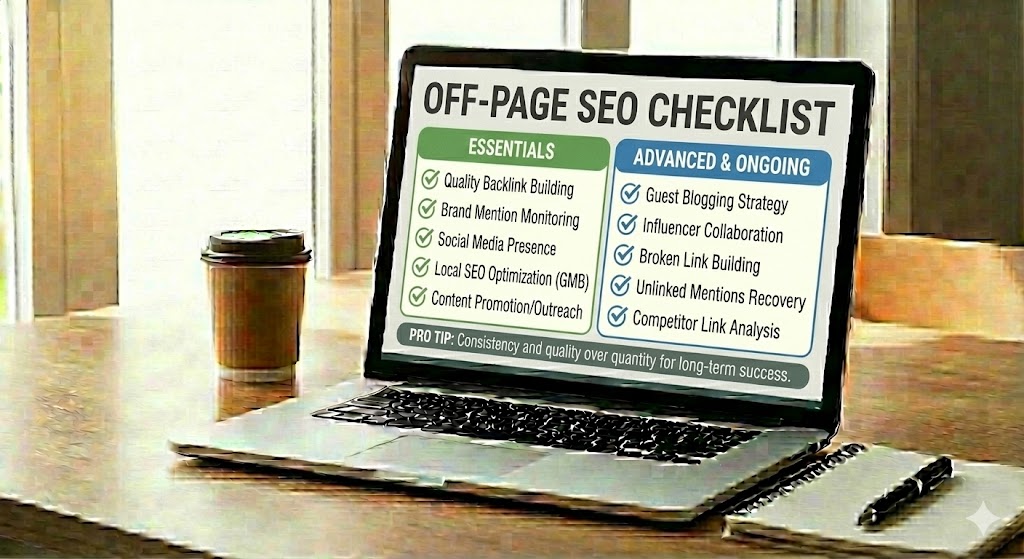
Off-page SEO is everything you do outside your website to help it rank higher in search engines. An easy way to understand it is to think of it as your website’s reputation and trust on the wider internet, built through links, mentions, and other signals that show your site is useful and reliable.
A checklist is a simple step-by-step list of tasks you can follow, so you do not feel lost or confused. For beginners, a clear Off-Page SEO checklist helps you avoid risky actions, like spammy links that can hurt your site instead of helping it, and keeps you focused on safe, long-term methods.
This introduction will guide you through the core building blocks of Off-Page SEO in a structured way. Each section will act like a small roadmap, so you always know what to do next and what to double-check. By following this checklist, you can work on your Off-Page SEO with more confidence, fewer mistakes, and a better chance to build a strong, trusted online presence over time.
Off-Page SEO Checklist
Before diving into details, it helps to see the bigger picture. The following high-level Off-Page SEO Checklist gives you a quick overview of the most important steps, so you can stay organized and avoid jumping in the wrong direction.
Use the list below as a simple map of your progress. You can come back to it anytime to see what you have done and what still needs work.
- Confirm basics: Make sure your site is crawlable, pages load fast, and content is helpful before chasing links.
- Prioritize quality backlinks: Seek links from relevant, trusted sites; avoid paid, spammy, or automated link sources.
- Keep link building safe: Grow links slowly, use mixed anchor text, and avoid any link schemes.
- Watch brand signals: Encourage honest reviews, natural brand mentions, and consistent name and NAP details.
- Review regularly: Check your backlink profile, remove or disavow toxic links only when truly needed, and stay within search engine rules.
What Is Off-Page SEO and Why Does It Matter
To use the checklist effectively, it helps to understand what you are actually improving. This section explains what Off-page SEO is and why it has such a strong impact on your rankings and visibility.
Think of the internet like a big classroom. Your website is one student, but what others say about that student matters a lot. Search engines pay close attention to these “opinions” when deciding who should be at the top of the class.
Off-page SEO is the group of actions that happen away from your own site, such as links, reviews, and mentions on other pages. These create signals of trust, authority, and popularity, which help search engines judge how strong and reliable your website really is.
Instead of only looking at your own content, Google and other engines study how the rest of the web reacts to it. When many trusted sites link to you or talk about you, it tells algorithms that your pages are useful, relevant, and worth showing to more users.
- Backlinks act like votes from other sites.
- Brand mentions show that people know and trust your name.
- Reviews and ratings help prove real-world reliability.
All of these pieces together explain why off-page work is not “extra”, but a core part of your Off-Page SEO Checklist and long-term ranking success.
Before You Start: Foundational Checks for Off-Page SEO
Launching into promotion without preparation often leads to wasted effort. This section helps you confirm that your site is technically sound and worth promoting, so every off-page action has a real impact.
Have you ever tried decorating a house before the walls were finished? Building links and mentions on the web without basic setup is very similar. Before using any Off-Page SEO Checklist, you need to be sure your site is ready to benefit from that effort.
These early checks protect your time and help every future link, review, or mention work harder for you. Think of them as the ground rules that keep all later steps safe and effective.
Check That Search Engines Can Reach Your Site
The first priority is basic access. Here you confirm that search engines can find, read, and store your pages correctly.
Start by making sure your site is crawlable and not blocked by mistakes:
- Review robots.txt so it does not block important pages.
- Ensure main pages return a 200 status code, not errors or redirects.
- Submit an XML sitemap to help search engines discover key URLs.
If crawlers cannot reach or understand your pages, even the best backlink will bring little value.
Confirm Basic On-Page SEO
Once crawlers can access your site, the next step is to polish the essentials on each page. Solid on-page setup makes your off-page efforts more effective and easier for algorithms to interpret.
Focus on a few foundational on-page elements:
- Each page has a unique title tag and clear meta description.
- Headings are structured in a logical order (H1, H2, H3).
- Internal links help users and crawlers move between related pages.
With these basics in place, any new link you earn will point to a page that is easier to rank and understand.
Ensure Content Is Worth Linking To
Technical health is only part of the foundation; the substance of your pages matters just as much. Other sites will only link to content that feels genuinely useful to their own audiences.
Good promotion cannot fix weak content. Before chasing backlinks, you need material that other sites would actually want to reference.
Check that your main pages provide clear value to visitors:
- Answer common questions directly and in simple language.
- Offer unique details, examples, or data that are not copied from others.
- Keep layout easy to read, with short paragraphs and clear headings.
As Brian Dean notes, “The best link building strategy is publishing content people genuinely want to link to.” Strong pages turn each backlink into a real long-term asset.
Backlink Checklist for Safe and Strong Authority
With your foundations in place, you can start focusing on backlinks, which are some of the most powerful off-page signals. This section shows you how to choose links that build authority without putting your site at risk.
Have you ever wondered why some pages seem to “collect” trust from all over the web while others stay invisible? The difference often lies in how carefully their backlinks are chosen and managed. This section gives you a clear, beginner-friendly checklist to build safe, lasting authority instead of short-term tricks.
Use the points below to guide every new link you try to earn. Treat each item like a small safety test before you say “yes” to a backlink.
- Target relevant websites: Prefer sites in the same or closely related topic, industry, or location.
- Check domain quality: Avoid pages filled with ads, spun text, or obvious spam patterns.
- Avoid paid and automated links: Buying links, using link farms, or auto-submit tools can trigger penalties.
- Mix link types: Aim for a natural blend of dofollow and nofollow links from different domains.
- Keep anchor text natural: Use simple phrases, questions, and branded names instead of repeating the exact same keyword.
- Prefer editorial placements: Links placed by real editors inside helpful content usually carry safer, stronger authority.
Link Building Safety and Anchor Text Checklist
After you know what a good backlink looks like, the next step is to build them in a way that appears natural over time. This part of the checklist focuses on link velocity and anchor text choices that keep your profile safe.
Have you ever seen a site suddenly jump in rankings and then disappear a few weeks later? That often happens when links are built in a risky way. This checklist helps you grow authority carefully, so your work lasts instead of causing problems.
Use the points below to keep every new backlink and its anchor text safe, natural, and within search engine rules.
- Grow links slowly: Aim for steady, gradual growth instead of sudden spikes that can look unnatural.
- Avoid link schemes: Stay away from private networks, link exchanges, and any “guaranteed links” offers.
- Do not use automated tools: Auto-submission or mass blog-comment tools often create spam links.
- Keep anchors varied: Mix branded, generic (“click here”), and partial-match keyword anchors.
- Limit exact-match anchors: Using the same keyword phrase again and again can trigger filters.
- Match context and promise: Make sure the anchor text honestly reflects the page users land on.
“Natural link profiles show variety, moderation, and clear relevance.” – Marie Haynes
Brand Mentions and Local SEO Off-Page SEO Checklist
Off-page signals are not only about links; your name itself is a powerful indicator of trust. In this section, you will focus on brand mentions and local SEO elements that show search engines your business is real and consistent.
Have you noticed how people often trust a shop more when they keep hearing its name from different places? Search engines act in a similar way. They look for brand signals and local references to confirm that your business is real, active, and trusted in the world outside your site.
This part of your Off-Page SEO Checklist focuses on how your name appears across the web, especially for local businesses. Use the steps below to build simple, clean signals that help search engines connect your brand with your area.
- Use the same brand name everywhere: website, profiles, and listings.
- Make sure your NAP details (name, address, phone) match exactly across all platforms.
- List your business on trusted local citation sites and directories.
- Ask happy customers for honest reviews on major review platforms.
- Reply politely to both positive and negative feedback to show real activity.
- Watch for unlinked brand mentions and politely request a link when it makes sense.
“Strong local signals come from consistency, not tricks.” – Phil Rozek
Social Media and Reputation: Off-Page SEO Checklist Essentials
Beyond links and citations, your social presence and daily interactions also shape how your brand is perceived. This section helps you turn social media activity and online reputation into steady support for your off-page efforts.
Ever wondered why some brands feel “everywhere” online, even if you are not visiting their website? That effect comes from a mix of social activity and online reputation, both of which strongly support your Off-Page SEO Checklist work.
Social platforms do not usually pass classic link authority, but they spread your content, attract natural links, and show search engines that real people care about your brand. Use the simple checks below to turn everyday posts into long-term trust signals.
- Share content regularly: Post useful updates on a steady schedule instead of random bursts.
- Focus on real engagement: Ask questions, reply to comments, and start conversations, not just push links.
- Avoid buying followers: Fake numbers do not help rankings and can damage credibility.
- Protect your reputation: Answer complaints calmly, correct mistakes, and thank users for positive feedback.
- Keep branding consistent: Use the same logo, name, and tone so people easily recognize you across networks.
“Online reputation is built one interaction at a time.” – Rand Fishkin
Toxic Backlinks, Manual Actions, and Realistic Off-Page SEO Timeline
As your off-page profile grows, monitoring risk becomes just as important as building new links. Here you will learn how to handle toxic backlinks, respond to manual actions, and set realistic expectations for how long results take.
Imagine working hard on your Off-Page SEO Checklist, only to see rankings suddenly drop. Often, this happens because of toxic backlinks or a manual action from a search engine reviewer, not because your whole strategy is wrong.
Toxic backlinks usually come from spammy sites, hacked pages, or low-quality directories that link to many unrelated topics. Check your backlink profile every few months and watch for patterns like hundreds of links from one domain, links from adult or gambling sites, or pages with nonsense content. Only consider the disavow tool if those links are clearly harmful and you cannot remove them by asking the site owner.
A manual action is different from normal ranking changes because it is a direct penalty. You may see a message in your search console saying that unnatural links or other spam were found. Fixing this means removing bad links where possible, documenting your clean-up, and sending a reconsideration request that explains what you changed and how you will avoid this in the future.
Even when everything is done correctly, Off-Page SEO moves slowly. New backlinks and brand signals can take several weeks to be fully crawled, indexed, and trusted. For a new site, meaningful progress often appears after 3–6 months, with stronger gains over 6–12 months as your profile grows naturally.
Think of this process like building a credit score. Each safe backlink, good review, and clean audit adds a bit more trust, but sudden “shortcuts” can reset your progress. By watching for toxic links, avoiding penalties, and accepting a realistic timeline, you turn your checklist into a steady, long-term growth plan instead of chasing quick wins that do not last.
Building Lasting Trust With a Practical Off-Page SEO Checklist
All of these steps come together to form a clear path for growing your site’s reputation beyond its own pages. A structured Off-Page SEO Checklist keeps you focused on healthy foundations, safe backlinks, strong brand signals, and a realistic pace.
Off-Page SEO is a long-term process, not a quick fix. By following this checklist consistently and staying within the rules, you can steadily build a more reliable, trusted presence across the web—one safe action at a time.