
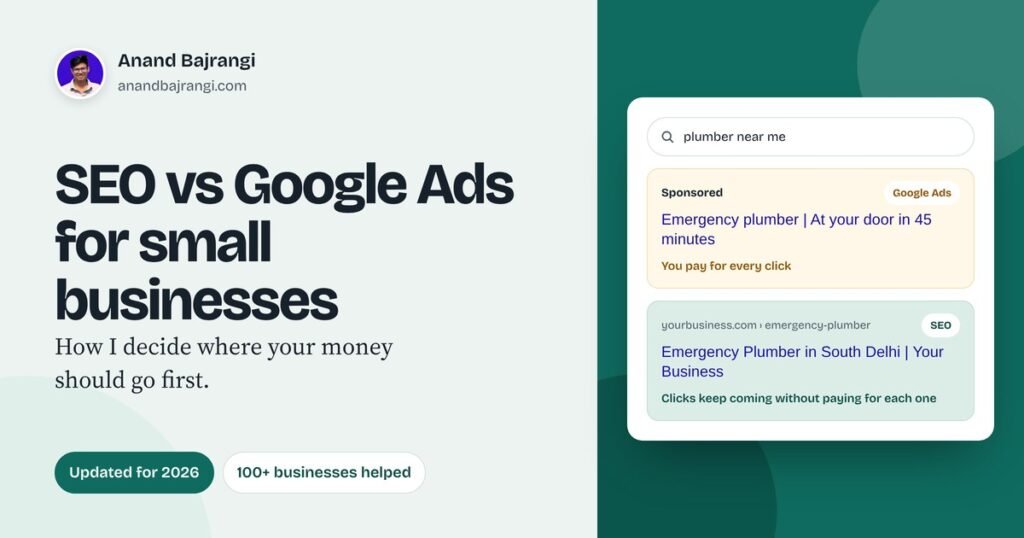
Short answer: Use Google Ads when you need enquiries this month and can measure every one of them. Use SEO to build enquiries that keep coming without paying for each click. For most small businesses, I start with the basics of both: a small, carefully tracked ad budget for quick leads, while SEO and your Google Business Profile build up in the background.
If you run a small business, you’ve probably heard advice like this:
“SEO takes six months, but you need to invest now.”
“Just boost your post and you’ll get sales.”
“Install this tool, add that plugin, hire this expert.”
The truth is that most small businesses don’t need complicated marketing. They need clarity, consistency and results without burning money. This is how I decide between SEO and paid ads for real businesses, the ones that can’t afford to wait and hope.
SEO vs Google Ads at a glance
| SEO | Google Ads | |
|---|---|---|
| How fast it works | Usually a few months before the gains are clear | Clicks within days of going live |
| What you pay for | Work on your website, content and Google Business Profile | Every click, for as long as the ads run |
| When you stop paying | Rankings fade slowly, so enquiries keep coming for a while | Leads stop almost straight away |
| Best for | Steady, lower-cost enquiries over time | Quick leads, new offers and testing what sells |
| Main risk | Doing the wrong work and waiting months to find out | Paying for clicks that never become customers |
If you’d like the textbook definitions, I’ve covered them in SEO vs SEM. This post is about the practical decision: where your money should go first.
Step 1: Understand the business like an owner
Before I suggest SEO, ads or both, I ask four questions:
- What’s your main product or service, the one that pays the bills?
- Who are your customers, and what do they type into Google when they need you?
- What’s your profit on a typical sale?
- What’s already working, and what isn’t?
The profit question surprises people, but it decides almost everything. If a new customer is worth ₹50,000 to you, paying ₹2,000 for a lead can be a bargain. If a customer is worth ₹500, ads have to be very cheap or they’ll lose you money. I don’t throw random keywords or ad budgets at a problem. I treat your business like my own, because if the numbers don’t work for you, they don’t work at all.
When I start with Google Ads
- You need enquiries now, for example because the business is new or it’s a quiet season.
- People already search for what you sell, with words like “near me”, “price” or “book”.
- You can answer quickly. A lead that waits a day for a reply is often a lead lost.
- You have a clear offer and a page that can turn a click into a call or an order.
When I start with SEO
- Your budget is small, and paying for every click would use it up fast.
- You serve a local area, where a strong Google Business Profile can bring calls without any ads.
- Clicks in your industry are expensive, as they often are for lawyers, clinics and finance.
- You’re building for the next few years, not the next few weeks.
In practice, the best results usually come from using both. Ads bring in leads while SEO builds up, and the ad data shows which searches turn into paying customers. That tells me exactly which pages and keywords to focus on for SEO.
My SEO approach: rank for searches that bring customers
SEO isn’t just about showing up on Google. It’s about showing up for the searches that lead to calls, enquiries and orders. This is what I focus on:
- Find low-competition, high-intent keywords. A search like “dentist in Saket open on Sunday” brings fewer visitors than “teeth whitening”, but far more of them become patients. Here’s how to find low-competition keywords.
- Fix the website basics: speed, mobile layout, and a clear page for every service you offer. My technical SEO checklist covers the essentials.
- Build local authority with your Google Business Profile: the right categories, real photos, regular updates and a steady flow of reviews.
- Write content that answers real questions. The questions customers ask you on the phone make the best topics.
- Track what’s working and improve every month, measuring calls and enquiries, not just rankings.
Example: one local service business I worked with reached page 1 with five targeted blog posts and a fully optimised Google Business Profile. No paid backlinks, no tricks. A restaurant client grew its online orders five times with local SEO.
My paid ads approach: spend smart, not big
I’ve seen small businesses lose ₹20,000 to ₹50,000 on ads with nothing to show for it. It’s rarely because ads don’t work. It’s because nobody decided who they were targeting, what they were offering, or how they’d measure the results.
My formula is simple:
- Set up tracking first. Calls, form enquiries and WhatsApp clicks are tracked before a single rupee is spent.
- Understand your customer’s problem, then write an ad that speaks to it clearly, with no big promises.
- Send people to a fast, focused landing page about that exact service, not your home page.
- Follow up quickly by phone, WhatsApp or email, and use remarketing to reach people who didn’t act the first time.
- Check every week. Look at the real search terms and results, cut what doesn’t work, and move the budget to what does.
Whether it’s Google Search Ads or Meta Ads, I keep campaigns minimal, focused and within budget. For some of my clients, that means leads at ₹30 to ₹70 per enquiry. It isn’t magic, just steady testing and improving.
Google Ads or Meta Ads?
Google Ads reach people who are already searching for what you sell, so they suit services people need right now. Meta Ads on Facebook and Instagram reach people who are scrolling, not searching, so they work better for products people didn’t know they wanted, local events and special offers. For most small service businesses, Google is the better place to start.
How much should a small business spend?
For SEO, a monthly budget pays for steady work on your website, content and Google Business Profile. My own SEO plans start at ₹15,000 a month.
For ads, start with a test budget you could afford to lose while you learn, then increase it only for what your tracking proves is working. If you can’t track your leads yet, fix that before you spend more. If you’d rather hand it over, see how I handle Google Ads management.
Mistakes I see small businesses make
- Boosting social media posts and hoping for sales, with no clear offer or audience.
- Sending ad clicks to the home page instead of a page about the exact service.
- Running ads without conversion tracking, so nobody knows what worked.
- Buying cheap backlinks that can get the website penalised. Here’s the difference between white hat and black hat SEO.
- Chasing traffic and rankings instead of calls, enquiries and sales.
- Giving up on SEO after a month, before it has had time to work. This guide explains how long SEO takes.
My core belief: keep it real, keep it simple
Small businesses don’t have time for “branding journeys” or seven-step funnels. They need people to call, visit or buy. That’s it. So I focus on three things:
- Showing up when customers search
- Running ads that make people act
- Helping websites turn more visitors into customers
I don’t sell big packages. I solve real problems.
Frequently asked questions
Is SEO or Google Ads better for a small business?
Neither is better for everyone. Google Ads are better when you need leads quickly and can track them. SEO is better value over time, especially for local businesses. Most small businesses do best with a small, well-tracked ad budget while SEO builds up.
How long does SEO take to work?
Usually several months, depending on your website, your competition and the work done. Local SEO in a less competitive area can move sooner.
Can I run Google Ads myself?
Yes, if you have time to learn and to check your campaigns every week. Get two things right first: conversion tracking and negative keywords. Without them, it’s easy to pay for clicks that never become customers.
Should I stop ads once SEO starts working?
Not always. Many businesses keep a smaller ad budget for their most valuable services, and cut ads for searches where they already rank well.
Need help deciding?
If you’re confused about SEO or ads, I get it. My team and I have worked with more than 100 businesses, and clarity and consistency always win. If you want someone who explains things in your language, works within your budget and focuses on results, let’s talk.
Start with a free SEO audit, or tell me about your business.
No fluff. Just growth.