
I have a confession: I’ve spent the last five years lying to you—and to myself.
We were all taught the same “Golden Rule” of SEO: to rank #1, you had to build the “Ultimate Guide.” We obsessed over 3,000-word counts, stuffed our articles with “What Is” definitions and historical fluff, and prayed to the gods of long-form content.
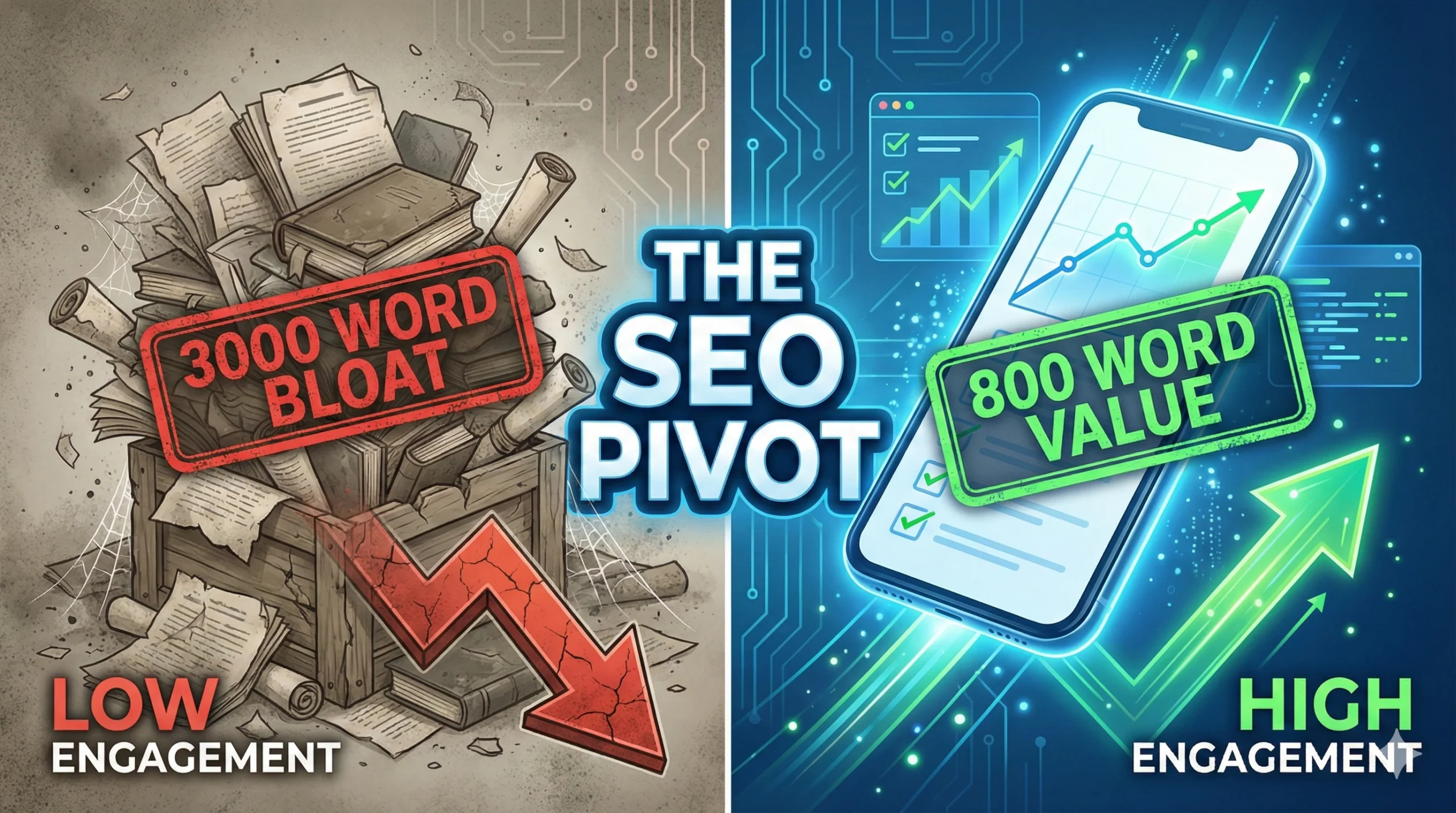
But in late 2025, that strategy isn’t just outdated—it’s a liability. While you’re busy polishing chapter seven of your massive guide, Google’s AI Overview (AIO) has already scraped your three best points, summarized them for the user, and effectively stolen your click before they even scrolled. The truth? Your readers don’t want an encyclopedia; they want a result. I’m officially killing the fluff and switching to “Decision-Ready” Micro-Content.
Here is why cutting 70% of my word count actually doubled my organic engagement.
The “Ultimate Guide” Model is Dying (And AI Killed It)
The “Ultimate Guide” was designed for a search engine that no longer exists. In the era of generative search, users have “TikTok Brain” applied to Google. They want the answer in the first 10 seconds, or they’re gone.
If you write 3,000 words, you aren’t “providing value”—you are just giving Google’s AI more free data to summarize so the user never has to visit your website. ### Old School vs. 2026 Strategy
| Feature | The Dead “Ultimate Guide” | The “Decision-Ready” Micro-Post |
| Primary Goal | Keyword Density & Topical Authority | User Outcome & Decision Speed |
| Structure | Linear (Intro -> History -> Tips) | The Inverted Pyramid (Answer First) |
| Visuals | Generic Stock Photos | Original Screenshots & Data Tables |
| AI Impact | Scraped & Summarized by AIO | Cited as the “Source of Truth” |
| Word Count | 2,500+ (Inflated) | 500–800 (High-Density) |
Proof of Experience: The 2025 Audit That Changed Everything
I used to be a “word count” addict. During my time working with digital marketing agencies in India, our standard SOP for every client—whether it was a dental clinic in Delhi or a global e-commerce brand—was the same: “Find the top-ranking competitor and write 500 words more than them.”
But three months ago, I ran an experiment that made me delete 40,000 words of “SEO content” from a client’s site.
We had a service page for a local clinic that was 3,500 words long. It was ranking #4, but the average engagement time was a miserable 12 seconds. Users were landing, seeing a wall of text, and bouncing.
The “Micro-Pivot” Result:
We cut that 3,500-word monster down to a 750-word “Decision-Ready” page. We removed the fluff and replaced it with a live pricing calculator, a 3-step timeline, and real-world photos.
Within 14 days, the page didn’t just stay at #4—it jumped to #1 and was cited as the primary source in the Google AI Overview for that city.
The “Decision-Ready” Framework
If you want to rank with 800 words, every single sentence must earn its place. Use this 4-step framework:
- The TL;DR “AIO Bait”: Place a 50-word executive summary at the very top. This is what AI Overviews look for. Give the AI the summary so you can control the narrative.
- The Inverted Pyramid: Put the most important “Golden Nugget” in the first 200 words. Stop saving the best for last.
- High-Value Density (HVD): Stop defining terms your audience already knows. If your reader is looking for “Advanced SEO,” they don’t need a paragraph titled “What is SEO?”
- The “Proof of Experience” Signal: AI can say “You should do X.” A human says “When I did X, I got Y result.” Always include a personal insight.
The 3-Day “Micro-Content” Challenge
Are you brave enough to take the path to the top of the SERPs? I challenge you to take the pivot this week:
- Day 1 (Triage): Find a page with high impressions but low engagement. Identify the fluff—anything an AI could have written in 2 seconds.
- Day 2 (The Cut): Be ruthless. Cut that 3,000-word article down to its most potent 800 words.
- Day 3 (The Injection): Fill the space with things AI can’t replicate: original screenshots, custom data tables, and your own “lessons learned.”
The Future Belongs to the Concise
The “Ultimate Guide” era was about quantity. The AI era is about value density. By respecting your reader’s time and providing immediate answers, you aren’t just optimizing for an algorithm—you’re building a brand that humans actually trust.