
When you write online, people and search engines both need to understand what your page is about. Keyword placement in content helps connect your words to the ideas people search for. When used correctly, it tells search engines, “This page matches this topic,” so your content has a better chance to appear for the right search terms.
Good keyword placement is not about saying the same word many times. It is about placing important words in smart, clear locations, such as titles, headings, and the first lines of your text. This makes your content easy to read and simple to understand for both humans and search engine systems that use algorithms to process language.
For beginners, this means learning to write in a natural way while still being careful and organized. Clear, helpful writing always comes first, and keywords are used to support that clarity. When you focus on meaning and structure instead of repetition, your content becomes stronger, more useful, and more likely to perform well in search results.
H1 Keyword Placement in Content
Your main heading is often the first element readers notice, and it also sends a strong signal to search engines. By using it wisely, you frame the entire page around a single clear topic. This section explains how to make your H1 heading work as a powerful guidepost.
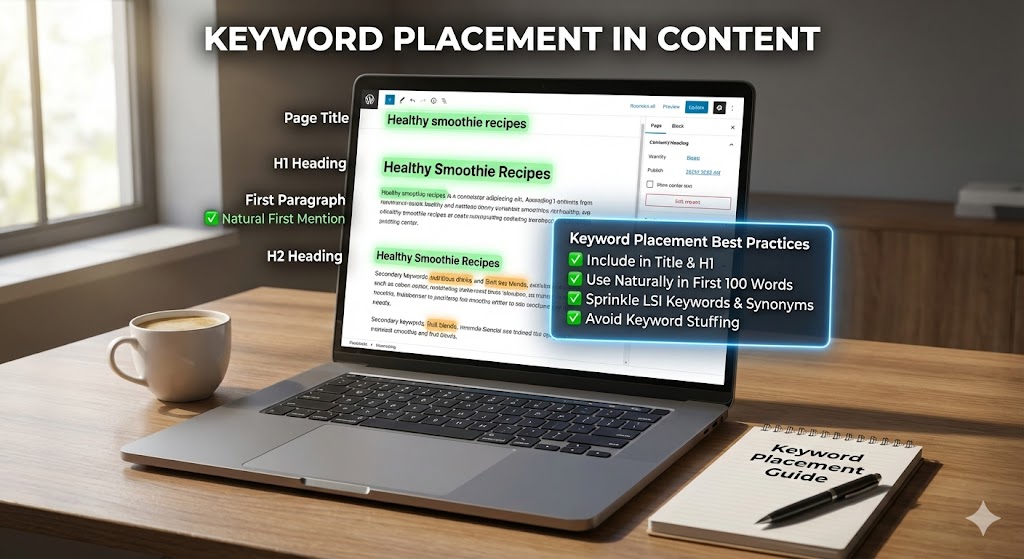
Within your H1 heading, aim to include the main phrase that best describes the page, such as “Keyword Placement in Content”. Keep the line short, direct, and easy to read, because this heading acts like a clear label for the entire page. Avoid adding many extra ideas in the same line; one main topic is enough.
To support the H1, echo its ideas in nearby sentences, using simple variations instead of exact repeats. For example, a page with the H1 “Keyword Placement in Content” might later mention “placing key phrases in the right parts of your article.” This keeps language natural while still reminding search engines of the central subject.
H2 Introduction: Why Keyword Placement in Content Matters
Before placing keywords, it helps to understand why their position makes such a difference. The way key phrases appear across your page affects both visibility and readability. In this part, you will see how smart placement shapes results and user experience.
Imagine two pages about the same topic. One is clear and easy to scan; the other feels messy and confusing. The first one usually wins in search results, not because it has more words, but because its important phrases are placed where they help most.
Search engines scan your text a bit like a teacher skims an essay. They look at headings, opening lines, and repeated themes to guess the main subject. When you use keyword placement in content wisely, you make that job easier, so your page is seen as relevant, focused, and trustworthy.
Strong structure also supports real visitors. Clear wording in strong positions lets people decide fast, “Is this page for me?” This creates a better user experience and often leads to more clicks, longer reading time, and more actions, such as sign-ups or sales.
- Well-placed keywords guide readers through your ideas.
- Search engines can classify your topic faster and more accurately.
- Clarity replaces guesswork, for both humans and machines.
What Is Keyword Placement in Content?
Before you can optimize, you need a clear definition of what you are optimizing. Keyword placement is less about volume and more about position and purpose. This section breaks down the idea into simple parts.
Think of your page like a small map. Certain words act as signposts, telling people and search engines where they are and what each part means. Those signposts are your main phrases, and where you put them is what we call keyword placement in content.
In simple terms, it is the planned position of important search phrases inside your text, headings, and other key areas. Instead of spreading words at random, you choose specific spots where they give the most help for understanding.
Search engines scan these spots to detect the core topic of a page. They look for patterns, such as a main phrase in the heading, near the start of the article, and a few times in the body. When those signals line up clearly, the page is easier to classify and can be matched to the right searches.
- Headings tell what each section is about.
- Opening lines set the main subject early.
- Body sentences confirm and expand the topic.
Why Keyword Placement Is Important for SEO
Once you understand what keyword placement is, the next step is seeing its impact on search performance. Placement works behind the scenes, shaping how pages are crawled, indexed, and ranked. Here, you will learn why these locations matter so much for SEO.
Imagine a library where books have no labels on the cover or spine. You could still open each one to see what it is about, but it would take a very long time. Search engines face the same problem when pages do not give clear signals about their topics.
Instead of reading every word in depth, search systems look for strong clues in special places. When those clues are clear and consistent, your page is easier to trust, sort, and show to the right people.
From an SEO point of view, good keyword placement works like a precise index. It helps crawlers quickly link your page to the correct search terms, which can lead to more stable rankings and more qualified visitors. This is not about tricks; it is about making meaning obvious.
- Higher relevance: focused wording helps match real user questions.
- Stronger crawling and indexing: bots understand each section faster.
- Better user signals: people stay longer when pages match their intent.
Many SEO professionals describe this as sending a clear message. As Rand Fishkin often notes, “Well-structured pages make it simple for algorithms to do the right thing.”
Primary Keyword Placement Areas in Content
Knowing that placement matters naturally leads to the question of where to focus. Some areas of a page carry more weight than others for both readers and search engines. This section highlights the primary locations that deserve the most attention.
When a page is well organized, readers can find what they need quickly, and search engines can do the same. To reach that point, certain spots in your writing act like strong anchors that quietly tell, “This is what this page is really about.”
These anchors are not random. They are specific locations where important phrases carry extra weight for both meaning and visibility. By placing your main term and close variations in these places, you create a clear, stable structure that supports the rest of your text.
- Title and main heading show the central topic at a glance.
- Opening lines and section labels keep the theme steady as readers scroll.
- Supporting areas, such as image descriptions, confirm what the content covers.
Over time, this careful layout helps build a pattern. Search engines see that pattern as a strong sign of focus, while visitors simply feel that the page is easy to follow and understand.
Keyword Placement vs Keyword Stuffing
After learning where to place key phrases, it is just as important to understand what to avoid. Using keywords carelessly can undo the benefits of good structure. In this section, you will see the difference between natural optimization and harmful overuse.
Have you ever seen a page that repeats the same phrase so often that it starts to feel strange? That is a sign that something has gone wrong, even if the topic itself is useful. Understanding this mistake will help you keep your writing safe, clear, and friendly for readers.
Keyword placement in content means putting key phrases in helpful, logical positions so people and search engines can quickly see the main subject. The words fit the sentence, sound natural, and add meaning. Each use should feel like it belongs there, not like it was pushed into the line just to impress an algorithm.
By contrast, keyword stuffing happens when a writer forces the same phrase into many places, even when it makes the text hard to read. Search systems now treat this as a spam signal, which can lower visibility instead of raising it. A simple check is to read your page out loud: if it sounds strange or robotic, you are likely using the term too often.
- Good placement: supports meaning and improves clarity.
- Stuffing: breaks the flow and may trigger search penalties.
- Goal: write for people first, then refine for search engines.
How Many Times Should a Keyword Be Used?
Questions about frequency often come up once writers start paying attention to placement. However, strict counts rarely reflect how people actually read. This part explains how to balance visibility and natural flow without chasing a rigid formula.
Writers often ask, “What is the right number?” They hope for a simple rule, like five or ten times per page. In real SEO, however, the answer depends more on clarity, length, and intent than on a fixed count.
Instead of chasing a magic number, focus on whether your page sounds like normal speech. If a phrase appears so often that reading feels heavy or strange, it is probably used too much. When it shows up in key spots and the rest of the text flows smoothly, you are usually in a safe range.
- Use your main term in the title, one heading, and near the start of the text.
- Sprinkle natural variations in later lines instead of repeating the same wording.
- Let the total count rise or fall with page length, not with a strict formula.
“Write for humans first; search engines learn from humans.” – Marie Haynes
Common Mistakes and Related Topics for Keyword Placement in Content
Even with good intentions, it is easy to slip into habits that weaken optimization. Small oversights can blur your page’s focus or send mixed signals. This section points out typical errors and connects them to related areas you may want to review.
Have you ever finished a page and still felt unsure what it was really trying to target? That feeling often comes from a few repeated errors that quietly weaken otherwise good writing. Learning to spot these patterns early saves time and protects your work from avoidable SEO issues.
Some problems are obvious, like saying the same phrase too often. Others are more hidden, such as skipping keywords in high-impact positions or using only exact matches. By understanding these missteps, you can turn them into simple checks before you publish.
One frequent mistake is ignoring intent. Writers sometimes chase a phrase that does not match what readers actually want, so the page attracts the wrong visitors. Another risk is over-optimizing single sections (like stuffing one paragraph) while leaving other key areas, such as meta description or image alt text, almost empty of meaningful terms.
Other common problems include:
- Using only one exact term and skipping natural variations.
- Forgetting to update wording when a topic or product changes.
- Placing important phrases only at the end of the page.
- Writing long blocks of text with no clear section focus.
- Copying a competitor’s phrases instead of reflecting your own content.
These issues connect closely with related topics that help support smart optimization. When you study them together, the full picture of on-page structure becomes much clearer.
- On-page SEO structure and internal layout.
- Search intent and audience research.
- Semantic keywords and topic clustering.
- Internal linking and anchor text choices.
- Content audits for outdated or weak pages.
- Technical SEO basics such as crawlability.
- Readability and simple language for users.
- Content freshness and regular updates.
Bringing Keyword Placement in Content Together
All of these points lead to a single goal: making your topic unmistakably clear. Effective keyword placement in content is about sending a clear, honest signal to both readers and search engines without sacrificing readability.
Across your page, careful structure beats raw repetition. Using your main term in titles, headings, opening lines, and other key spots creates a strong pattern of meaning, while natural variations keep the language smooth and reader-friendly.
As you keep practicing, think of keyword placement as part of a wider system that includes search intent, on-page layout, semantic context, and technical SEO. When these pieces work together, your content does more than rank: it answers questions clearly, respects your audience’s time, and builds lasting trust.