
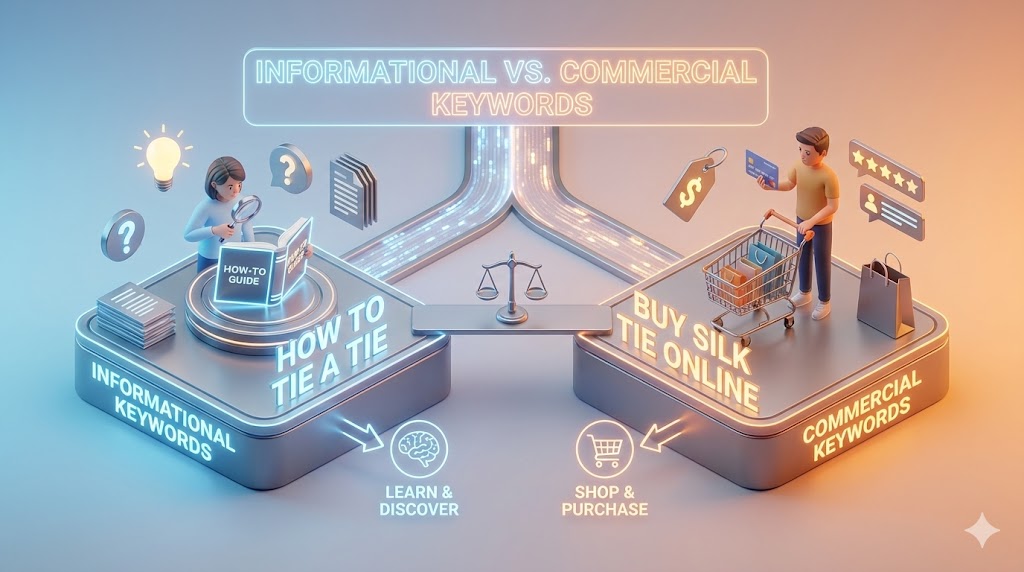
When people search on Google, they do not always want to buy something right away. Many times, they just want to learn, understand, or solve a problem. Other times, they are almost ready to buy and are looking for the best product, service, or deal. This is why not all keywords are meant for selling.
In SEO, we often separate keywords into two simple groups: informational keywords and commercial keywords. Informational keywords are used when someone wants to get knowledge, learn “how to do” something, or understand a topic better. Commercial keywords are used when someone is closer to buying and is checking options, prices, or comparing products.
Understanding the difference between these two types of keywords helps you create the right content for the right search. It also helps you plan a clear path, or simple funnel, that starts with learning and can later lead to a purchase. In this article, you will learn what each type of keyword means, how to spot them, where to use them, and how they work together to make your SEO more effective.
Informational vs Commercial Keywords
Before diving into each keyword type, it helps to see how they sit side by side. Informational and commercial keywords are two halves of the same journey, each reflecting a different stage of what the searcher wants.
Have you ever noticed that some searches feel like asking a teacher, while others feel like talking to a shop assistant? That contrast is at the heart of how search intent shapes which words people type into Google.
In this part of the guide, we will look more closely at how these two groups of terms behave in real life, how they signal what a person wants, and why mixing them up can weaken your SEO strategy.
Informational keywords usually appear in queries that include words like “how”, “why”, “what”, or “guide”. They fit early stages of the journey, when someone is exploring a topic, learning basics, or trying to solve a problem without yet choosing a product.
By contrast, commercial keywords often contain words such as “best”, “price”, “review”, or “near me”. These phrases show that the person is comparing options, checking features, or getting ready to make a decision, which makes them strongly linked to revenue-focused pages.
- Informational: great for traffic, trust, and education, but weaker for instant sales.
- Commercial: lower volume in many cases, yet higher conversion potential per visitor.
Introduction to Informational vs Commercial Keywords
Once you see that search intent splits into learning and buying, the next step is to understand how both sides work together. This section builds the bridge between the two so you can plan content with the whole journey in mind.
Imagine you walk into a library and, right next door, there is a small shop. In one place, you ask questions and learn, in the other, you compare items and think about buying. Search engines work in a very similar way.
In SEO, informational vs commercial keywords play these two roles. One side focuses on learning, the other on choosing and buying. To use them well, you need to see how they connect, not just how they differ.
At a simple level, informational terms answer questions like “how does this work?” or “why does this happen?”, while commercial phrases support actions like “which one should I pick?” or “where can I get it at a good price?”. Together, they form a basic path that moves a visitor from curiosity to decision.
- Informational phrases help you show expertise and build early trust.
- Commercial phrases help you turn that trust into leads, sign‑ups, or sales.
What Are Informational Keywords?
After seeing the big picture, it is useful to zoom in on the first half of the journey: learning. Informational keywords capture the moments when people are curious, confused, or just starting to explore a topic.
Have you ever typed a question into Google just to understand something better, with no plan to buy right away? Those kinds of searches are driven by curiosity, problems, and learning needs, not by shopping plans.
That is exactly where informational keywords come in. They signal that a person wants an answer, explanation, or step‑by‑step help, so your content must respond with clear, simple guidance instead of a sales pitch.
At their core, informational keywords are phrases people use to learn. The intent behind them is usually to understand a topic, fix an issue, or discover options without making a choice yet. They support early stages of a simple funnel, when a visitor is still figuring out what the problem really is.
- how to fix leaking tap
- what is digital marketing
- why is my phone overheating
- beginner guide to email setup
“People search to learn first and to buy second.” – Rand Fishkin
What Are Commercial Keywords?
Once a person understands their issue, their searches naturally shift from “what is this?” to “what should I choose?”. That transition is where commercial keywords take over and signal stronger buying or comparison intent.
Think about the moment when a person stops just reading and starts asking, “Which one should I get?” That shift is where commercial keywords become important, because they reflect a clear interest in products, services, or deals.
These phrases show buying intent or at least strong comparison intent. The searcher is not just learning anymore; they are weighing options, checking benefits, and looking for reasons to choose one solution over another.
In simple terms, commercial keywords are search phrases used when someone is close to taking action. They often appear when a user has already done some research and now wants to decide what to buy, where to buy it, or which provider to trust.
- best noise cancelling headphones
- email marketing tool reviews
- web design service pricing
- plumber near me
Because they are tied to decisions and money, commercial keywords usually connect to product pages, service pages, and comparison content that can quickly turn visitors into leads or customers.
Informational vs Commercial Keywords: Key Differences
Now that both keyword types are clear on their own, it is easier to compare them side by side. Understanding the contrast in intent and usage helps you decide which terms belong on which pages.
Have you ever felt that some searches make you want to keep reading, while others push you to finally choose and act? That quiet shift in mindset explains why the gap between informational and commercial keywords matters so much in real SEO work.
Instead of seeing them as rivals, it helps to view them as two sides of the same journey. One side attracts people who are still learning, the other supports people who are weighing options and getting close to a decision.
The most important difference is intent strength. Informational terms usually show a soft intent to learn or diagnose a problem, while commercial phrases carry a harder intent to compare, evaluate, or buy. This intent decides which pages should rank: in‑depth guides, or product and service pages.
- Informational terms work best on blogs, tutorials, and FAQs that answer questions clearly.
- Commercial terms belong on comparison pages, pricing pages, and service descriptions built to convert.
Using Informational Keywords in Your SEO Strategy
Knowing what informational queries look like is only useful if you can apply them. This section focuses on how to turn those learning-focused searches into content that builds trust and prepares visitors for later decisions.
Have you ever landed on a helpful article, learned exactly what you needed, and only later realized which website taught you? That quiet moment of trust is where informational keywords start to support your whole SEO plan.
Instead of selling too early, you use these terms to meet people at the problem‑aware stage, give them clear answers, and gently introduce your brand as a helpful guide.
To turn this into a repeatable strategy, connect informational phrases to specific content formats. Simple structures work best for beginners:
- Write how‑to tutorials that solve one clear problem step by step.
- Create short FAQs around common questions your customers ask.
- Publish beginner guides that explain core ideas in plain language.
Over time, link these helpful pages to your commercial content (product, service, or pricing pages). This way, readers who first arrive to learn can move smoothly toward comparison and purchase when they are ready—without feeling pushed or rushed.
Using Commercial Keywords in Your SEO Strategy
Just as informational terms drive education, commercial phrases should drive action. Here the goal is to connect high-intent searches to pages designed to convert, not just to inform.
Picture a visitor who already understands their problem and now asks, “What should I choose?” At this point, teaching alone is not enough; your pages must help them compare, evaluate, and act. That is where a smart use of commercial keywords turns interest into real business results.
Instead of guessing, you can place these terms carefully on pages that are built to convert. This means shaping both your content and layout so that every element answers a buying question and removes doubt.
Start by mapping phrases like “best…”, “price…”, “near me”, “reviews” to specific, action‑focused pages. For example, send “best running shoes for flat feet” to a comparison page, and “running shoe brand X price” to a detailed offer page. Each phrase should match a clear decision step.
- Use comparison lists and pros/cons to support quick choices.
- Include clear calls to action such as “get quote” or “book now”.
- Answer key objections (cost, guarantees, support) in short sections.
As these pages gain traffic, link back to your best guides so cautious visitors can keep learning. Over time, this creates a loop between learning and buying that strengthens your whole SEO strategy.
Informational vs Commercial Keywords in a Simple SEO Funnel
When you combine both keyword types, they form a clear path from first question to final action. Thinking of this as a simple SEO funnel makes it easier to see which phrases belong at each stage.
Have you ever wondered how a stranger moves from asking basic questions on Google to finally trusting you enough to buy? That path can be seen as a simple SEO funnel built from both informational and commercial keywords.
In a basic funnel, visitors move through three clear steps: learning, comparing, and deciding. Each step needs different keyword types and different pages, but they should all connect smoothly so people never feel lost or pushed.
At the top of the funnel, informational phrases like “how to improve sleep” or “what causes back pain” bring in broad, curious readers. Your role here is to give honest answers, use plain language, and introduce your solution gently inside helpful guides, checklists, and FAQs.
As interest grows, mid‑funnel searches such as “types of mattresses” or “memory foam vs spring” start to appear. These bridge terms mix learning and light comparison, so pages like overview articles or feature breakdowns work well and can link both up to guides and down to detailed offers.
Near the bottom of the funnel, commercial terms like “best mattress for back pain” or “orthopedic mattress price” take the lead. These should land on tightly focused comparison pages, service descriptions, and pricing sections where you use clear benefits, social proof, and calls to action to support a final decision.
- Top: informational queries → guides and tutorials.
- Middle: mixed intent queries → feature and option breakdowns.
- Bottom: commercial queries → offer, pricing, and booking pages.
“Great SEO is not just about traffic; it is about guiding people from questions to confident action.” – Aleyda Solis
Bringing Intent and Keywords Together for Stronger SEO
All of these pieces come together when you consistently match search intent with the right type of content. Doing this turns your site into a guided path instead of a set of disconnected pages.
Understanding informational vs commercial keywords is really about understanding what people want at different moments. When you match your pages to this intent, you stop guessing and start building a clear, guided journey from first question to final decision.
Informational terms help you earn attention and trust by teaching, while commercial phrases help you focus that trust into action through comparisons, offers, and next steps. Used together, they turn your site into a path rather than a collection of random pages.
If you remember one idea, let it be this: good SEO aligns content with intent at every stage of the funnel. Plan your topics, pages, and internal links so visitors can move naturally from learning to choosing without feeling pushed. As you refine your keyword research and content, keep checking: Is this searcher trying to understand, or trying to decide?