
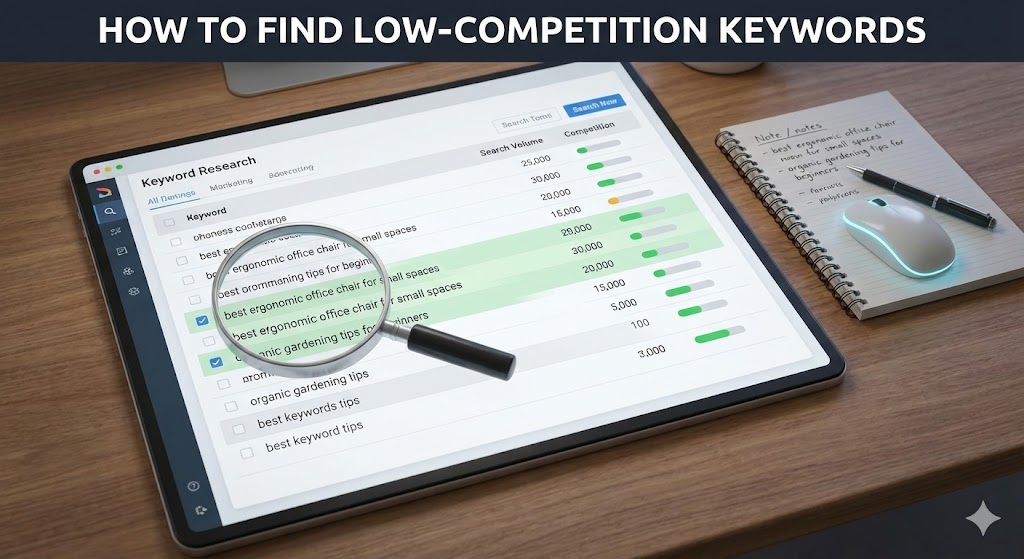
Finding the right words to use on your website can be hard, especially when many other sites are trying to rank for the same terms. This is why learning to find low-competition keywords is so important. These are search phrases that people look for, but not many websites are trying to rank for them. When you target these keywords, you have a better chance to appear on the first page of search results.
For beginners, low-competition keywords are one of the simplest and safest ways to grow traffic. You do not need a strong domain, big budget, or advanced SEO skills to start. By focusing on easier keywords, you can get faster results, learn how SEO works step by step, and avoid competing with large, established websites.
This introduction will guide you through clear, simple methods to discover these keywords. You will learn what low-competition keywords are, why they matter, and how to find them using a repeatable process. The goal is to give you a practical path so you can start ranking pages, even if your site is new and your SEO knowledge is still growing.
How to Find Low-Competition Keywords
Before you dive into tools or long lists of phrases, it helps to understand the basic approach. Finding low-competition keywords is less about tricks and more about choosing your battles wisely. With a simple, repeatable method, you can slowly uncover keywords your site can realistically rank for.
Imagine you are opening a small shop in a big city. Instead of setting up right beside the largest mall, you choose a quiet street where people still walk and buy things. This is the same idea behind finding low-competition keywords: you look for places where people search, but big sites are not fighting hard.
To do this well, you need a simple process you can repeat. The steps below show how to move from a broad idea to specific phrases that give your pages a real chance to rank.
First, write down a clear topic you want to cover, such as “easy bread recipes for kids”. Then, expand it into longer phrases, check what already appears in search results, and judge if those pages are strong or weak. By doing this slowly and carefully, you build a list of realistic, low-pressure opportunities that match what your visitors actually want.
Introduction to How to Find Low-Competition Keywords
Once you know the general process, the next step is to look more closely at how it works in practice. Instead of jumping straight from an idea to publishing content, you move through a few simple checks that keep you focused on phrases with real potential.
Have you ever typed something very specific into a search engine and still found only a few useful pages? Those gaps are where low-competition keywords often live, and learning to spot them is a skill you can practice. Instead of guessing, you will follow a simple path that turns broad ideas into phrases you can actually rank for.
In this next part of the article, you move from knowing why these phrases matter to understanding how to uncover them in a structured way. You will go from a basic topic to longer phrases, compare pages that already rank, and decide which terms are realistic for a new or small site.
As you follow the process, focus on three things: clarity of topic, search intent, and strength of current results. By checking these points each time, you slowly build a list of phrases that match what people want and where your content has a fair chance to appear near the top.
Understanding What Low-Competition Keywords Are
Before you can look for easy opportunities, you need a clear picture of what you are actually trying to find. Knowing what truly counts as a low-competition keyword keeps you from wasting time on phrases that are still too hard to rank for.
Have you ever found a search result on page two or three that answered your question better than the big sites on top? That kind of hidden result often targets a low-competition keyword, and understanding this idea will shape how you plan your content.
At a basic level, these phrases are search terms that many people use, but few strong sites target well. They are often longer, more detailed, and match a very clear need. Instead of chasing broad words like “shoes,” you look for specific phrases such as “comfortable walking shoes for flat feet in summer.”
Two main things make a phrase truly “low competition.” First, few high-authority pages are optimized for that exact wording in their titles, headings, and URLs. Second, the pages that do rank may be short, outdated, or only partly related to the query. When both are true, your well-written page can stand out more easily.
- Short, broad terms: usually high competition, slow results.
- Specific, detailed phrases: usually lower competition, faster wins.
- Clear search intent: makes it easier to create exactly the content users expect.
Why Low-Competition Keywords Matter for Beginners
Understanding what low-competition keywords are naturally leads to the next question: who benefits from them the most? If you are just getting started with SEO, these phrases can change how quickly you see progress and how confident you feel.
Imagine building a tiny boat in a sea full of giant ships. You would not sail straight into the busiest lane first. You would start in calmer water, where you can learn to steer. Low-competition keywords are that calmer water for new sites.
For someone just starting, these phrases give faster signs of progress. Pages can start to appear in search within weeks instead of many months, so you can see what works, improve, and stay motivated instead of feeling stuck.
They also mean you need less money, fewer links, and simpler tools to get results. A well-written article that clearly answers a specific question like “how to clean white sneakers with baking soda” can outrank older, unfocused pages, even if your domain is new.
- Easier wins help you learn SEO by practice, not theory.
- Lower risk makes it safer to test ideas and content styles.
- More targeted visitors often leads to higher sign-ups or sales.
How to Find Low-Competition Keywords by Starting with a Clear Topic
Once you see why these keywords matter, the first practical step is choosing the right starting point. A focused topic makes it much easier to turn vague ideas into specific, rankable phrases.
Have you ever sat in front of a blank page, not knowing which words to target? That confusion often happens when the subject is too wide. Narrowing down your idea is the first practical move toward finding real, rankable phrases.
Begin by picking one focused theme instead of a broad field. Rather than “fitness,” choose something like “simple home workouts for office workers” or “beginner stretching routine after running.” This tighter frame makes it easier to spot specific questions people ask and to avoid fighting for huge, vague terms.
Once you have that clear theme, list out related angles in plain language. Ask yourself what a real person might type, such as “how to stretch after a 5k run” or “quick exercises at desk for back pain.” From there, you can turn this list into a starting pool of potential low-competition keywords that are rooted in one well-defined topic, not random guesses.
Using Long-Tail and Question-Based Keywords to Lower Competition
After narrowing your topic, the next move is to shape it into the kinds of phrases that naturally face less competition. Long-tail and question-based keywords help you connect your focused idea with very specific searches.
Have you noticed that the most helpful pages you find often use very specific phrases, not short, vague words? That is because long, detailed searches usually have fewer sites fighting for attention, which makes them powerful options for new websites.
By shaping your ideas into long-tail phrases and natural questions, you can reach people who already know what they want. These searchers are often closer to buying, subscribing, or taking action, so your effort pays off more quickly.
When you use this kind of wording, you move away from crowded, one-word terms and step into smaller “lanes” where big sites are not paying close attention. That is where your careful, focused content can quietly move to the top.
- Long-tail keywords are longer, more detailed phrases like “easy vegan pasta recipe without nuts.”
- Question-based searches sound like real speech, such as “how to fix blurry photos on phone.”
- Both types often have clearer intent and softer competition than short, generic terms.
Checking Search Results, Intent, and Difficulty When Finding Low-Competition Keywords
Turning ideas into long-tail and question-based phrases is only part of the work. To avoid guessing, you also need to check what already ranks and how strong those pages are, so you can focus on keywords with a genuine opening.
Have you ever wondered why some pages with simple layouts still appear above more polished sites? Often, it is because someone carefully checked search results, user intent, and ranking difficulty before choosing their phrase. This step turns random guessing into a more logical process.
Once you have a few ideas, you need to see what already shows up in the search engine. Type your phrase in and look closely at the first page. You are checking whether the current results are strong, focused competitors or a mix of weak, unfocused pages.
As you scan the results, pay attention to three things: what type of content appears, how well it answers the query, and how powerful those sites seem. If you see short articles, off-topic pages, or forums at the top, that often signals lower real-world difficulty, even if any tool score looks high.
- Look at titles and URLs to see if they match your phrase exactly.
- Open a few results and judge if they answer the search clearly and fully.
- Notice whether you see big, famous domains only, or smaller sites as well.
Intent is the next piece. Ask yourself what the searcher truly wants: information, a product, a comparison, or a quick how-to. When your planned page fits that search intent better than current results, you can sometimes outrank larger sites simply by being more useful and direct.
Difficulty is not just a number from a tool; it is also a visual check. If you find older posts, thin content, or pages with little structure, you are looking at a chance to write something clearer and more complete. That is where a small site can create a stronger answer and slowly climb the rankings.
Common Mistakes and Who Should Focus on Low-Competition Keywords
As you apply these steps, a few frequent errors can quietly slow your progress. Being aware of them helps you stay focused on keywords that truly match your site’s strength and audience.
Have you ever felt like you are doing “everything right” but still not seeing more visits from search? Often, the problem is not effort, but a few quiet mistakes that hide your pages from view. Fixing these small errors can make your low-competition strategy work much faster.
One big issue is chasing high-volume phrases that are still far too hard, while ignoring easier options that fit your topic better. Another is picking words that do not match what the searcher really wants, so even if you rank, people leave quickly and your page slowly drops.
- Choosing phrases only by search volume and ignoring difficulty and intent.
- Targeting terms that are still too broad, even when they look “long-tail.”
- Copying competitors’ keywords without checking if you can create a better answer.
- Forgetting to use the main phrase in the title, URL, and key headings.
- Writing one post per tiny variation instead of covering closely related searches together.
- Skipping manual checks of the results page and trusting only tool scores.
- Ignoring local or niche modifiers like city names or very specific use cases.
These traps affect some groups more than others. New blogs with few links, small local businesses that need nearby customers, and niche sites in very specific fields gain the most from low-competition phrases. For them, targeting calmer search spaces is not just smart; it is often the only realistic path to steady growth.
Bringing Low-Competition Keyword Strategies Together for Steady SEO Growth
All of these ideas fit together into one simple approach: choose focused topics, turn them into specific phrases, and check real search results before you write. By doing so, you avoid crowded terms and lean into keywords where your content can genuinely compete.
For beginners and smaller sites, the strength of this method is that it focuses on real search intent, practical difficulty, and steady progress instead of chasing big numbers. You learn to choose phrases where you can genuinely offer the best answer, not just join a race you cannot win yet. Over time, these targeted wins build trust, traffic, and confidence.
If you keep refining your topics, watching for common mistakes, and testing new ideas, low-competition keywords become a long-term growth engine rather than a one-time trick. Start small, stay consistent, and let each successful page guide your next move so your search visibility grows one carefully chosen keyword at a time.