
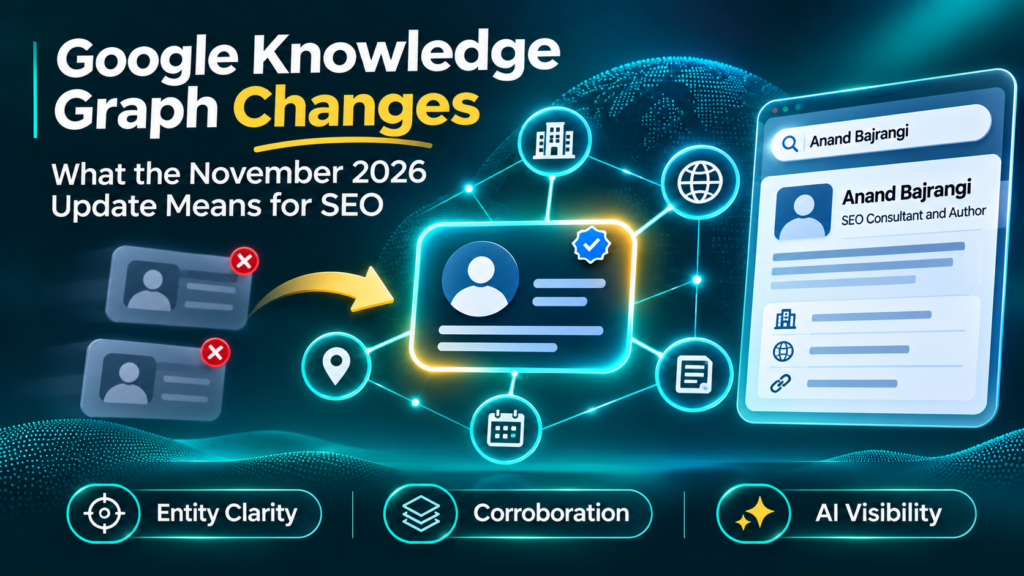
Google’s Knowledge Graph is an important part of how Search connects facts about people, companies, places and other real-world entities. In November 2026, new third-party tracking data reported a notable change: the number of person entities returned in one monitored sample fell sharply, while company entities changed very little.
The finding has attracted attention from SEO professionals because entity understanding can influence how brands and people are represented in search features, including Knowledge Panels. But the figures need careful interpretation. They come from an independent tracking dataset, not a Google announcement that it removed 10% of all people from its global Knowledge Graph.
In this article, we explain what the report found, what it does and does not prove, and how businesses, authors and SEO teams can strengthen the clarity and consistency of their online identity.
What Changed in Google’s Knowledge Graph in November 2026?
A report published by Search Engine Land on 20 November 2026, based on Kalicube’s daily tracking, described a sharp change in the entities returned for a monitored group of names.
- The tracked Person entities fell by 10.1% during the reported refresh.
- The number of tracked Company entities changed very little.
- The overall count in the sample dropped by about 6.1% on 16 November, then partially recovered the following day.
- The report said many of the removed person entries were ambiguous or duplicate records with little identifying information, such as no subtitle or description.
Important context: These percentages describe Kalicube’s tracked sample and methodology. They are not a published count of Google’s entire Knowledge Graph, and Google has not announced a global 10% deletion of person entities.
What Is Google’s Knowledge Graph?
Google describes the Knowledge Graph as a database of facts about people, places and things. It helps Search connect information and answer factual questions. Information can come from a range of public sources and from data supplied or verified by content owners.
For example, Google may understand that a person is an author, that the person wrote a particular book, and that the author works for a specific organization. These connections help distinguish one entity from another with a similar name.
Google’s official explanation is available in its Knowledge Panel Help documentation.
Knowledge Graph vs Knowledge Panel: What Is the Difference?
These terms are related, but they are not interchangeable.
| Term | Meaning |
|---|---|
| Knowledge Graph | Google’s underlying system for connecting facts about entities. |
| Knowledge Panel | An information panel that Google may display in Search for an entity when its systems consider it useful. |
| Knowledge Graph Search API | A developer-facing interface that can return matching entities and related information; it is not the same as a Google Search ranking report. |
A change in a third-party Knowledge Graph API tracking sample does not automatically mean every affected person will lose a Knowledge Panel or see an organic ranking decline.
Why Were Some Person Entities Reportedly Removed?
According to the Search Engine Land analysis, many of the entries that disappeared were weakly defined duplicates. They shared a name with another person but had little additional information to help distinguish them.
This points to a practical challenge for search systems: names alone are not enough to establish identity. A clear entity needs context that helps distinguish it from other people or organizations.
Useful identifying context may include:
- A clear professional role or occupation.
- A consistent biography and description.
- Verified association with an organization, publication or body of work.
- Consistent references from reputable, independent sources.
- A website or profile that clearly identifies the person or organization.
These are sensible identity and reputation practices. They should not be presented as a guaranteed formula for entering or remaining in Google’s Knowledge Graph.
Does a Knowledge Graph Score of 24 Mean an Entity Is Safe?
The Search Engine Land report discusses resultScore values returned by the Knowledge Graph Search API. Its author observed that some tracked person entities with a score of 24 disappeared, while the tracked individuals’ own established entities at that score remained.
That is an observation from the dataset, not an official Google threshold. Google has not published a score of 24 as a safety level, ranking factor or requirement for a Knowledge Panel. The report also notes that resultScore indicates how well an entity matched a request, rather than providing a public measure of an entity’s overall authority.
SEO professionals should therefore avoid selling a “score 24” service or promising that a particular score will protect a Knowledge Panel. Focus instead on whether the entity is accurately identified and consistently described.
What Does This Mean for Personal Branding and E-E-A-T?
For consultants, authors, founders and subject-matter experts, a clear digital identity can help people and automated systems understand who they are and what work they are associated with.
Google’s Knowledge Graph is not an E-E-A-T scorecard, and the November sample does not prove that a specific E-E-A-T signal caused entities to be removed. However, clear authorship, verifiable credentials and consistent information are useful for readers and for systems trying to reconcile information about the same person.
Practical steps include:
- Create a strong About page. State your full professional name, role, experience, areas of expertise and notable work in plain language.
- Use a consistent author identity. Keep your name, biography, profile image and professional details consistent across your website and relevant profiles.
- Connect your work. Link to books, articles, talks, projects and organizations you are genuinely associated with.
- Use structured data accurately. Where appropriate, use Schema.org Person markup and properties such as name, url, image, jobTitle, sameAs and worksFor. Only include facts that are true and visible or otherwise verifiable.
- Build independent corroboration. Seek genuine mentions and author profiles from reputable organizations, publications, professional associations and event sites.
- Keep information current. Update biographies, roles and links when they change, and correct outdated or misleading information.
What Should Companies Do?
The November report said company entities in its monitored sample barely moved compared with person entities. That does not mean companies can ignore entity clarity.
Businesses should make it easy to understand the relationship between their brand, website, products, services, locations and leadership.
- Maintain a complete About page with the correct legal or trading name.
- Keep contact details and business locations accurate.
- Use Organization or an appropriate more specific Schema.org type where it accurately describes the business.
- Connect official social profiles using sameAs only when they genuinely represent the business.
- Keep product, service and company descriptions consistent across trusted profiles.
- Earn credible coverage, reviews and professional references without manufacturing mentions.
How to Check Your Knowledge Panel and Entity Information
- Search Google for your exact name or company name, including a location or profession if the name is common.
- Check whether the displayed Knowledge Panel refers to the correct person or business.
- Review the title, description, image, website and related profiles shown.
- Check whether your website’s About page and author pages communicate the same facts.
- Review structured data with Google’s Rich Results Test where the markup type is supported. Remember that the Rich Results Test does not validate Knowledge Graph inclusion.
- If you are eligible to claim a Knowledge Panel, follow Google’s verification process and suggest corrections when information is inaccurate.
Google explains how to claim and manage a Knowledge Panel. Claiming a panel allows eligible representatives to suggest changes; it does not guarantee that Google will display a panel for every query.
What SEO Professionals Should Avoid
- Do not assume that a temporary panel disappearance means an organic ranking penalty.
- Do not treat third-party resultScore values as official Google authority scores.
- Do not create fake profiles, biographies, awards or company listings to manufacture entity signals.
- Do not add irrelevant sameAs links or schema properties that cannot be verified.
- Do not promise clients guaranteed Knowledge Graph inclusion or a Knowledge Panel.
Frequently Asked Questions
Did Google officially confirm a 10% Knowledge Graph cleanup in November 2026?
No. The 10.1% figure comes from Kalicube’s tracking of Person entities in its monitored dataset, as reported by Search Engine Land. It is not an official Google announcement or a measurement of the entire global Knowledge Graph.
Will this update remove my Google Knowledge Panel?
Not necessarily. The report does not establish that every entity affected in its sample lost a Knowledge Panel. Google says panels are generated automatically when its systems determine that enough relevant information is available for a query.
Is a Knowledge Graph score of 24 a ranking factor?
There is no published Google guidance establishing 24 as a ranking factor or a safe threshold. Do not use it as a target or guarantee.
Can structured data guarantee a Knowledge Panel?
No. Accurate structured data can help describe an entity, but it does not guarantee Knowledge Graph inclusion or a Knowledge Panel.
Should every professional create a personal website?
A personal website can provide a stable place to publish an accurate biography, work history and original content. It is a useful personal-branding asset, but it does not guarantee a Knowledge Panel.
Conclusion: Build a Clear and Verifiable Digital Identity
The November 2026 Knowledge Graph report is a useful reminder that entity clarity matters. In the tracked sample, ambiguous and weakly described person entries were more likely to disappear than established identities. But the figures should be read as independent research, not as a confirmed global Google cleanup.
For businesses and professionals, the practical response is straightforward: publish accurate information, maintain a clear About page, connect genuine profiles and work, use structured data responsibly, and build corroboration from trustworthy sources.
Do not chase an unofficial score or promise a Knowledge Panel. Build a digital identity that real people can verify and understand.
Sources and Further Reading
- Search Engine Land: Google’s November Knowledge Graph update dropped 10% of person entities overnight — third-party tracking analysis published 20 November 2026.
- Google: How the Knowledge Graph works — official explanation of Knowledge Graph facts, sources and Knowledge Panels.
- Google Search Central: Introduction to structured data — official structured data guidance.
- Schema.org: Person — properties for describing people.
Updated: 21 November 2026. This article distinguishes independent tracking observations from Google’s official documentation.