
When people search online, they want answers they can trust. Google’s goal is to show content that is not only useful, but also safe, correct, and written by people who know what they are talking about. To do this, Google uses special quality guidelines to check if a page shows real knowledge, honest intent, and care for the user.
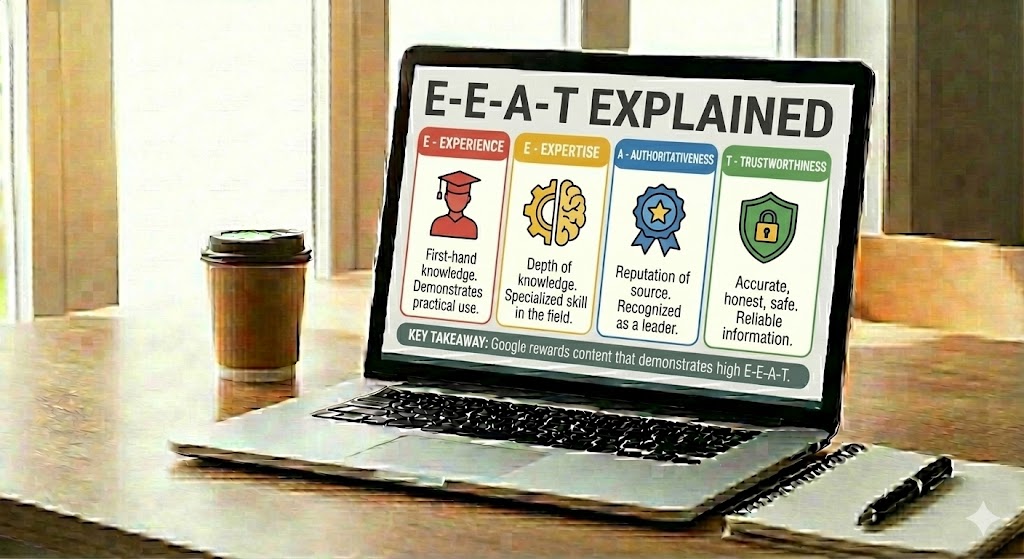
One of the key ideas behind these guidelines is called E-E-A-T. It helps explain how Google looks at the quality and trust of content. In simple words, E-E-A-T is about whether the content creator has real-life experience, strong subject knowledge, clear recognition from others, and high levels of trust and honesty.
This guide breaks down E-E-A-T step by step so beginners can understand it easily. You will see what each part means, why it matters for SEO, and how you can improve your own pages in a safe and simple way. By the end, you will understand why focusing on quality and trust is more powerful than chasing quick tricks.
E-E-A-T Explained: Why Google Cares About Quality and Trust
Before looking at each element of E-E-A-T on its own, it helps to understand why Google cares about these ideas at all. At its core, E-E-A-T is Google’s way of reflecting the same kind of judgment people use in real life when they decide who to listen to and who to ignore.
Imagine asking two people the same question: one is a doctor, the other just guesses. Whose answer would you rely on? That simple choice is very close to how Google wants to rank pages online.
Behind the search results, Google uses E-E-A-T to check if a page shows real value for users, not just smart use of keywords. The goal is to highlight content that is safe, accurate, and created by reliable people, especially for topics that affect health, money, or safety.
- Experience shows that the writer has first-hand contact with the topic, not just theory.
- Expertise checks if the person understands the subject deeply and can explain it clearly.
- Authoritativeness reflects recognition from others, such as citations or recommendations.
- Trustworthiness covers honesty, accuracy, and transparency across the whole site.
Together, these elements help Google’s systems reduce noise from low-quality pages and lift results that users can rely on. Over time, sites that focus on helpful, honest, well‑supported information tend to build stronger visibility than those chasing short‑term tricks.
E-E-A-T Explained: What Experience, Expertise, Authority, and Trust Mean
Once you know why E-E-A-T matters, the next step is to understand what each part actually represents. Google’s guidelines turn that vague “gut feeling” about whether content is reliable into specific qualities that can be evaluated.
Think about the last time you searched for advice online. Did you feel sure the person who wrote it actually knew what they were talking about? This section looks at how Google breaks that feeling into four clear ideas: Experience, Expertise, Authoritativeness, and Trustworthiness.
Experience is about first-hand contact with a topic. A review written by someone who has used a product for months usually feels more real than one copied from the box. Google’s guidelines value content that shows real-life use, personal tests, and concrete examples, because this helps users avoid guesswork and risky decisions.
Expertise focuses on deep subject knowledge. A tax guide written by a trained accountant or a detailed explanation of an algorithm from a computer scientist carries more weight than random opinions. Clear, accurate explanations, correct terms, and up‑to‑date facts are all signs of strong expertise.
Authoritativeness is about recognition from others. When respected sites, researchers, or industry groups refer to a source, it signals that the source is seen as a go‑to reference. This can show up as citations, mentions, or quotes across the web and in trusted publications.
Trustworthiness ties everything together. It covers honesty, safety, and transparency across the page and the whole site. Clear contact details, accurate claims, safe payment pages, and correcting mistakes all build trust. Without trust, even strong experience and expertise can lose their value in Google’s quality view.
Understanding Experience in E-E-A-T
After seeing how E-E-A-T works as a whole, it is useful to look more closely at each part, starting with experience. This first “E” is especially important for content that guides real-world decisions, like reviews, tutorials, and travel advice.
Have you ever read a review and thought, “This person has clearly never tried this”? That feeling is exactly what Google wants to avoid. In E‑E‑A‑T, the first “E” for Experience helps search systems tell the difference between content based on real use and content written from guesses or second‑hand notes.
In simple terms, experience means first-hand contact with the subject. The person creating the page has actually done the thing they are talking about: used the tool, followed the recipe, visited the place, or tested the advice. This kind of writing often includes specific details, timelines, and personal results that are hard to fake and very helpful for readers making decisions.
Google’s guidelines value pages that clearly show this kind of practical, real‑world insight. You can highlight it by including:
- Personal tests and experiments, such as “I ran this for 30 days and here is what happened.”
- Step‑by‑step notes that reflect what you actually did, including mistakes or lessons learned.
- Concrete examples and numbers, like costs, time taken, or performance results.
As search systems get better at understanding language, they can pick up signals that content is based on lived experience, not just theory. For topics like product reviews, travel guides, tutorials, or local services, this kind of authenticity can make your page stand out against more generic, copied, or automatically generated text.
Expertise and Authoritativeness in E-E-A-T Explained
Experience is only one part of how content earns trust. To give users reliable answers, Google also looks at how deeply a creator understands a topic and how widely that knowledge is recognized.
Have you ever closed a page because it sounded unsure or vague? That reaction often comes from weak expertise or low authoritativeness, even if the topic itself is simple.
In E‑E‑A‑T, expertise is about deep, reliable knowledge. It shows when a writer explains ideas clearly, uses correct terms, and avoids unsafe or outdated tips. For beginner guides, this can be as simple as using the right technical vocabulary and giving steps that actually work in real life.
Authoritativeness goes one step further: it reflects how much the wider community treats a source as a go‑to reference. This often appears through citations, mentions, and references from other respected sites or professionals. Over time, these signals help search systems see that a site is not just knowledgeable, but also a trusted point of reference.
- Expertise: correct explanations, up‑to‑date facts, and clear teaching.
- Authoritativeness: being quoted, recommended, or linked to by others.
For content creators, combining both means writing with solid understanding and earning visible recognition from peers and users, which strongly supports E‑E‑A‑T overall.
Trustworthiness and Its Role in Content Evaluation
Alongside experience, expertise, and authority, trust acts as the element that holds everything together. Even the most skilled or well-known source can lose value if users cannot feel safe relying on what they read.
When people read advice about money, health, or legal topics, they often feel a bit nervous. A single wrong step can cost time, peace of mind, or real cash. That is why trustworthiness sits at the center of how pages are judged for quality.
In E‑E‑A‑T, trust means users can safely rely on what they see: the information is accurate, the site is honest about who runs it, and actions like sign‑ups or payments are secure. Google’s quality guidelines treat trust as the foundation; strong experience and expertise still need clear signals that the page is not trying to mislead, hide, or confuse.
To show this clearly, creators can add simple but powerful trust signals:
- Transparent identity: clear author names, short bios, and easy‑to‑find contact details.
- Verifiable accuracy: dates on content, corrected errors, and references to reliable sources.
- Safe interactions: secure forms, clear pricing, and honest descriptions of products or services.
These details may look small, but they help search systems and real readers separate responsible content from pages that cut corners or hide important facts. Over time, websites that make trust visible tend to build stronger reputations and more stable search performance.
Why E-E-A-T Matters for SEO and Different Website Types
Understanding the pieces of E-E-A-T is useful, but it becomes even more powerful when you see how they affect real websites. Different kinds of sites show experience, expertise, authority, and trust in different ways, yet the underlying principles stay the same.
Have you ever wondered why two similar pages can rank very differently, even when both target the same keywords? Often, the difference comes from how well each site shows clear quality and trust signals, not just from how the text is optimized.
Search engines use E‑E‑A‑T to understand which pages are safer, more accurate, and more reliable for users. This helps protect people from risky advice and rewards sites that invest in helpful, responsible information across many types of content.
For personal blogs, strong E‑E‑A‑T can turn simple stories into trusted guides. Detailed case studies, honest failures, and clear takeaways show real‑life experience that readers and algorithms can recognize as useful, especially in niche hobbies, travel, or DIY tutorials.
Company and service sites benefit when pages explain who is behind the business, share team qualifications, and provide clear policies. These elements support expertise and trustworthiness, which can improve visibility for local searches and reduce user doubt before contact or purchase.
In e‑commerce, buyers want proof that products work as promised. Rich product pages with tested insights, clear specs, and transparent returns policies help show experience and trust, reducing risk for shoppers and signaling quality to search systems.
Topics related to health, finance, and safety—often called YMYL (Your Money or Your Life)—face even closer quality checks. Here, visible professional credentials, careful sourcing, and accurate updates are critical, because the content can directly affect a person’s well‑being or long‑term decisions.
How Beginners Can Improve E-E-A-T and Avoid Common Myths
Knowing that E-E-A-T influences visibility is only helpful if you can act on it. Beginners do not need advanced tools or complex tactics; small, consistent improvements in clarity, openness, and honesty can make a real difference.
Have you ever tried to “fix SEO” in a weekend by changing a few tags and keywords? Many people do, then feel confused when nothing really improves. Instead of chasing quick tricks, beginners can focus on simple, low‑risk steps that make their pages look more honest, helpful, and reliable to both users and search systems.
The ideas below show practical actions you can take, plus common myths to avoid. You do not need advanced technical skills; most changes involve writing more clearly, showing who you are, and being open about how you work.
To start, focus on a few basic habits that quietly support all parts of E‑E‑A‑T. These do not require new tools or big budgets, only a bit of time and consistency.
- Write original explanations in your own words, not copies.
- Add short author bios that mention real roles, studies, or years of practice.
- Include dates and updates on pages that can go out of date.
- Describe how you tested a product, method, or service in clear steps.
- Make contact details and policies easy to find in menus or footers.
While you apply these habits, it also helps to be careful about common myths. Many beginners waste time on ideas that sound clever but have little or no effect on trust or quality.
- Believing that adding the word “expert” everywhere will boost rankings.
- Thinking one fancy badge or logo replaces real qualifications or sources.
- Publishing huge amounts of thin, repeated content instead of a few strong guides.
- Hiding affiliate links or ads so users cannot see what is sponsored.
- Using auto‑generated text without review, fact‑checking, or editing.
- Ignoring user feedback and never correcting errors or unclear parts.
- Assuming E‑E‑A‑T is a switch you can flip once, instead of an ongoing practice.
As many SEO educators point out, trust grows from actions, not labels.
“You do not declare trust; you earn it by being consistently accurate, open, and helpful.” — Marie Haynes
Building Lasting Search Visibility Through Quality and Trust
All of these ideas point in the same direction: long-term results come from earning user confidence, not exploiting short-lived tricks. E-E-A-T simply gives a clear way to think about how that confidence is built.
Across this guide, one pattern stays clear: E‑E‑A‑T is not a trick or a shortcut, but a simple way of thinking about how to earn and keep user trust. Google’s systems use it to tell the difference between pages that only look optimized and pages that are genuinely helpful, accurate, and safe to rely on.
For beginners, the key takeaway is that real experience, clear expertise, visible authority, and honest behavior work together. If you focus on creating pages you would confidently recommend to a friend, you will move in the same direction as Google’s quality guidelines and build a site that can grow and adapt for years to come.