
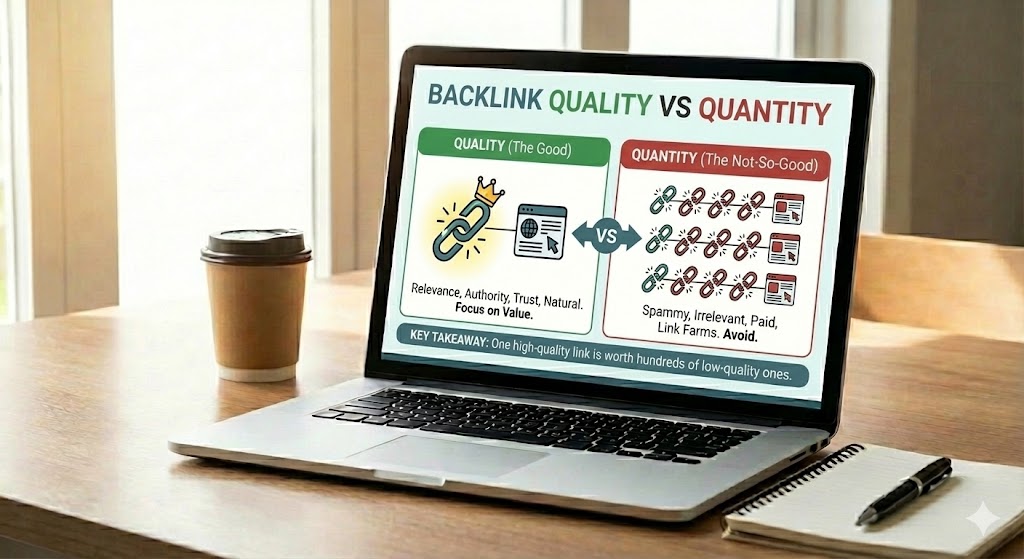
Many beginners think that more backlinks always mean better SEO results. It is easy to see a big number and believe your website is winning. But in search engine optimization, this idea is often wrong and can even be risky for your site.
Backlinks are links from other websites that point to your pages. On the surface, they may all look the same, but not all backlinks carry the same weight or value. Some links can strongly help your rankings, while others can do almost nothing, or even harm your site in the eyes of search engines.
To understand real success in SEO, you must learn the difference between backlink quality and backlink quantity. This guide will show you, in simple steps, why a few strong, trustworthy links can be far more powerful than hundreds of weak ones, and how this shapes your overall link-building strategy.
Backlink Quality vs Quantity
At first glance, a long list of backlinks looks like clear progress. But when you look closer, you quickly see that some links help a lot, while others add almost no value at all. This is where the real difference between backlink quality vs quantity becomes important.
When we talk about quality, we mean links that come from trusted, relevant, and respected websites that add real value for users. These links are usually natural, placed inside helpful content, and make sense for the topic, much like a careful peer review in science.
By contrast, a focus on pure quantity often leads to links from random pages, weak blogs, or even automated systems. Such links may look impressive in a report, but they bring little real authority and can increase risk.
- High-quality links support long-term growth and stable rankings.
- Large numbers of weak links can trigger spam signals and waste effort.
Introduction to Backlink Quality vs Quantity
Many site owners compare themselves to competitors by looking only at link counts. Seeing thousands of backlinks can make any smaller site feel far behind. Yet search engines care far more about trust and relevance than they do about raw totals.
Imagine two websites: one has 50 links, the other has 5,000. Which one is stronger? At first glance, the bigger number seems like an easy win, but search engines care more about trust and relevance than simple counts.
This is where the idea of backlink quality vs quantity becomes practical. A small group of links from reliable, topic-related sites often sends a clearer signal than thousands of random mentions. Instead of chasing every possible link, beginners need to understand which links actually move rankings and which ones simply add noise.
- Quality-first strategies build a natural, safe link profile over time.
- Number-focused tactics can create patterns that look artificial or spammy.
As you move through this guide, you will see how to recognize strong links, avoid weak ones, and keep both quality and quantity in balance so your site can grow steadily without needless risks.
What Does Backlink Quality Mean?
Before you chase more links, it helps to understand what makes a single link truly powerful. Thinking of links as recommendations makes this easier to see: not every recommendation carries the same weight.
Think of each link to your site like a personal recommendation. Some people are experts and very honest, and their words carry a lot of power. Others are unknown or untrustworthy, so their opinion does not change much in the real world.
In the same way, backlink quality describes how strong, trustworthy, and useful a link is in the eyes of search engines. A single link from a respected, topic-related site can be more valuable than many links from weak or random pages.
Several simple factors usually point to a high-quality backlink:
- The linking site has real traffic, real readers, and consistent content.
- The topic of the linking page is closely related to your page.
- The link is placed inside helpful content, not in a list of hundreds of URLs.
- The anchor text (the clickable words) is natural and descriptive, not stuffed with keywords.
- The link is gained in a safe, natural way, not by spam, tricks, or paid schemes.
When these elements come together, the link sends a clear message: your page is useful, relevant, and worth recommending. That is what backlink quality really means for beginners learning off-page SEO.
What Does Backlink Quantity Mean?
Once quality is clear, it becomes easier to see where simple numbers fit into the picture. Link totals still matter, but only when you understand what they actually represent.
Have you ever seen a report showing hundreds of links and felt impressed, but also a bit confused? Numbers can look powerful, yet they do not always tell the whole story about your site’s strength.
Backlink quantity simply means the total count of links pointing to your pages, no matter where they come from or how strong they are. It measures how many websites link to you, not how good those links are. A site might collect links from forums, comments, small blogs, or directories and quickly raise its total.
However, numbers alone do not guarantee better rankings. A large pile of weak, unrelated links can look unnatural and may even create risk signals for search engines. To use volume in a safe way, it should grow from relevant mentions, simple shares, and natural references that fit your topic, instead of from automated tools or spammy tactics.
Backlink Quality vs Quantity: Key Differences for SEO
With both ideas defined, the next step is to see how they behave in real search results. Search engines must constantly decide whether a site deserves higher visibility, and backlinks play a major role in that decision.
Picture a teacher grading projects. One student hands in a few well-done pages, another submits a thick stack of messy work. Which one truly deserves the higher grade? Search engines face a similar choice when they look at your links.
To understand backlink quality vs quantity, you need to see how each side affects rankings, risk, and long-term growth. Below are the main ways they differ in real SEO.
- Impact on SEO: A handful of trusted, relevant links can move rankings more than hundreds of weak mentions that nobody reads.
- Risk level: Chasing big numbers with spammy or automated links can lead to filters, lost visibility, or even manual actions.
- Long-term value: Natural links from authoritative, niche-related sites often keep sending traffic and trust for years.
- Sustainability: Building quality is slower, but it creates a stable, realistic link profile that is easier to maintain than massive low-value link blasts.
Why Backlink Quality Matters More Than Quantity
Once you see the differences, it becomes clearer why search engines reward strength over volume. A smaller set of strong links can shape your visibility far more than a large pile of weak mentions.
Think about a friend asking which book to read. Would you trust ten random strangers or one respected teacher who really knows the topic? Search engines face a similar choice when they look at links pointing to your site.
High-quality links send strong trust signals. They come from sites that already have authority, real visitors, and solid content. When such pages recommend you, search engines see this as proof that your content is worth showing higher in results, which helps your pages grow steadily.
Focusing on strength over volume also gives you more stable rankings. Strong links are harder for competitors to copy, last longer, and are less likely to disappear or be ignored. This creates a safer, more predictable path for your SEO over months and years.
- Stronger trust signals from respected, relevant sites
- More stable rankings that do not jump up and down all the time
- Lower penalty risk because you avoid spammy link patterns
- Better user value, since visitors arrive from real, interested audiences
When Backlink Quantity Still Matters
Quality may lead, but quantity does not disappear from the equation. There are situations where a broader spread of links helps search engines and users discover more of your content.
Have you ever noticed that big, popular sites seem to be mentioned everywhere online? While a few strong links can move the needle, there are moments when having more relevant links also plays an important role in growth.
In some stages of SEO, extra volume helps search engines see your site as active, talked about, and connected within its topic. The key is that this volume must come from real, related places, not from spam or automation.
For new domains, a wider set of simple links can help search engines discover different pages. Mentions from small blogs, niche forums, or community sites create a natural base of references, especially when your brand or name is just starting to appear online.
Quantity can also support growth when you publish shareable resources, like guides or tools. Many small, honest mentions may be weak alone, but together they show a clear pattern of interest and can bring steady referral traffic over time.
- Broad discovery: More legitimate links help crawlers find and recrawl your pages.
- Brand awareness: Frequent mentions slowly build recognition in your niche.
- Traffic diversity: Many low‑to‑medium strength links can send small but consistent visits.
- Support for strong links: A background of natural volume makes powerful backlinks look more organic.
Used this way, link volume is not about chasing a big number in a report. It is about creating a realistic pattern of mentions that supports your best, high-quality backlinks instead of trying to replace them.
How Beginners Should Approach Backlink Quality vs Quantity
Knowing all this, beginners often wonder where to start. The safest answer is to follow a simple plan that respects both trust and scale, without rushing into risky tactics.
Looking at other sites, you might see huge link numbers and feel behind. Instead of chasing those totals, it helps to follow a simple plan that keeps your site safe while it grows.
A beginner-friendly approach focuses on slow, steady gains and clear rules. This way, you learn what works, avoid risky tricks, and let search engines build trust in your pages over time.
Start by creating useful, easy-to-read content that people might honestly want to mention. Then, look for a few relevant websites, forums, or communities where you can inherently share that content, without spamming.
- Put quality first, treating every new link like a public recommendation.
- Let quantity grow slowly from real mentions, not automated tools.
- Review your links sometimes and avoid obvious spammy sources.
Over months, this calm, careful method builds a natural link profile that supports strong rankings without sudden penalties or surprises.
Putting Backlink Quality and Quantity in the Right Balance
In the end, backlinks are not about chasing the biggest number or a single perfect link. Real progress comes from combining strong recommendations with a natural level of broader mentions that match your niche.
Backlinks are not a simple numbers game. They act like public votes of trust, and search engines look closely at who is voting for you, why, and how those links were earned. When you understand this, the idea of backlink quality vs quantity becomes much clearer and less confusing.
For beginners, the safest path is to treat every new link like a serious recommendation. Put quality first, let honest quantity grow naturally, and avoid shortcuts that try to trick search engines. Over time, this mix of strong, relevant links supported by a realistic level of broader mentions builds a profile that looks natural, passes trust, and keeps risks low.
Remember: a few good links can do more for you than a mountain of weak ones. Focus on useful content, real connections in your niche, and patient growth so that both the quality and the quantity of your backlinks work together to improve your SEO results.