
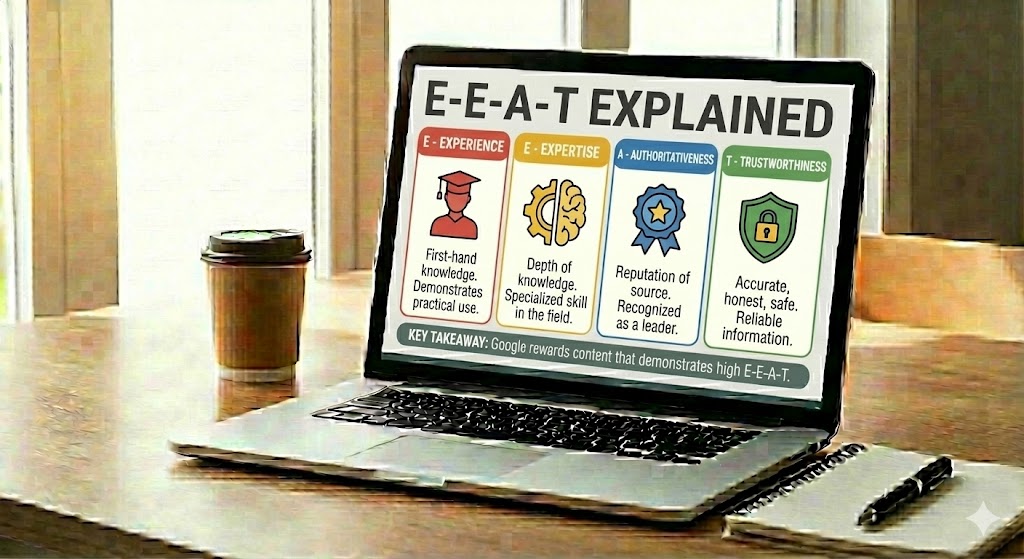
Quick answer: E-E-A-T stands for Experience, Expertise, Authoritativeness and Trustworthiness. It is part of Google’s Search Quality Rater Guidelines and helps explain the qualities of helpful, reliable content. E-E-A-T is not a single ranking factor or a score you can add to a page. Google uses many automated systems to rank results, while human quality raters use the guidelines to assess search quality and provide feedback.
For website owners, the practical lesson is simple: publish information that is accurate, useful and transparent. Show relevant first-hand experience where it exists, demonstrate subject knowledge, earn a reputation in your field and make it easy for people to trust your business and content.
What does E-E-A-T mean in SEO?
E-E-A-T is short for four qualities that Google’s Search Quality Rater Guidelines discuss when evaluating the quality of a page and its creator:
- Experience: first-hand or life experience with the topic.
- Expertise: the creator’s knowledge or skill in the subject.
- Authoritativeness: the reputation of the creator, content or website as a source on the topic.
- Trustworthiness: whether the page and its publisher are accurate, honest, safe and reliable.
Trust is central to the framework. A page can be written by someone with experience and strong subject knowledge, but it still needs to be honest about its claims, sources, ownership and purpose.
Is E-E-A-T a Google ranking factor?
It is important to understand this correctly. E-E-A-T is not a single direct ranking factor, numeric score or technical tag. Google uses a range of automated ranking systems and signals to surface helpful results. Its Search Quality Rater Guidelines give human raters a common framework for assessing the quality of search results. Rater feedback helps Google evaluate and improve its systems; raters do not directly change the ranking of individual pages.
This does not mean the ideas behind E-E-A-T are unimportant. Google’s guidance encourages creators to make content helpful, reliable and people-first. Improving the real qualities described by E-E-A-T can improve the usefulness and credibility of a website, even though adding an author box or a badge does not automatically improve rankings.
1. Experience: show first-hand knowledge
Experience means the content creator has relevant first-hand involvement with the topic. This could mean using a product, visiting a location, completing a process, managing a project or learning from direct work.
For example, a product review is more useful when the reviewer has actually tested the product and explains what happened. A local service guide can be stronger when it includes real project photographs, practical details and lessons from work in that area.
Ways to demonstrate experience
- Share original photographs, screenshots, demonstrations or test results.
- Explain the process you followed, including limitations and mistakes.
- Use genuine case studies and examples, with permission to share client information.
- Describe what you personally observed rather than presenting assumptions as facts.
- Clearly separate first-hand findings from information gathered from other sources.
Never invent personal experience, product testing, customer stories or project results. If you have not tested something yourself, say what sources you used and explain the limits of your review.
2. Expertise: demonstrate subject knowledge
Expertise is the knowledge and skill needed to explain a subject correctly. The level and type of expertise required depend on the topic. A personal hobby guide may draw on practical knowledge, while medical, financial and legal advice can require appropriately qualified professionals and careful review.
Ways to demonstrate expertise
- Publish accurate explanations with clear examples and correct terminology.
- Identify the author and explain relevant qualifications, experience or responsibilities.
- Have high-stakes content reviewed by a suitably qualified professional.
- Cite reliable primary sources for important claims, data and recommendations.
- Correct errors and update advice when laws, products, tools or guidance change.
A long author biography is not a substitute for useful content. Explain why the author is relevant to the subject, and make sure the page itself answers the reader’s question.
3. Authoritativeness: build a recognised reputation
Authoritativeness relates to how the creator, organisation or website is recognised by others in its field. Reputation is built over time through reliable work, useful resources and genuine recognition—not by simply describing yourself as an authority.
Ways to build authority
- Create original resources that other professionals and publishers may find useful.
- Earn relevant editorial mentions, citations and links through worthwhile work.
- Contribute expert commentary, interviews, research or presentations where appropriate.
- Maintain accurate profiles and business information across trusted platforms.
- Build depth in the subjects that genuinely match your experience and services.
Do not buy links, create fake awards or arrange misleading endorsements to appear authoritative. A smaller number of genuine, relevant references is more valuable to users than a collection of artificial signals.
4. Trustworthiness: make your website reliable
Trustworthiness is the most important part of E-E-A-T. Visitors should be able to understand who publishes a page, why it exists, how its claims can be checked and whether it is safe to use the website.
Ways to improve trust
- Provide clear business, contact and customer-support information.
- Explain who created or reviewed important content.
- Use accurate claims, transparent pricing and clear terms and policies.
- Disclose advertising, sponsorships and affiliate relationships where required.
- Use secure connections and protect forms, accounts and payment information.
- Correct mistakes and keep important pages up to date.
- Make it easy for visitors to understand how products, services and recommendations work.
How E-E-A-T applies to different websites
Blogs and publishers
Show who wrote an article, cite original sources, distinguish reporting from opinion and add original analysis. Update older content when facts change. Do not publish multiple near-identical articles just to target small keyword variations.
Local businesses and service providers
Explain your services, service areas, process, team and customer support clearly. Use genuine project photographs and case studies where permitted. Keep your business details accurate and encourage honest customer feedback without offering rewards for positive reviews or filtering out negative feedback.
Ecommerce websites
Provide accurate product specifications, original images, useful demonstrations, transparent delivery and return policies, and accessible customer support. Reviews should come from genuine customers and should not be manipulated.
Health, finance and other high-impact topics
Google uses the term “Your Money or Your Life” (YMYL) for topics that can significantly affect a person’s health, financial stability, safety or well-being. These topics call for especially strong accuracy and trust. Use qualified contributors or reviewers when needed, rely on authoritative sources, explain uncertainty and avoid presenting general information as personalised professional advice.
E-E-A-T and AI-generated content
Using AI tools does not automatically make a page low quality. The important question is whether the finished content is helpful, accurate, original and created for people. AI can help with research organisation, outlines and editing, but it can also produce incorrect facts, invented references and generic explanations.
- Have a knowledgeable person review the content before publication.
- Verify every statistic, quotation, source and technical recommendation.
- Add genuine experience, original analysis and useful examples.
- Do not claim a human performed tests or research when that did not happen.
- Avoid mass-producing pages that add little value or exist mainly to manipulate search rankings.
Google’s guidance focuses on the quality and purpose of content, not on a blanket ban on AI writing tools. Read its guidance on generative AI content for details.
A practical E-E-A-T audit checklist
Use this checklist to review important pages on your website. Prioritise the questions that matter most for your audience and topic; not every item applies to every page.
- Is the purpose of the page clear?
- Does the page answer the visitor’s main question?
- Is the author or responsible organisation identified?
- Are relevant experience and qualifications described accurately?
- Are first-hand examples genuine and clearly explained?
- Are important facts supported by reliable sources?
- Are claims, images, testimonials and reviews authentic?
- Are commercial relationships and sponsored content disclosed?
- Are contact details, policies and customer support easy to find?
- Is the page current, accurate and free from misleading statements?
- Does the website protect user information and provide secure interactions?
- Does the content offer something useful beyond a generic summary?
Common E-E-A-T myths to avoid
- Myth: E-E-A-T is a direct ranking score. Reality: it is a quality framework in Google’s rater guidelines, not a score shown in Search Console.
- Myth: An author bio guarantees better rankings. Reality: accurate author information helps readers understand who is responsible, but a bio alone does not guarantee ranking improvements.
- Myth: Every article needs a professional credential. Reality: the right experience depends on the subject. High-impact topics need more careful sourcing and qualified review.
- Myth: More backlinks automatically mean more authority. Reality: reputation should be earned through relevant, trustworthy work. Manipulative link schemes can violate spam policies.
- Myth: AI content is always against Google’s rules. Reality: the focus is on helpfulness, accuracy and policy compliance, not simply which tool helped create the content.
- Myth: Adding an E-E-A-T schema tag improves rankings. Reality: there is no special E-E-A-T schema or markup that turns these qualities into a ranking boost.
Frequently asked questions about E-E-A-T
What does E-E-A-T stand for?
E-E-A-T stands for Experience, Expertise, Authoritativeness and Trustworthiness. These are qualities described in Google’s Search Quality Rater Guidelines.
Is E-E-A-T a direct Google ranking factor?
No. E-E-A-T is not a single direct ranking factor or numerical score. Google’s automated systems use many signals to rank pages. The rater guidelines help human evaluators assess search quality and provide feedback on systems.
Which part of E-E-A-T is most important?
Google describes trust as the most important member of the E-E-A-T family. Experience, expertise and authority can all help support trust, depending on the page and topic.
How can a new website build E-E-A-T?
Start by publishing accurate, useful content, identifying responsible authors, citing reliable sources, explaining your real experience and providing clear business and contact information. Build a reputation through good work over time; do not fake reviews, credentials or links.
Does E-E-A-T matter for local SEO?
Trust and credibility matter to local customers. Accurate business details, genuine reviews, clear service information, real examples and responsive customer support help people assess a local business. These practices support a reliable online presence, although E-E-A-T is not a separate local ranking score.
Can AI-generated content demonstrate experience?
AI cannot truthfully claim personal experience. A human contributor can use AI for assistance and then add verified first-hand knowledge, original evidence and expert review. Be transparent about the process when it is relevant to readers.
Final thoughts
E-E-A-T is best treated as a practical standard for creating content people can rely on, not as an SEO trick. Show real experience where you have it, explain subjects accurately, earn recognition through useful work and make your website honest and safe. These habits help visitors make informed decisions and support the broader goal of publishing helpful, reliable content.