
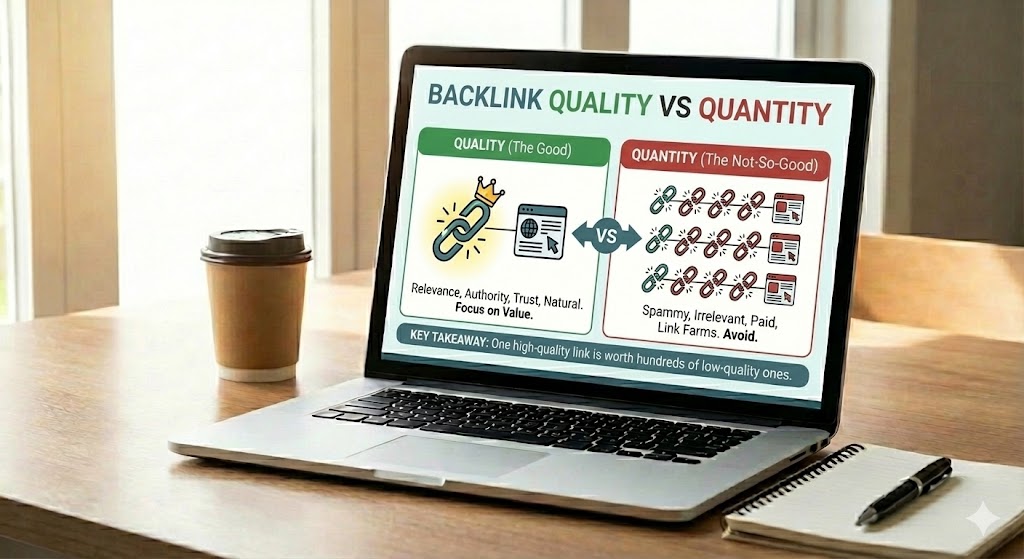
When comparing backlink profiles, it is tempting to assume that the website with the largest number of links must have the strongest SEO performance. That is not a reliable way to judge link quality. A backlink profile should be evaluated by relevance, editorial context, the reason the link exists, the page that contains it, and whether it can bring real visitors.
Backlinks can help search engines discover pages and understand relationships between websites. But raw link counts do not tell the full story. A smaller number of relevant, editorially earned links may be more valuable than thousands of links created through directories, automated tools, or paid schemes intended to manipulate rankings.
This guide explains backlink quality vs. quantity, how to evaluate referring domains, which link patterns deserve investigation, and how to build a sustainable link acquisition process without chasing arbitrary targets.
Quick answer: Is backlink quality more important than quantity?
Quality and relevance should guide your link-building strategy; quantity is a supporting metric, not the goal. A link from a relevant publication that independently references your useful research can bring qualified visitors and provide meaningful context. A large number of unrelated or manipulative links may provide little value and can create policy risk.
- Evaluate the linking page and website, not just a third-party authority score.
- Prefer links that make sense to the linking site’s audience.
- Look for genuine editorial context and a clear reason for the reference.
- Measure referral visits, leads, and business relevance as well as link counts.
- Do not assume every low-authority, foreign-language, or unfamiliar link is harmful.
- Avoid buying links or using automated schemes to manipulate ranking signals.
1. What is backlink quality?
Backlink quality is a practical assessment of how relevant, credible, useful, and naturally placed a link is. There is no single public Google score that labels a backlink as high or low quality. Third-party SEO metrics can help with research, but they are estimates from those tools, not Google’s own ranking measurements.
Use these factors when reviewing an individual backlink:
- Topical relevance: Does the linking page cover a subject related to the page being linked to?
- Editorial reason: Is the link included because it supports a point, cites a source, or helps the reader?
- Page quality: Is the linking page useful, original, maintained, and accessible to visitors?
- Audience fit: Could the site’s actual readers reasonably be interested in your resource?
- Placement and context: Is the link part of meaningful content rather than a hidden, automated, or sitewide block?
- Acquisition method: Was it earned naturally, or was it created through a scheme intended to pass ranking credit?
- Destination quality: Does your linked page satisfy the expectation created by the reference?
A link does not need to come from a famous website to be useful. A specialist publication, professional association, local organisation, or respected niche resource may be a better audience match than a much larger but unrelated website.
2. What does backlink quantity mean?
Backlink quantity refers to the number of links pointing to a website or page. SEO tools may report total backlinks, referring domains, new links, lost links, and links to individual URLs. These are different measurements.
| Metric | What it measures | How to use it |
|---|---|---|
| Total backlinks | Known link instances pointing to a site or page | Monitor broad link growth, but inspect duplicates and sitewide links |
| Referring domains | Distinct domains linking to the site | Understand the breadth of websites mentioning the brand |
| Referring pages | Individual pages that contain links | Review the context and placement of links |
| New and lost links | Links discovered or no longer detected during a period | Investigate changes and important lost references |
| Follow and qualified links | Link attributes such as follow, nofollow, sponsored, and UGC | Understand link context and whether links are appropriately qualified |
One website can link to you from hundreds of pages, so total backlinks can rise much faster than referring domains. Neither metric alone proves authority, trust, or ranking strength.
3. Backlink quality vs. quantity: key differences
| Evaluation area | Quality-focused approach | Quantity-focused approach |
|---|---|---|
| Selection | Relevant websites and useful pages | Any available website or placement |
| Editorial context | Link supports the reader and topic | Link added mainly to increase counts |
| Acquisition | Earned through resources, expertise, and relationships | May rely on bulk submissions, automation, or paid placements |
| Measurement | Relevance, referral value, and link context | Raw totals and changes in tool scores |
| Risk management | Follows search spam policies | Can encourage manipulative patterns |
| Long-term value | Can support discovery, reputation, and referral traffic | May create reporting growth without meaningful audience value |
This is not a claim that every link from a small site is bad or that every link from a large site is good. Evaluate the actual page and how the link was obtained.
4. Why relevant links can be more useful than large link counts
They reach the right audience
A link from a specialist resource can introduce your content to people who already care about the subject. Even if the page sends a modest number of visits, those visitors may be more likely to read, enquire, subscribe, or become customers.
They provide useful editorial context
A contextual reference can help readers understand why your resource is worth visiting. A link to an original study, detailed guide, calculator, or useful tool is more meaningful when the surrounding text explains its relevance.
They can build brand recognition
Being referenced by relevant industry publications, professional communities, and local organisations can increase awareness. Brand visibility and referral value are worthwhile outcomes even when a link does not produce a measurable ranking change.
They are harder to manufacture credibly
Useful editorial references generally require something worth citing: original data, expertise, a genuinely helpful tool, a strong resource, or a meaningful contribution. That is a healthier long-term focus than buying large quantities of links.
5. When backlink quantity is still useful to measure
Quantity is not meaningless. It can help describe the scale and breadth of a website’s link profile when interpreted alongside quality and context.
- Competitor research: compare referring-domain trends to identify publications and communities relevant to your market. Do not copy a competitor’s entire backlink list.
- Campaign reporting: track how many relevant websites referenced a research report, event, or resource.
- Link reclamation: monitor lost links to identify valuable pages or references that have disappeared.
- Brand discovery: understand how widely your organisation is being mentioned across relevant websites.
- Coverage analysis: identify important topics or sections of your site that have few external references.
There is no universal safe number of backlinks to acquire per month. A natural link profile can grow slowly, quickly, or unevenly depending on news coverage, research, product launches, and audience interest. Do not treat a competitor’s link count as a target or assume a sudden increase is automatically a penalty risk.
6. How to evaluate a backlink: a practical scoring framework
Use the following framework to organise manual reviews. It is an internal prioritisation aid, not a Google score and not a guarantee of ranking impact.
| Factor | Questions to ask | Positive evidence |
|---|---|---|
| Relevance | Does the topic fit your page and audience? | Clear topical relationship |
| Editorial value | Would the link make sense without SEO? | Reference supports a useful point |
| Page usefulness | Does the page offer real value? | Original, helpful content |
| Audience | Could visitors be interested in your resource? | Relevant readers and referral potential |
| Placement | Is the link visible and contextually placed? | Natural in-content reference |
| Acquisition | Was the link earned or paid for ranking credit? | Voluntary editorial reference or properly qualified sponsorship |
| Destination | Does your page fulfil the promise of the link? | Useful and closely matched landing page |
You can record each factor as Strong, Mixed, or Weak and add a note. Avoid adding the labels into a single numeric score that pretends to predict Google’s ranking decisions.
7. Examples: strong, weak, and risky backlinks
Example A: Relevant editorial reference
A digital marketing publication writes about website migration and links to an original migration checklist because it helps readers plan redirects. The topic, context, and destination match. This is a useful editorial reference.
Example B: Specialist community resource
A professional association lists a genuinely useful member resource in a relevant resource library. The page is maintained and intended to help members. The link may bring qualified referral visits even if the association’s website is not a major media brand.
Example C: Low-value bulk directory submissions
A service creates hundreds of directory or bookmark links on unrelated websites, with keyword-rich anchors, primarily to manipulate rankings. This is not a sound link-building strategy. Google lists low-quality directory and bookmark links among examples of link spam.
Example D: Paid sponsorship
A company pays for a sponsorship article or placement. Advertising and sponsorship can be legitimate, but links should be qualified with rel="sponsored" or nofollow as appropriate. Payment should not be disguised as an editorial endorsement intended to pass ranking credit.
8. How to build backlinks with quality first
1. Publish something worth referencing
Create original research, practical templates, useful tools, expert explanations, data summaries, or detailed resources. Make the page easy to understand and cite.
2. Find relevant websites and publishers
Build a prospect list based on topic fit, audience, editorial standards, and the type of resource they publish. Review actual pages rather than relying only on domain-level metrics.
3. Personalise outreach
Explain why the resource is relevant to that publisher’s readers. Reference a specific article or topic and make a clear, low-pressure request. Do not send mass generic emails or demand a followed link.
4. Use digital PR and expert contributions
Offer useful data, original commentary, interviews, case studies, or subject expertise. A contribution should help the publisher’s audience first. Any paid placement must be disclosed and links appropriately qualified.
5. Reclaim genuine unlinked mentions
When a relevant website mentions your organisation or research without linking, consider a polite request to add a reference if it would help readers. Do not pressure publishers or treat every brand mention as a link obligation.
6. Build useful local and industry relationships
Participate in professional associations, community projects, relevant events, and industry resources. Focus on real collaboration and audience value, not reciprocal link arrangements.
For more ideas, see this beginner’s guide to link-building strategies and the off-page SEO checklist.
9. Link attributes: follow, nofollow, sponsored, and UGC
Link attributes provide context about the relationship between the linking site and the destination. They should be used accurately, not treated as a quality score.
| Attribute | Typical use | Practical note |
|---|---|---|
| No attribute | Ordinary editorial link | Use when the link is a normal reference and no qualification is needed |
rel="nofollow" |
When you do not want to imply endorsement or pass ranking credit | Google treats it as a hint |
rel="sponsored" |
Advertisements, sponsorships, and paid placements | Preferred qualification for paid links |
rel="ugc" |
User-generated content such as forum or comment links | Helps identify links created by users |
Do not assume that a nofollow link has no value. It may still send visitors, support discovery, and create brand exposure. Likewise, do not assume that a followed link is valuable just because it is followed.
10. How to audit backlink quality
- Export backlink data: collect available external link reports from Search Console and your preferred SEO tools.
- Group by referring domain: identify repeated sitewide links and domains with many links.
- Review important linking pages: open the actual page and assess topic, context, placement, and purpose.
- Check acquisition history: compare the link with outreach, sponsorship, agency, or campaign records.
- Identify policy concerns: look for paid ranking links, automated placements, excessive exchanges, or other manipulative patterns.
- Check referral value: use analytics to understand visits and conversions where measurable.
- Record decisions: classify links as relevant, neutral/unclear, or requiring investigation, and document why.
- Review important lost links: contact the publisher only when restoring the reference would be useful and appropriate.
Search Console’s Links report is useful for examples of links Google has found, but it is not a complete list of every link on the web. Third-party tools also have their own crawl coverage and metrics.
11. Should you remove or disavow low-quality backlinks?
No—not simply because a third-party tool labels a link toxic or because the referring domain has a low authority score. Unusual, irrelevant, scraper, or low-quality links can appear naturally across the web. Their presence alone does not prove that they are harming your site.
Start by checking whether there is evidence of a link scheme that your organisation or an agency created, or whether Search Console reports a manual action for unnatural links. If you paid for ranking links, participated in manipulative exchanges, or used automated link schemes, stop the practice and address the underlying issue.
Google’s disavow tool is an advanced feature. Google says most sites do not need it. Consider it only when there is a considerable number of spammy or artificial links and there is a manual action, or a strong likelihood of one, connected to those links. Review Google’s disavow links guidance before using it. You can also read this guide to understanding toxic backlinks and the Google disavow tool guide.
12. Backlink performance: what should you measure?
| Metric | Why it matters | Review frequency |
|---|---|---|
| Relevant referring domains | Shows breadth of relevant external references | Monthly or quarterly |
| New and lost important links | Highlights meaningful changes worth investigating | Monthly |
| Referral sessions | Measures visitors sent by external links | Monthly |
| Assisted leads or sales | Connects referral activity to business outcomes | Monthly or quarterly |
| Target-page visibility | Shows how the linked pages perform over time | Monthly |
| Policy and acquisition review | Checks whether link campaigns follow search spam policies | For each campaign and periodic audit |
Do not attribute a ranking change to one backlink without evidence. Rankings can change for many reasons, including content, competition, technical issues, search updates, and changes in user demand.
13. Common backlink quality and quantity myths
- Myth: More backlinks always mean higher rankings. Link counts alone do not establish quality or ranking impact.
- Myth: Every link from a low-authority website is harmful. Evaluate relevance, context, and how the link was acquired.
- Myth: A sudden increase in backlinks automatically causes a penalty. A legitimate news story or popular resource can attract many links. Investigate the source and acquisition method instead of reacting to volume alone.
- Myth: There is a perfect monthly backlink target. There is no universal safe or ideal number of links to build each month.
- Myth: Every nofollow link is worthless. Qualified links can still bring referral visits and awareness.
- Myth: You should disavow every link labelled toxic by an SEO tool. Tool scores are not Google’s own penalty labels. Follow Google’s disavow guidance and assess the evidence.
Frequently asked questions
How many backlinks does a website need to rank?
There is no fixed number. Ranking depends on many factors, including relevance, content quality, competition, technical accessibility, and links. Focus on earning references that make sense for your audience rather than reaching a backlink quota.
Are referring domains more important than total backlinks?
Referring domains can give a clearer view of how many distinct websites link to you, while total backlinks show the number of link instances. Neither metric is a standalone measure of link quality or ranking strength.
Can one high-quality backlink be better than 100 low-quality links?
It can be more useful, particularly when it is relevant, editorially earned, and reaches the right audience. But there is no universal conversion ratio between one strong link and a set of weaker links.
Do backlinks from small websites help SEO?
They can be useful when the site and page are relevant, genuine, and helpful to readers. Website size or a third-party authority score should not be the only selection criteria.
Should I buy backlinks to increase link quantity?
Do not buy links for the purpose of manipulating rankings. Paid advertising and sponsorship can be legitimate when links are properly qualified with sponsored or nofollow attributes.
How often should I audit backlinks?
Review your link profile periodically, such as quarterly, and after major campaigns or when you receive a relevant Search Console notification. Investigate meaningful changes rather than reacting to every new link.
Official Google resources
- Google Search spam policies: Link spam
- Google Search Central: Link best practices
- Google Search Console: Manual Actions report
- Google Search Console: Disavow links to your site
Final thoughts
Backlink quality vs. quantity is not a contest between one magic number and another. Build a link profile through relevant resources, genuine editorial references, useful relationships, and transparent promotion. Track referring domains and link growth, but judge success by relevance, referral value, business outcomes, and compliance with search spam policies. A sustainable strategy earns links because the resource deserves to be referenced—not because a report needs a bigger number.