
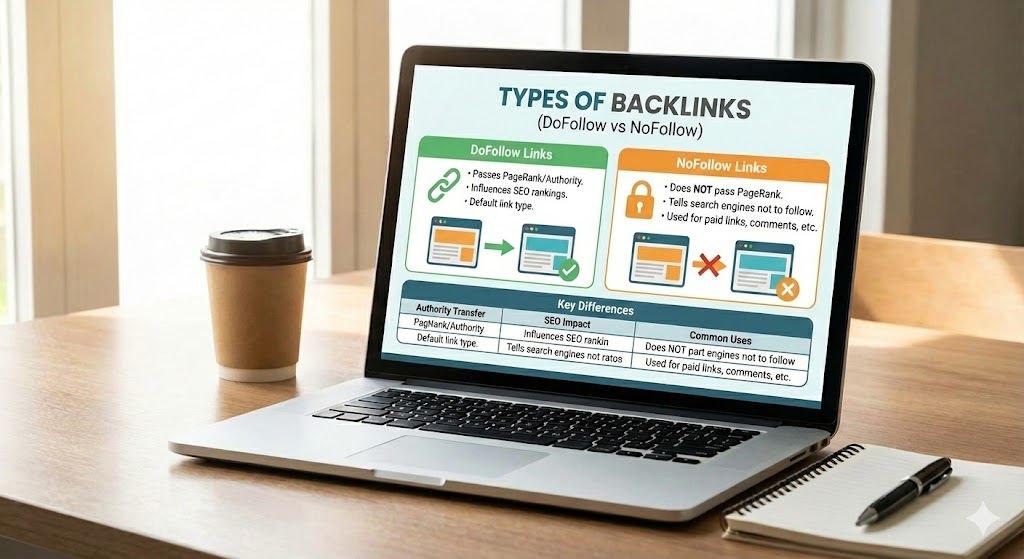
In SEO, the terms DoFollow and NoFollow are commonly used to describe how a link is qualified. The important detail is the HTML rel attribute. A normal link has no special rel value; Google can use ordinary links to discover pages and understand relationships between them.
This guide explains the difference between followed links, nofollow, sponsored and ugc, with practical examples for link building, affiliate links, comments and backlink audits.
Quick answer: DoFollow vs NoFollow
DoFollow is industry shorthand for a normal link without a qualifying rel attribute. There is no special rel="dofollow" HTML attribute. NoFollow usually means a link with rel="nofollow", which tells Google that you do not want to imply an ordinary endorsement or association through that link. Google treats these link attributes as hints, not absolute commands.
| Link type | HTML example | Typical use |
|---|---|---|
| Normal / followed | <a href="/guide/">Guide</a> |
Editorial links and ordinary references |
| Nofollow | rel="nofollow" |
Links you do not want to endorse or associate with |
| Sponsored | rel="sponsored" |
Advertisements, paid placements and sponsorships |
| UGC | rel="ugc" |
User-generated links, such as comments and forum posts |
1. What is a DoFollow backlink?
A DoFollow backlink is simply a standard hyperlink without a qualifying rel value such as nofollow, sponsored or ugc. “DoFollow” is a common SEO term, not a formal HTML attribute.
Example:
<a href="https://example.com/seo-guide/">SEO guide</a>Google can use crawlable links to discover pages and understand their relevance. Links may also contribute to Google’s link-based signals. However, no individual backlink guarantees rankings, and link value depends on many factors, including context and Google’s systems.
2. What is a NoFollow backlink?
A nofollow link includes rel="nofollow" in its anchor element:
<a href="https://example.com/" rel="nofollow">External resource</a>Use this when you link to a page but do not want to imply that your site endorses it or wants to pass the usual ranking credit. Google treats nofollow as a hint. It does not guarantee that Google will never crawl or discover the destination, because Google may find that URL through other links or sources.
A nofollow link can still be useful to people. It may send referral visitors, introduce your brand to a relevant audience and lead to future mentions or editorial links. Do not judge a link only by whether it is followed.
3. Sponsored links: paid placements and affiliate links
Use rel="sponsored" for links created as part of advertisements, sponsorships or other compensation arrangements. This includes paid placements and affiliate relationships where the link is part of a commercial arrangement.
<a href="https://merchant.example/product" rel="sponsored">View product</a>Google says nofollow is still an acceptable way to qualify paid links, but sponsored is preferred. The key is to qualify compensated links rather than selling or buying links intended to manipulate search rankings.
4. UGC links: comments, forums and community posts
Use rel="ugc" for links placed by users in areas such as comments and forum discussions:
<a href="https://community.example/topic" rel="ugc">Community discussion</a>You can combine values, for example rel="ugc nofollow", if that suits your moderation and qualification approach. Sites with user-submitted links should also use spam prevention, moderation and sensible account controls.
5. Key differences at a glance
| Question | Normal link | Nofollow / sponsored / UGC |
|---|---|---|
| Is there a special rel value? | No qualifying value | Yes, one or more rel values |
| Can users click it? | Yes | Yes |
| Can it send referral traffic? | Yes | Yes |
| Does the attribute guarantee Google’s treatment? | No | No; Google treats these values as hints |
| Typical purpose | Ordinary editorial reference | Qualify paid, user-generated or non-endorsed links |
6. When should you use each link attribute?
- Normal link: Use for a genuine editorial reference when you are comfortable linking normally.
- Nofollow: Use when you link to a destination but do not want to imply endorsement or association, and sponsored or UGC is not the more specific label.
- Sponsored: Use for advertising, paid placements, sponsorships and compensated links.
- UGC: Use for links contributed by visitors or community members.
Do not add nofollow to every external link automatically. If you cite a trustworthy source because it supports your article, a normal link is generally appropriate. Choose the attribute based on the relationship and purpose of the link.
7. Do nofollow links help SEO?
They can help indirectly by bringing relevant visitors, increasing brand exposure and helping people discover useful resources. Google also treats link attributes as hints, so it is inaccurate to say that every nofollow link has zero possible search value. At the same time, do not build a campaign around the expectation that nofollow links will pass ranking credit.
Measure nofollow links using practical outcomes such as referral sessions, engaged visitors, enquiries, assisted conversions and relevant audience reach. Use Search Console and analytics data where available, and remember that attribution may be incomplete.
8. How to check whether a backlink is followed or nofollow
- Open the page that contains the backlink.
- Right-click the link and choose Inspect, or use View Page Source.
- Find the anchor element and inspect its
hrefandrelattributes. - If there is no qualifying rel value, it is a normal link; if you see
nofollow,sponsoredorugc, record the relevant value. - Check that the link is visible, clickable, relevant and points to the intended destination.
Example of a normal link:
<a href="https://anandbajrangi.com/">Anand Bajrangi</a>Example of a nofollow link:
<a href="https://anandbajrangi.com/" rel="nofollow">Anand Bajrangi</a>9. Backlink audit checklist
- Confirm the referring page exists and the link works.
- Check whether the page and website are relevant to your topic or audience.
- Review the surrounding text and anchor text for natural context.
- Identify whether the link is normal, nofollow, sponsored or UGC.
- Check whether the link was paid for, exchanged or placed by a user.
- Look for hacked pages, automated spam or obvious link schemes.
- Record referral traffic and business value where measurable.
- Investigate patterns before taking action; do not treat a third-party toxicity score as proof of a Google penalty.
For a broader evaluation process, read the guide to backlink quality vs quantity and the off-page SEO checklist. You can also learn how anchor text in backlinks affects context and usability.
10. Common mistakes to avoid
- Thinking “dofollow” is an HTML attribute: it is shorthand for an ordinary link without a qualifying rel value.
- Assuming nofollow blocks indexing: it is not a reliable deindexing method.
- Using nofollow for every external citation: qualify links according to the relationship, not by default.
- Leaving paid links unqualified: use sponsored or nofollow for compensated placements.
- Expecting a fixed ratio: there is no universal ideal percentage of followed and nofollow backlinks.
- Buying links for ranking credit: link schemes can violate Google’s spam policies.
- Judging links only by attributes: relevance, context, audience and genuine referral value matter too.
Frequently asked questions
Is DoFollow a real HTML attribute?
No. “DoFollow” is an SEO industry term for a standard link without a qualifying rel attribute. There is no need to add rel="dofollow".
Does NoFollow mean Google will never crawl the link?
No. Google treats the attribute as a hint. The destination may still be discovered through other links, sitemaps or sources.
Are nofollow backlinks bad for SEO?
No. They can provide referral traffic, exposure and useful audience connections. The attribute alone does not make a link harmful.
Should affiliate links be nofollow or sponsored?
Google recommends rel="sponsored" for paid and compensated links. nofollow remains an acceptable alternative for qualifying paid links.
Can I combine sponsored, UGC and nofollow?
Yes. Multiple values can be used together, such as rel="ugc nofollow", when they accurately describe the link relationship.
What is the ideal ratio of dofollow to nofollow backlinks?
There is no universal ratio to target. Focus on earning relevant, genuine links and qualifying paid or user-generated links correctly.
Final thoughts
The practical difference between DoFollow and NoFollow is the relationship expressed by the link’s rel attribute. Normal links are ordinary editorial references; nofollow, sponsored and ugc help describe links that should be qualified. Build links because they help people find useful resources, and measure both search visibility and real referral value.