
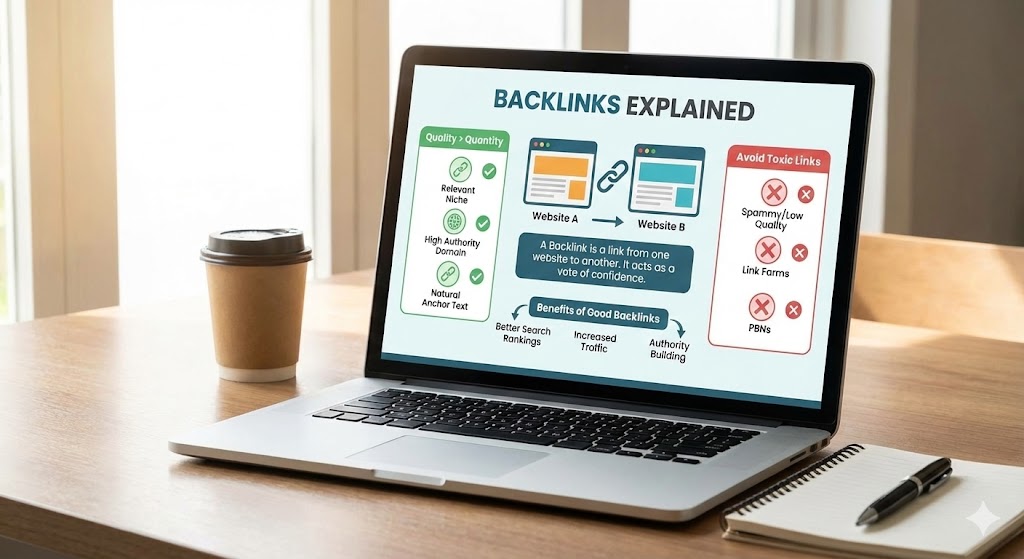
A backlink is a link on another website that points to a page on your website. Backlinks help people discover useful resources and help search engines understand how pages are connected. They are an important part of SEO, but the number of links alone does not determine whether a page will rank.
This guide explains how backlinks work, what makes a link useful, how link attributes such as nofollow and sponsored are used, and how to earn links without relying on risky shortcuts. It focuses on backlinks specifically; for the wider role of digital PR, mentions and reputation, see what off-page SEO includes.
What is a backlink?
A backlink (also called an inbound or incoming link) is a hyperlink from a page on one website to a page on another website. If a news article links to your research report, that link is a backlink for your report.
Every link has a source page and a destination page. The clickable words are called the anchor text. A standard HTML link generally uses an anchor element with an href attribute:
<a href="https://example.com/research/">read the research report</a>Google explains that crawlable links help it discover pages and understand their relevance. Descriptive anchor text also gives readers and search engines useful context. A link should therefore work for people first, not exist simply to insert a keyword.
How do backlinks help SEO?
Links can help search engines discover pages and are one of the signals used when assessing relevance. A link can also send qualified referral visitors, introduce your work to a new audience and help build relationships with publishers or organisations in your field.
However, a backlink is not a guaranteed ranking boost. Search engines evaluate many signals, and not every link is treated equally. Some links may be ignored, discounted or considered spam. A site with more backlinks is not automatically better than a site with fewer, more relevant references.
- Discovery: links can provide paths for crawlers and people to find a page.
- Context: the source page, surrounding text and anchor can help explain what the destination is about.
- Referral traffic: a useful link can bring visitors who are already interested in the topic.
- Recognition: genuine editorial references can help your organisation become known in its industry.
Common types of backlinks
Backlinks can be grouped by how they are created or where they appear. These categories describe the context of a link; they do not guarantee a particular SEO value.
| Type | What it means | What to check |
|---|---|---|
| Editorial link | A writer independently references your page because it adds value to an article. | Is the reference relevant and genuinely useful to readers? |
| Resource-page link | A relevant website includes your guide, tool or research in a curated resource list. | Is the page maintained and selective, rather than a random link dump? |
| Business or professional profile | A directory, association or partner profile links to your website. | Is the profile legitimate, accurate and useful to people? |
| Guest article link | A link appears in an article contributed to another publication. | Does the article serve that publication’s audience, and are commercial links qualified? |
| Forum or comment link | A user shares a link in a discussion or comment. | Does it answer the discussion naturally, without promotion or spam? |
| News or research citation | A publisher references original data, a report, an expert comment or a useful resource. | Is the citation accurate and editorially justified? |
Follow, nofollow, sponsored and UGC links
People often use the phrase “dofollow backlink” to describe a normal link without a qualifying rel value. “Dofollow” is common industry shorthand, not a special HTML attribute. A regular link does not need a rel attribute.
Google provides these values to help publishers describe the relationship between their page and the linked destination:
- Regular link: no special
relvalue is needed when the link is a normal editorial reference. rel="nofollow": use when you do not want to imply an endorsement or association, and the other values do not apply.rel="sponsored": use for advertisements, sponsorships and paid placements.rel="ugc": use for links placed by users, such as in comments or forum posts.
More than one value can be used together, for example rel="ugc nofollow". These attributes are hints to Google; they do not mean that a link cannot send referral traffic or that the destination can never be discovered by other means. See Google’s documentation on qualifying outbound links.
What makes a backlink useful?
There is no single public score that tells you whether a backlink is valuable. Third-party metrics such as Domain Authority, Domain Rating and similar scores can help compare prospects within a tool, but they are not Google ranking metrics. Do not approve a link just because a tool reports a high score.
Review the whole context instead:
- Topical relevance: does the linking page cover a subject connected to your page, business or audience?
- Editorial purpose: would the link still make sense if search engines did not exist?
- Real audience: does the publication appear to serve readers, customers or professionals?
- Page quality: is the source page useful, maintained and understandable, or filled with unrelated outbound links?
- Placement and context: is the link part of meaningful content, with a clear reason for the reference?
- Destination quality: does your linked page answer the question or provide the resource promised by the anchor?
- Transparency: if money, products or another benefit influenced the placement, is the link correctly qualified?
A relevant link from a smaller specialist publication may be more useful to your audience than a link from a large site with no topical connection. Evaluate the actual page and its readers, not only the domain-level score.
Anchor text: how to use it naturally
Anchor text is the visible, clickable text of a link. Good anchor text is concise, descriptive and relevant to both the source sentence and destination page. For example, “technical SEO checklist” is clearer than “click here” when linking to a technical SEO checklist.
Use natural variations. Do not repeatedly demand exact-match commercial keywords from publishers or force keywords into sentences. An unnatural pattern of keyword-rich links created to manipulate rankings can be a link-spam concern. Google’s link best practices explain how descriptive anchors help users and search engines understand links.
How to earn backlinks safely
The most sustainable approach is to publish something worth referencing and make relevant people aware of it. Link earning takes time; there is no guaranteed number of links or fixed timeline for results.
1. Publish original resources
Create practical guides, original research, useful templates, calculators, datasets, case studies or expert explanations. Include clear methodology and update information where appropriate so other publishers can assess and cite the resource.
2. Build relevant publisher relationships
Identify journalists, editors, professional associations, suppliers, community organisations and specialist publishers who already cover your subject. Read their content and understand their audience before pitching. Offer a specific fact, resource or expert contribution rather than a generic request for a backlink.
3. Use digital PR and expert commentary
Share genuinely newsworthy findings, original data or useful expert perspectives. Make claims verifiable and provide supporting material. A publisher should remain free to decide whether to mention or link to your website.
4. Contribute useful guest content
Write for a publication because its readers will benefit from your expertise, not simply to place a keyword-rich link. Follow the publisher’s editorial rules. If the placement is paid or sponsored, the link should be appropriately qualified. Read the separate guide to healthcare guest posting and publisher vetting for additional editorial considerations.
5. Reclaim genuine mentions and broken references
If a relevant publisher mentions your brand without linking, you can politely ask whether a link would help readers find the referenced resource. If a useful page links to a URL that no longer works, suggest a current replacement only when it genuinely solves the problem. Do not send repeated or misleading requests.
Backlink practices that create risk
Google defines link spam as creating links to or from a site primarily to manipulate search rankings. Its examples include buying or selling links for ranking credit, excessive reciprocal exchanges, automated link creation, low-quality directory links, keyword-rich advertorial links that pass ranking credit, and links distributed through widgets or templates.
- Buying links or sponsored articles that pass ranking credit.
- Large-scale link exchanges or partner pages created only to cross-link.
- Automated submissions to directories, forums or comment sections.
- Private networks or pages built mainly to sell links.
- Low-value guest posts produced mainly to place exact-match anchors.
- Hidden links or sitewide footer links distributed for ranking manipulation.
Advertising and sponsorship are normal business activities. The issue is disguising paid placements as editorial endorsements or allowing them to pass ranking credit. Qualify paid links with rel="sponsored" (or nofollow where appropriate). Review Google’s current spam policies before running a link campaign.
How to audit your backlinks
A backlink audit is a review of links pointing to your website. It helps you understand which sites reference you, identify useful relationships, investigate suspicious patterns and check whether a known link scheme needs attention. A third-party tool’s “toxic” label is not proof that Google considers a link harmful.
- Export available link data: use the Links report in Google Search Console and, if useful, one or more reputable backlink tools.
- Review important sources: inspect top linking domains, recently discovered links and links to your most important pages.
- Check the live page: confirm that the link exists, the source page is accessible and the context is genuine.
- Classify the relationship: note editorial citations, partnerships, profiles, user-generated links, paid placements and suspicious patterns separately.
- Investigate policy violations: look for evidence of links you or an agent arranged to manipulate rankings, rather than treating every unfamiliar domain as a problem.
- Record actions: document the source URL, destination URL, reason for concern, outreach attempt and outcome.
Search Console’s link report is a sample of links known to Google, not a complete inventory of every link on the web. Third-party crawlers also have their own coverage and update limits. Compare sources and avoid treating any one tool as the final authority.
Should you disavow backlinks?
Usually, no action is needed for ordinary low-quality, irrelevant or automatically created links that you did not arrange. Google says its systems can generally assess and ignore many such links. The Disavow Links tool is an advanced feature and incorrect use can harm your site’s search performance.
Consider disavowal only when there is a substantial pattern of artificial links pointing to your site and a manual action or a clear risk of one, particularly where you or an agent were involved in creating the links. First make a reasonable effort to remove links that violate Google’s policies. Use the tool carefully and follow the official Disavow Links guidance and manual actions guidance. Do not disavow links solely because a third-party tool labels them toxic.
How to measure backlink activity
Measure outcomes, not just the number of new links. A simple monthly review can include:
- New and lost referring domains, with the source pages checked manually.
- Referral sessions and engagement from important links in analytics.
- Conversions or enquiries assisted by referral visitors, where tracking is available.
- Search impressions, clicks and page performance in Google Search Console.
- Whether important resources are being cited by relevant publications and communities.
- Any manual action or security issue reported in Search Console.
Do not set an arbitrary backlink quota. The right level of activity depends on your industry, resources, content and legitimate opportunities. A small number of meaningful references can be more useful than hundreds of unrelated placements.
Backlinks and internal links: what is the difference?
A backlink comes from a different website and points to your site. An internal link connects one page on your website to another page on the same website. Backlinks can introduce external visitors and help search engines discover your content. Internal links help visitors navigate your site and help search engines understand its structure. Both matter, but they solve different problems.
For practical ways to acquire legitimate links, continue with link-building strategies for beginners. For the broader context, revisit the guide to off-page SEO.
Frequently asked questions
Are backlinks still important for SEO?
Links remain useful for discovering pages and assessing relevance, but they are only one part of search systems. Content quality, intent, usability, technical accessibility and many other signals also matter.
How many backlinks do I need to rank?
There is no fixed number. The number of links needed varies by query, competition, content and many other factors. Focus on useful resources and relevant references rather than a target count.
Are nofollow links useless?
No. A nofollow link may still send visitors, help people discover your brand and create relationships. The attribute tells search engines about the link relationship; it does not prevent a person from clicking it.
Is a high Domain Authority or Domain Rating link always good?
No. These are third-party metrics, not Google ranking scores. Check the source page, topic, audience, editorial standards and reason for the link.
Can I buy backlinks?
You can pay for advertising or sponsorship, but paid links should be qualified with rel="sponsored" or an appropriate nofollow value. Buying links to pass ranking credit violates Google’s link-spam policies.
Should I remove every spammy backlink?
No. Do not panic over every strange link or automated report. Investigate whether you or an agent created an artificial link scheme. Follow Google’s guidance if there is a manual action or a substantial policy-violating pattern.
How long does link building take to show results?
There is no reliable fixed timeline. Search engines need to discover and process links, and a link may not change rankings. Evaluate referral value and broader search performance over time.
Final thoughts
Backlinks are connections between pages, but their value comes from context and usefulness—not from a raw count. Build resources worth citing, develop real relationships with relevant publishers, use honest outreach and qualify paid or user-generated links correctly. Audit links with care and avoid disavowing links just because a tool gives them a negative score.
The strongest backlink strategy is one that would still make sense to readers even if search engines did not exist.