
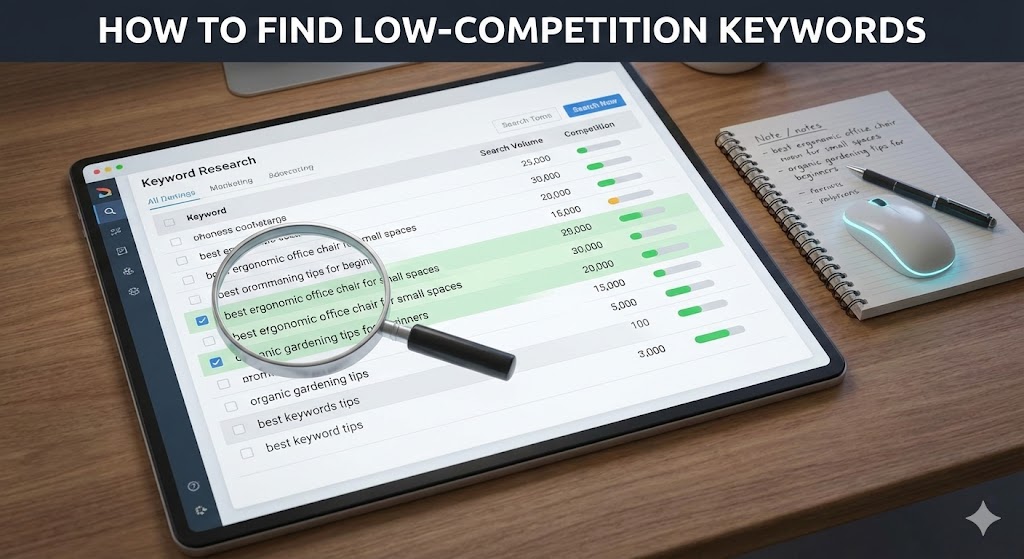
Low-competition keywords may offer realistic opportunities for websites that cannot immediately compete for broad, established terms. But a low score in a keyword tool does not guarantee easy rankings. The best opportunities are relevant to your audience and can be answered better than the current results.
What is a low-competition keyword?
It is a query where the current search results may be more achievable for your website than highly competitive alternatives. Competition depends on the market, intent, quality of ranking pages, links, site relevance and the resources you can invest.
Start with customer problems
Collect questions from sales calls, customer support, reviews, forums, product feedback and your own service experience. These questions often reveal specific needs that broad keyword lists miss.
Use long-tail and question-based searches
Explore specific phrases, problem statements, comparisons and how-to questions. For example, instead of only researching “office removal”, investigate a specific need such as “how to prepare a small office for weekend relocation”. Confirm that people actually need the answer and that it fits your service or expertise.
Review search results manually
- Search the query in the correct country and language.
- Check the page types that rank.
- Review how directly those pages answer the question.
- Look for missing practical details, outdated advice or poor user experience.
- Decide whether you can create a genuinely better resource.
Use keyword tools carefully
Compare estimated volume, difficulty and related terms across tools, but remember that data is modeled and may vary. Use Search Console to find queries where your site already receives impressions. Use autocomplete and related questions for discovery, not as proof of exact volume.
Prioritize by value, not just difficulty
Assess relevance to your audience, intent, potential business value, current visibility, content effort and ability to provide a useful answer. A low-competition phrase that attracts the wrong audience may not deserve priority.
Example opportunity review
| Query idea | Research question | Possible action |
|---|---|---|
| specific how-to question | Are current answers incomplete? | Create a practical tutorial |
| local service need | Is the service genuinely available there? | Improve a relevant local page |
| product comparison | Can you provide accurate, useful comparisons? | Create a transparent comparison |
| very low-volume phrase | Does it signal meaningful customer value? | Include within a broader page if appropriate |
Common mistakes
- Assuming low difficulty guarantees a ranking.
- Publishing thin pages for every question variation.
- Ignoring intent and business relevance.
- Trusting a single tool’s search volume estimate.
- Copying competitor pages instead of adding original value.
- Targeting topics outside your experience or audience.
Low-competition keyword checklist
- Does the topic match your audience and offer?
- Have you checked the real search results?
- Can you provide a more useful answer?
- Is the page format aligned with intent?
- Are demand and difficulty treated as estimates?
- Is the topic mapped to the right existing or planned URL?
- Can success be measured beyond rankings?
FAQs
Are long-tail keywords low competition?
Not always. Specific phrases can be competitive, and some may have very little demand. Review each opportunity individually.
Can a new website rank for low-competition keywords?
It can, but there is no guarantee. A useful, relevant page and a technically accessible site are important foundations.
Should I target keywords with zero reported volume?
Investigate whether the query reflects a real customer need. Tool databases may miss low-volume searches, but do not create a page without a clear purpose.
Official resources
Key takeaway: Find realistic opportunities by combining customer knowledge, intent and manual SERP review. Low competition is useful only when the topic is valuable and you can serve it well.