
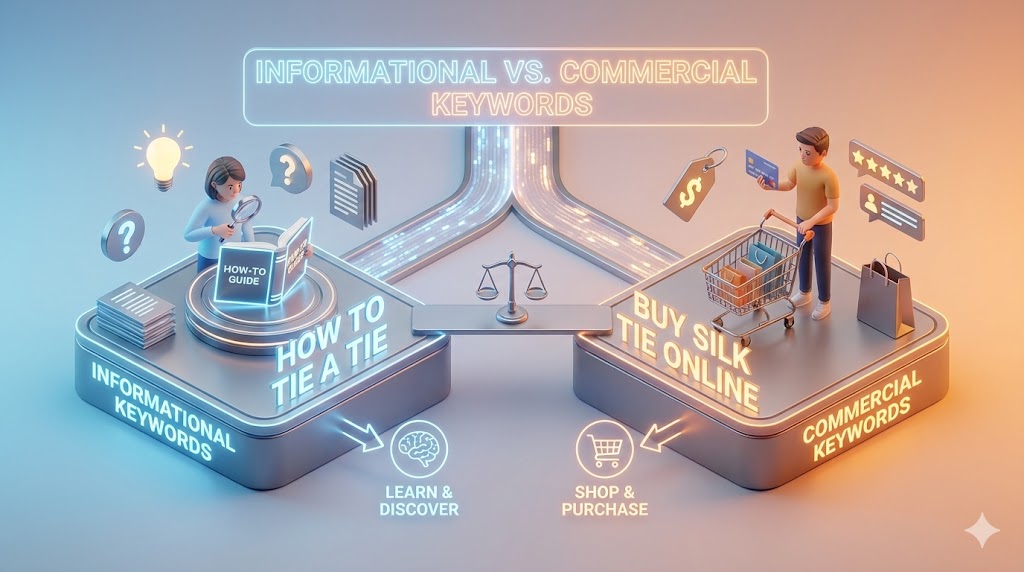
Informational and commercial keywords represent different stages of a searcher’s decision. Informational searches focus on learning, while commercial investigation searches focus on evaluating options. Understanding the difference helps you choose the right page and next step.
What are informational keywords?
These queries show that someone wants an explanation, answer or instructions. Examples include “what is email marketing”, “how to improve website speed” and “why do images need alt text”. Guides, tutorials, definitions and educational resources often fit this intent.
What are commercial keywords?
Commercial investigation queries suggest that someone is comparing products, services or providers before deciding. Examples include “best email marketing software”, “SEO agency reviews” and “Shopify vs WooCommerce”. Comparison pages, reviews, case studies and detailed service pages may fit.
How are they different?
| Factor | Informational | Commercial |
|---|---|---|
| Main goal | Learn or solve a question | Compare and evaluate |
| Common wording | What, why, how, guide | Best, review, vs, alternatives |
| Page format | Guide or tutorial | Comparison or evaluation page |
| Useful next step | Related learning resource | Product details, demo or consultation |
How to identify intent
- Read the query and identify the action the searcher wants.
- Search it in the target market.
- Review the page types and features shown in results.
- Check whether the results focus on explanations or comparisons.
- Choose a page format that meets the expectation.
Words such as “best” or “review” can suggest commercial intent, but they are clues rather than fixed rules. Always inspect the actual results.
Build a content funnel
An informational article can introduce a problem and link to a relevant comparison guide. The comparison guide can help users evaluate options and link to a product or service page. The service page can explain the offer and provide a clear contact or booking action. Each link should be useful and appropriate, not forced.
Examples by business type
- Software: “what is CRM” (informational) vs “best CRM for small business” (commercial).
- Retail: “how to choose a mixer grinder” (informational) vs “mixer grinder model comparison” (commercial).
- Home services: “how to prepare for a move” (informational) vs “best removalists in Melbourne” (commercial).
Common mistakes
- Sending informational queries to a hard-selling page.
- Writing a basic blog post when users need a detailed comparison.
- Assuming one word always defines intent.
- Failing to link useful content across the customer journey.
- Making unsupported claims in comparison content.
FAQs
Are commercial keywords transactional?
Not always. Commercial investigation usually means the person is evaluating options. Transactional intent is more directly focused on taking an action, such as buying or booking.
Which keyword type converts better?
Commercial and transactional queries may be closer to a decision, but conversion depends on the audience, offer, page quality and business model.
Can one page target both intents?
Sometimes. If the search results show mixed intent, a page can explain the topic and help users compare options. Keep the structure clear and useful.
Official resources
Key takeaway: Informational searches need useful answers; commercial searches need trustworthy evaluation. Match the page to the user’s decision stage.