
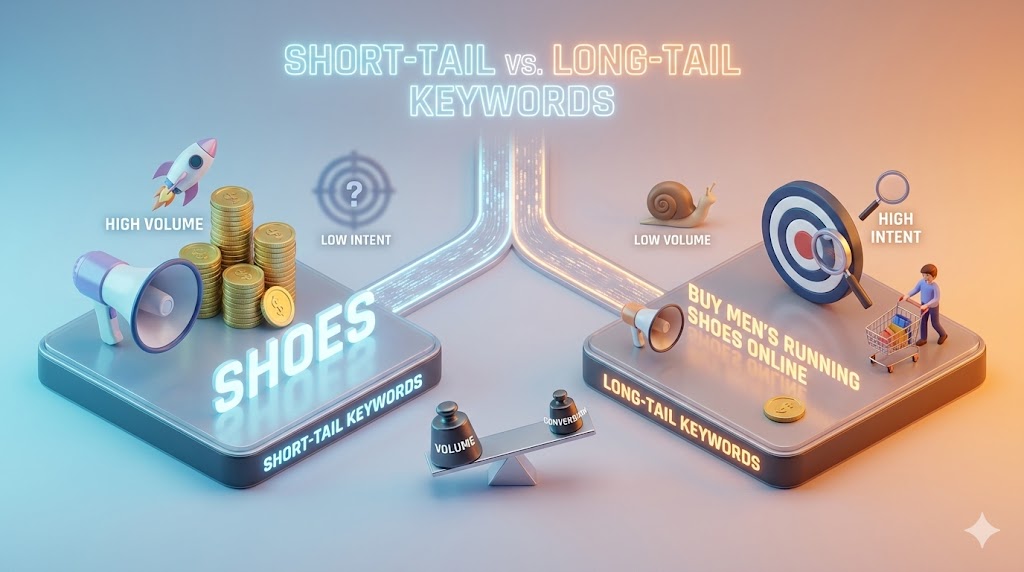
In SEO, the words people type into a search engine are called keywords, and their length and detail level can strongly change the results you get. Choosing the right kind of keyword can mean the difference between getting random visitors and attracting people who are ready to take action.
There are two main groups you need to understand: short-tail keywords and long-tail keywords. Short-tail keywords are very broad and usually made of one to three words. Long-tail keywords are more detailed phrases that often show a clearer user intent, such as wanting to buy, learn, or compare.
Both types can help your website, but they work in different ways. Short-tail keywords can bring a lot of search volume, but they also have higher competition. Long-tail keywords usually have fewer searches, yet they often lead to better conversion rates because they match what the user wants more closely. Understanding how and when to use each type is a core skill in SEO that can guide your whole keyword strategy.
Short-Tail vs Long-Tail Keywords
Traffic numbers alone do not tell the full story of SEO success. Some pages draw many visitors but few buyers, while others attract smaller, more motivated audiences. A major reason for this difference is how well a site balances short-tail and long-tail terms.
This section moves beyond basic definitions to show how each group behaves when directly compared. By seeing how they differ in reach, intent, and results, you can decide where to invest time and budget at each stage of a project, treating them as complementary tools rather than rivals.
| Aspect | Short-Tail Keywords | Long-Tail Keywords |
| Typical length | 1–3 words, very broad | 4+ words, more detailed |
| Search volume | Usually high | Usually low to medium |
| Competition | Often very strong | Often weaker and easier |
| User intent clarity | More unclear or mixed | More specific and focused |
| Conversion potential | Lower on average per visit | Higher on average per visit |
| Best use | Brand reach, awareness, broad topics | Targeted offers, niche problems, quick wins |
Viewed side by side, the pattern is clear: broad terms help you get seen, while longer phrases help you get chosen. Effective strategies usually blend both, using wide phrases to build visibility and detailed ones to capture people who are ready to act.
Introduction to Short-Tail vs Long-Tail Keywords in SEO
Think about two shop signs: one reads “Shoes”, the other “running shoes for flat feet”. Both can draw attention, but they appeal to different types of visitors. That contrast captures how short and long phrases behave in search marketing.
Building on the comparison above, this section explains how these terms fit into a practical SEO workflow. Rather than focusing only on length, you will see how each type supports different stages of the marketing funnel, from first contact to final purchase.
In day-to-day work, professionals often group ideas into a keyword portfolio. Within that portfolio, short phrases usually act as top-of-funnel magnets, while detailed phrases behave more like mid- and bottom-funnel filters that pick out users with stronger intent.
- Short-tail terms help you test broad topics, discover demand, and shape high-level content pillars.
- Long-tail terms guide detailed pages, FAQ sections, and product or service descriptions aimed at action.
As your site grows, data from both groups feeds back into your strategy. You might begin with easier, specific phrases and then gradually expand toward broader, more competitive territory once you have authority and real visitor behavior to learn from.
Understanding Short-Tail Keywords
Short phrases often receive the most attention in SEO campaigns. Many sites chase them, even when they are hard to rank for, because they strongly influence overall visibility, branding, and topic authority across search engines.
This part looks at how broad phrases behave in real projects, what they do well, and where they can quietly drain time and budget if you are not careful. By understanding their strengths and limits, you can use them more deliberately.
At their core, short phrases act like big signs on a busy road. A term like “shoes”, “insurance”, or “laptops” can reach thousands of people with very different needs. This reach helps you understand general demand and build content themes that later support more precise terms.
Because these phrases are so general, they often sit near the top of the funnel. Someone searching “digital marketing” might be a student, a job seeker, or a buyer; pages built around these terms work best as educational hubs that introduce broad topics rather than push a quick sale.
- Topic discovery: Broad terms reveal which areas have strong interest, guiding future content clusters.
- Brand exposure: Even low rankings for big phrases can send steady, mixed-intent traffic over time.
- Internal linking base: High-level pages built around these words can link down to detailed, action-focused pages.
There is, however, a hidden trade-off. Ranking for only a few broad words can be slow and risky, since competition is intense and user intent is mixed. Many sites use them as supporting pillars while relying on detailed phrases to bring in visitors who are closer to making a decision.
Understanding Long-Tail Keywords
Most people have, at some point, typed a long, detailed question into a search bar as if speaking to a real person. Those natural, very specific phrases are what SEO professionals call long-tail keywords, and they often reveal exactly what someone wants at that moment.
Where broad phrases cast a wide net, these longer expressions work more like a precision tool. They capture smaller groups of people who share a clear problem, goal, or situation, making them extremely valuable for pages that aim to drive sign-ups, leads, or sales.
Longer phrases are usually made of four or more words and often include details such as location, use case, price level, or user type. For example, instead of “shoes”, someone might search for “best running shoes for flat feet” or “black leather office shoes under 100”. These extra details show strong intent and help you design content that answers that need exactly.
In practice, these longer queries support many tasks: they guide product pages, comparison posts, tutorials, and FAQ sections. Because fewer sites compete for the exact same wording, they tend to have lower competition, making them ideal targets for newer sites that need early wins and steady, qualified traffic.
- Higher conversion chance: Visitors using long, detailed phrases often know what they want and are closer to taking action.
- Better content ideas: Real search phrases reveal the exact questions, fears, and preferences of your audience.
- Easier rankings: Many long phrases have less direct competition, so well-written pages can succeed faster.
Over time, a wide collection of these specific terms can build a strong traffic foundation. As many small streams of visitors flow through your site, they not only bring conversions but also help prove your relevance to search engines, which then supports your broader, short-tail ambitions.
Short-Tail vs Long-Tail Keywords: Core Differences
Two search phrases can look similar yet deliver very different SEO outcomes. The contrast usually comes from a few core differences that affect traffic, cost, and how well pages match real needs.
This section ties together what you have learned so far and turns it into practical comparison points for planning content, budgets, and timelines. By understanding these distinctions, you can choose the right emphasis for each project.
At the most basic level, broad phrases work like signals to search engines about the main topics you want to be known for, while longer phrases act as precise entry doors that match narrow questions or buying situations. These roles shape how quickly you can rank, what kind of visitors you attract, and how much value each visit creates.
Because of this, the real decision is rarely “which is better?”, but rather “what mix fits this goal, this page, and this stage of growth?”. A new blog, for example, might lean heavily on detailed phrases, then slowly layer in broader ones as authority grows.
- Short phrases favour reach, brand signals, and long-term authority building.
- Long phrases favour relevance, quick wins, and measurable actions such as sign-ups or sales.
- The most stable sites treat both as parts of one keyword portfolio, not as rivals.
Using Short-Tail vs Long-Tail Keywords in Your Strategy
Planning a page often raises the question of which phrases should lead and which should quietly support. Choosing the right mix of short-tail and long-tail terms is where theory turns into a real, working SEO plan.
Rather than setting them against each other, it helps to view them as different tools in one toolbox. Your aim is to place each type where it brings the most value for your traffic, leads, and sales.
In practice, a strong plan starts from your main topics and then breaks them down into layers of intent. Broad terms define your core themes, while longer phrases fill in the exact questions and buying situations people have around those themes.
- Use broad terms for pillar pages that introduce a subject and attract wide interest.
- Use detailed phrases for supporting articles, product pages, and FAQs that solve narrow problems.
One useful workflow is to map phrases to the marketing funnel. Top-of-funnel pages can target a few broad expressions to build awareness, while mid- and bottom-funnel content leans on specific, long phrases to turn interest into measurable action.
“Strategy is about making choices and trade-offs.” – Michael Porter. In SEO, that means deciding where you accept high competition for visibility and where you prefer easier wins from focused, lower-volume queries.
Over time, performance data should guide adjustments. If a broad term sends many visits but few actions, you might add new, longer variations to capture people who are closer to deciding; if a detailed phrase converts very well, you can build related short-tail content around it to scale the opportunity.
Common Mistakes with Short-Tail vs Long-Tail Keywords
Even a large list of search phrases will not guarantee results if they are applied in the wrong way. Many pages underperform because of how short-tail and long-tail terms are combined, not because the keywords themselves are useless.
This section highlights frequent errors that quietly limit growth. By spotting them early, you can adjust your content and budget before they are wasted.
- Chasing only broad phrases and ignoring detailed ones, which blocks quick wins and early conversions.
- Stuffing many similar terms into one page instead of writing clear, helpful content that answers a focused need.
- Using long, specific phrases on the wrong pages, such as putting strong buying terms on a simple info-only article.
- Copying search terms without checking intent, so the page does not match what visitors actually want to do.
- Expecting short phrases to convert well even though their mixed intent makes actions less likely per visit.
- Never updating phrases with new data, keeping weak terms and missing new, high-intent questions users now type.
Bringing Short-Tail and Long-Tail Keywords Together in SEO
Choosing between short-tail vs long-tail keywords is less important than learning how they work together. Broad terms help search engines understand what your site is about and attract wide interest, while specific phrases connect you with people who already know what they want and are closer to taking action.
By treating your keywords as a balanced portfolio, you can support every stage of the marketing funnel, from first click to final conversion. Short phrases build visibility and authority, long phrases build relevance and results, and both are strongest when guided by real data rather than guesses.
As you plan new content, keep asking how each term supports your goals, your users, and your existing pages. With a clear mix of broad signs and precise entry doors, your keyword strategy becomes a steady, testable path to lasting SEO growth instead of a gamble on volume alone.