
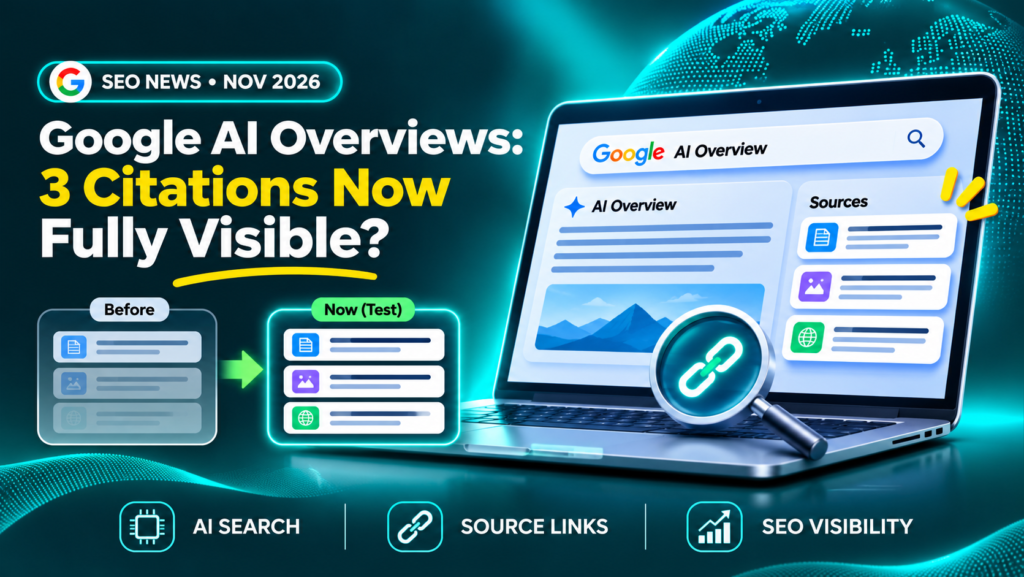
Google is testing another change to how sources appear inside its AI-generated search answers. In screenshots observed by SEO professionals on 17–18 November 2026, the citation cards alongside some desktop AI Overviews appeared fully visible, rather than fading the lower cards. The reported layout showed three source cards clearly without requiring users to open the full AI Overview.
Related publisher update: See how the proposed shared AI training control in robots.txt differs from allowing content to be retrieved or cited in AI-powered search experiences.
This is a small interface change, but it raises an important question for publishers and SEO teams: if source links become easier to notice, could that create more opportunities for users to visit the websites cited by Google’s AI answers?
Important: This is an industry-observed interface change, not a confirmed permanent Google rollout. Google has not publicly confirmed its scope, purpose or permanence. This article separates the reported observation from its possible SEO implications.
What Changed in Google AI Overviews?
AI Overviews are Google’s AI-generated summaries that appear in Search for some queries. They can include links to webpages used as sources for the answer. On desktop, these sources have appeared in cards alongside the generated response.
According to screenshots shared by SEO consultant Brodie Clark and reported by Search Engine Roundtable on 17 November, the citation cards were displayed more prominently in a newer layout. Previously, the first card could appear clear while the cards below it were visually faded. In the observed version, three cards appeared fully visible, making the second and third sources easier to notice.
A related “Show All” control has also been observed in some results, allowing users to expand the source list. That control does not appear consistently, and it should be treated as a separate interface test.
Before vs. Observed Test: How Citation Visibility Appears to Differ
| Element | Earlier observed layout | Newer observed layout |
|---|---|---|
| First citation | Visible | Visible |
| Second and third citations | Could appear faded | Reported as fully visible |
| Need to expand to notice sources | Lower cards could be less prominent | Three cards visible by default in the observed example |
| Rollout status | Previous interface behaviour | Unconfirmed observation; scope unknown |
The comparison describes screenshots reported by observers. It is not a statement that every Google user now sees this design.
Why Could This Matter for SEO?
1. More visible citations may improve source discovery
If users can see more source cards without clicking to expand an AI Overview, they may have an easier path to discover the websites behind an answer. This could benefit publishers whose pages are selected as sources.
However, greater visibility does not automatically mean more clicks. Users may read the AI summary and leave, or they may choose only one source. Website owners should measure actual referral traffic before assuming that the interface test has improved visits.
2. Being cited and earning a click are different outcomes
SEO reporting should distinguish at least three things:
- AI visibility: whether a brand or page is cited in an AI-generated answer.
- Citation visibility: how prominently the source link is displayed to the searcher.
- Referral engagement: whether the user clicks through and takes a meaningful action on the website.
A page may receive an AI citation but very few visits. Similarly, a citation display test can change how visible a link is without changing which page Google selects as a source.
3. Source quality and page relevance still matter
The interface observation does not reveal a new ranking factor or a new method for earning citations. It does not prove that Google has changed its source-selection systems.
For practical SEO, continue creating pages that answer the query clearly, provide useful detail, demonstrate first-hand knowledge where possible and support important claims with trustworthy evidence. Avoid publishing thin pages simply to target AI citations.
4. AI search reporting needs context
When tracking AI Overview visibility, record the date, query, device and visible layout. The interface can change between observations, and a single screenshot is not enough to establish a permanent trend.
Where analytics identifies traffic from Google Search, review landing-page sessions and conversions alongside Search Console performance. Google’s documentation on identifying Search traffic through HTTP Referer headers is useful background for understanding referral attribution: Google’s guidance on Google Search traffic referrers.
What Should SEO Professionals Do Now?
There is no need to redesign a website or change an SEO strategy because of an unconfirmed citation-card test. Instead, use this as a reason to improve measurement and source quality.
- Monitor important queries: Check whether your key pages appear as sources in relevant AI Overviews. Use a repeatable query set and record the date and device.
- Review cited landing pages: Make sure the page answers the search intent directly and provides information that is genuinely useful.
- Improve page clarity: Use descriptive headings, concise explanations, meaningful examples and clear page structure.
- Strengthen evidence: Cite primary sources for factual claims and add original data, expertise or first-hand experience where relevant.
- Measure real outcomes: Track organic sessions, referral traffic, enquiries, leads and sales. Do not treat a citation count as a conversion metric.
- Keep testing consistent: Compare the same queries over time rather than drawing conclusions from one search result.
What Website Owners Should Avoid
- Do not assume that all AI Overview citations are now permanently visible.
- Do not promise clients a fixed number of AI citations or guaranteed clicks.
- Do not rewrite every page just to imitate the wording of an AI answer.
- Do not confuse a more visible citation card with a confirmed ranking boost.
- Do not judge performance using screenshots alone; validate with analytics and Search Console data.
How This Fits into the Future of SEO
Google’s AI search experience is continuing to evolve. The way an answer is presented, how source links are displayed and how people move from an AI response to a website can all influence the search journey.
For SEO professionals, this means reporting should go beyond a simple ranking position. It should explain whether a business is discoverable, whether its information is represented accurately, whether users visit its website and whether those visits lead to business outcomes.
We have discussed a similar measurement shift in our guide to ChatGPT Business Hub and AI visibility insights. Platform-provided visibility metrics, observed AI citations and actual website conversions are different data points, and each should be reported clearly.
Frequently Asked Questions
Has Google officially announced that all AI Overview citations will be fully visible?
No. The change discussed here was observed in screenshots and reported by SEO industry sources. Google has not confirmed a universal rollout or explained whether the design is permanent.
How many citations were visible in the reported test?
The reported desktop example showed three citation cards fully visible without the fade effect seen in earlier layouts.
Does this mean websites will receive more organic traffic?
Not necessarily. More visible source links may create an easier opportunity to click, but traffic impact has not been established. Website owners should monitor referral sessions and conversions.
Does the test change which websites Google cites?
The observation concerns how citation cards are displayed. It does not establish a change to the system that selects sources for AI Overviews.
Should businesses change their SEO strategy because of this?
No major strategy change is justified by an unconfirmed interface test. Continue investing in useful content, technical accessibility, clear business information and measurement of real outcomes.
Conclusion
Google’s reported test of fully visible AI Overview citation cards is worth watching because it may make more source links noticeable to searchers. But the distinction between an observed interface change and a confirmed ranking or traffic improvement is essential.
For now, SEO professionals should monitor the change, improve the quality and clarity of pages that deserve to be cited, and measure whether visibility leads to visits and conversions. The strongest long-term approach is still to create content that people genuinely need and that search systems can understand and trust.
Sources and Further Reading
- Search Engine Roundtable: Google AI Overviews With Unfaded Citation Block (17 November 2026)
- Brodie Clark: Google SERP feature observations
- Google Search Central: AI features and your website
- Google Search Central: Identifying Google Search traffic
Published: 19 November 2026. Updated as further confirmation becomes available.